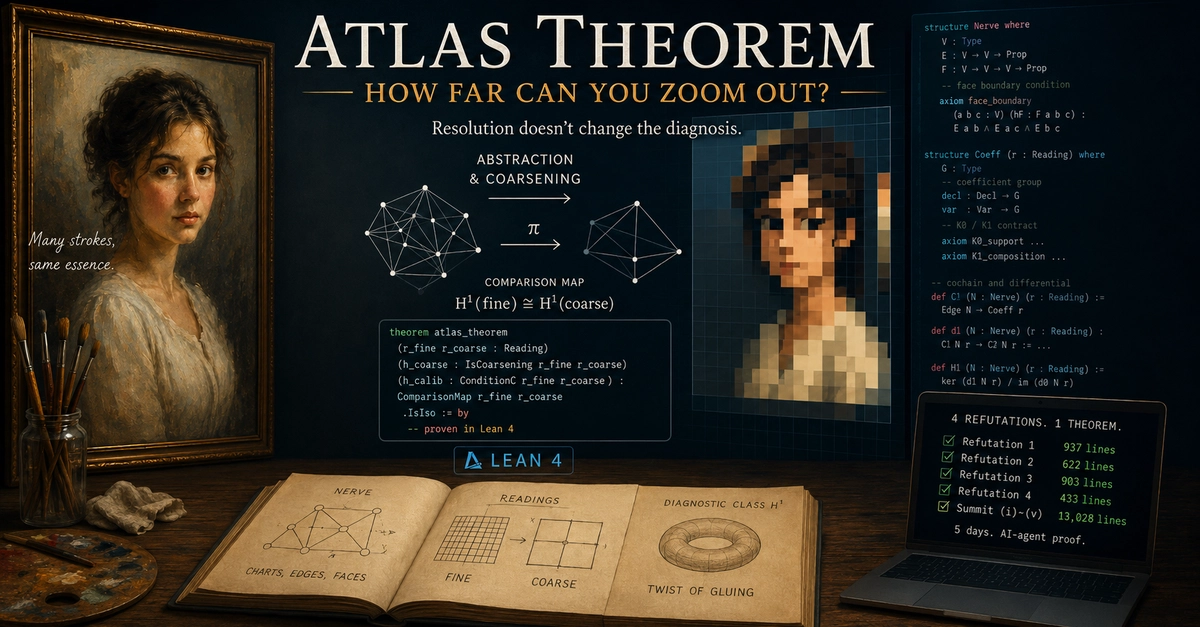
The Atlas Theorem: A New Paradigm for Code Review
The common wisdom in software development is that to truly understand code, you must examine it line by line, scrutinizing every detail. This meticulous approach, while thorough, is time-consuming and often impractical for large, complex systems. What if there was a way to guarantee that a high-level, zoomed-out view of the code could still identify every single bug? This is precisely the question the Atlas theorem, recently proven using formal methods, aims to answer.
Developed within the framework of Algebraic Architecture Theory (AAT), the Atlas theorem provides a mathematical foundation for understanding how different levels of code abstraction relate to defect detection. AAT treats source code as the ultimate source of truth, abstracting implementation details into discrete units called 'Atoms.' Specifications are transformed into mathematical equations, or 'laws,' and architectural analysis is performed using the principles of algebraic geometry. In this formal system, defects are not merely lines of buggy code but manifest as 'cohomology classes'—algebraic fingerprints that can be detected and analyzed.
The core of AAT lies in its ability to formally verify software architecture. It posits that by translating architectural requirements into algebraic equations, one can mathematically prove the correctness of a system's design. This is akin to how mathematicians prove theorems; the logic is rigorous, and the conclusions are irrefutable, provided the initial axioms and definitions are sound.
Formal Proof in Lean 4
The proof of the Atlas theorem was achieved by an AI agent operating within an AI agent loop, utilizing the Lean 4 formal verification system. Lean 4 is a sophisticated theorem prover and programming language that allows developers to write formal proofs and check them for correctness. This environment is crucial for establishing the absolute certainty required for such a theorem. The AI agent's task was to demonstrate, within Lean 4, that under specific conditions, a coarser-grained reading of the code would not miss any defects present in a finer-grained reading, nor would it introduce false positives.
The theorem establishes conditions under which zooming out—reading code at a higher level of abstraction—is as effective for defect detection as zooming in—reading code at the most granular level. This is not a trivial claim. It requires a formal guarantee that no bugs are missed and no phantom bugs are introduced by the simplification process. The conditions for this guarantee are termed the 'calibration condition C' and the requirement for 'adequate readings.' These ensure that the abstraction process is meaningful and that the relationship between different levels of detail is well-behaved.
Understanding the 'Atlas Theorem' Conditions
The Atlas theorem states that for two 'adequate readings' of a codebase, where one is a coarsening (a higher-level abstraction) of the other, and a 'calibration condition C' is satisfied, the diagnostic fingerprints of defects will coincide precisely. This means that if a defect exists, a coarse-grained review will find it, and if a coarse-grained review flags something, it corresponds to a real defect in the finer-grained view.
What are these 'adequate readings' and 'calibration condition C'? An 'adequate reading' implies that the abstraction process preserves the essential architectural properties being checked. It's not just about simplifying; it's about simplifying in a way that is meaningful for the analysis at hand. The 'calibration condition C' is the critical link that ensures the fidelity of the abstraction. It essentially guarantees that the coarse-grained view accurately reflects the fine-grained reality for the purpose of defect detection. Without satisfying these conditions, the theorem warns, both failure modes—missing defects (zooming out too far) and fabricating defects (zooming in incorrectly or over-interpreting abstract details)—can occur. The theorem provides finite counterexamples to demonstrate precisely when and how these conditions fail.
Think of it less like a simplified map and more like a layered geological survey. A broad overview map of a continent might show major mountain ranges but miss small hills. However, if the map is 'calibrated' and 'adequate' for tectonic plate analysis, it will accurately show the boundaries and major fault lines, which are the 'defects' at that scale. Zooming into a specific region might reveal smaller hills, but if the calibration holds, these hills won't be mistaken for major fault lines, and the major fault lines visible on the overview map will still be present and correctly identified.
Implications for Software Development
The implications of the Atlas theorem are profound for the practice of software development, particularly in large-scale projects and safety-critical systems. For decades, the industry has grappled with the challenge of efficient yet effective code reviews. This theorem suggests that it may be possible to develop review processes that are significantly faster without sacrificing defect detection rates.
Senior reviewers, for instance, often employ a strategy of reading code at varying resolutions. They might quickly scan modules to grasp the overall architecture and then dive deep into specific functions only when necessary. The Atlas theorem provides a mathematical justification for this heuristic: if the 'conditions' are met, this varied-resolution approach is not just a time-saver but a provably correct method for finding bugs. This could fundamentally alter how teams approach code quality assurance, potentially leading to faster development cycles and more robust software.
However, the theorem's power is conditional. The critical question for development teams now becomes: how do we practically ensure that our 'readings' are 'adequate' and that our 'calibration condition C' is met? This shifts the focus from simply reviewing code to formally understanding and verifying the properties of our abstraction and review processes themselves. It suggests a future where architectural analysis tools, informed by AAT, could guide reviewers, highlighting areas where the 'calibration' might be weak or where a deeper dive is mathematically mandated.
The theorem does not eliminate the need for detailed code inspection entirely. Instead, it offers a framework for optimizing it. It suggests that for certain architectural properties, a high-level review is sufficient. This could be particularly impactful in areas like security, where understanding the overall system design and identifying potential vulnerabilities at an architectural level is often more critical than finding a minor off-by-one error in a single function.
What remains to be seen is how easily and widely AAT and its associated theorems, like Atlas, can be adopted. The mathematical sophistication required for its application might present a barrier to entry for many development teams. Yet, the promise of provably correct, efficient code reviews is a powerful incentive to explore these formal methods more deeply. The Atlas theorem is not just an academic curiosity; it's a potential blueprint for a more efficient and reliable future in software engineering.