
The Subtle Distinction: k-Coloring vs. Chromatic Number
The problem of graph coloring, a cornerstone of discrete mathematics with applications spanning scheduling, resource allocation, and circuit design, often involves determining the minimum number of colors needed to color the vertices of a graph such that no two adjacent vertices share the same color. This minimum number is known as the graph's chromatic number, denoted \(\chi(G)\). For decades, computing \(\chi(G)\) has been recognized as an NP-hard problem, meaning that for large graphs, finding the exact minimum number of colors is computationally infeasible. However, a recent theoretical breakthrough, detailed in a new preprint, establishes a critical distinction: while finding the exact chromatic number remains intractable, determining if a graph admits a valid coloring with a specific number of colors, say k, is demonstrably easier.
This finding, originating from research that has gained traction on platforms like Hacker News, doesn't just refine our understanding of graph theory; it has profound implications for algorithms and practical applications where approximations or bounded solutions are often more valuable than exact, but unachievable, optima. The research hinges on a formal proof that the decision problem for k-coloring (i.e., "Does graph G admit a k-coloring?") belongs to a lower complexity class than the optimization problem of finding \(\chi(G)\).
Complexity Classes and the k-Coloring Problem
At its core, the research leverages concepts from computational complexity theory. The problem of determining the chromatic number \(\chi(G)\) is known to be in NP-hard. This implies that there is no known polynomial-time algorithm that can solve it for all graphs. If such an algorithm existed, it would imply P=NP, a monumental and widely disbelieved conjecture in computer science.
The new work focuses on the k-Colorability Problem, which asks: Given a graph G and an integer k, does G admit a vertex coloring using at most k colors? For a fixed integer k, this problem is known to be NP-complete. However, the crucial insight of the recent research is to compare the complexity of k-Colorability for a fixed k against the complexity of finding the exact chromatic number for any k. The proof demonstrates that for any fixed k, the problem of determining k-colorability is strictly easier than the general problem of finding \(\chi(G)\).
Think of it like trying to find the exact altitude of a mountain versus determining if the mountain is taller than, say, 5,000 meters. Finding the precise altitude might require complex surveying equipment and extensive calculations (analogous to finding \(\chi(G)\) and being NP-hard). However, simply checking if it exceeds a specific height threshold (analogous to k-coloring) can often be done much more efficiently, perhaps with a simple visual inspection or a less precise measurement tool. The new proof formalizes this intuition within the rigorous framework of computational complexity.
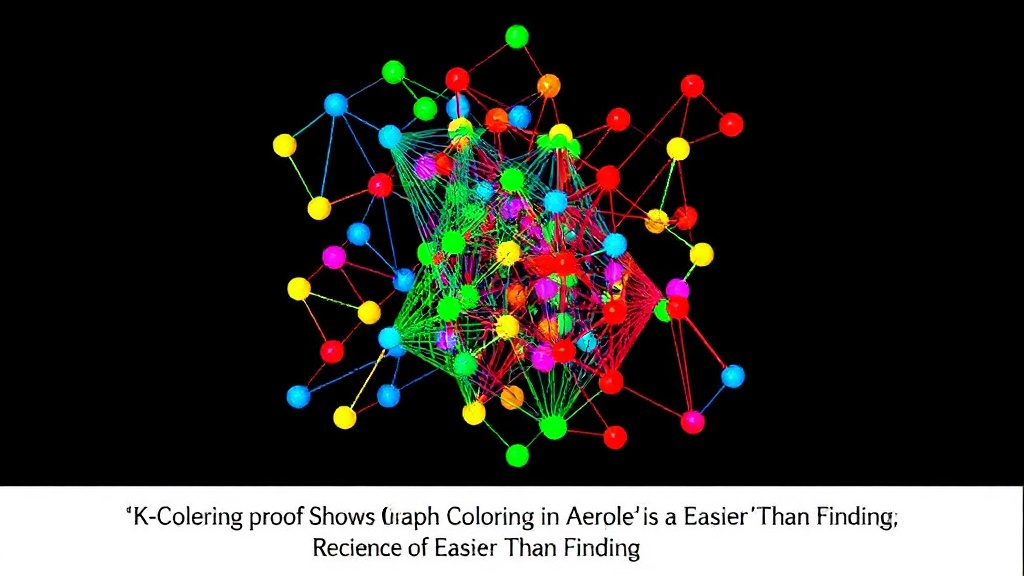
The Proof's Core Idea
While the full details of the proof are extensive and rely on advanced techniques in theoretical computer science, the general thrust involves constructing a polynomial-time reduction. This reduction shows how to transform an instance of the k-Colorability problem into an instance of the Chromatic Number problem, such that the solution to the latter can be used to efficiently solve the former. Crucially, the reduction is designed such that it only works efficiently when k is fixed, highlighting the inherent difficulty in determining \(\chi(G)\) without a predefined upper bound.
The research essentially shows that if one could solve the general Chromatic Number problem efficiently (i.e., in polynomial time), then one could also solve the k-Colorability problem efficiently for any fixed k. However, the converse is not necessarily true. The difficulty lies in the fact that \(\chi(G)\) could be arbitrarily large, requiring a search space that grows with the graph size and potential number of colors, whereas k-Colorability is bounded by the fixed parameter k. This fixed-parameter tractability is key.
This distinction has been a subject of theoretical interest, but the new paper provides a concrete, formal proof that solidifies this understanding. It moves beyond the general NP-hardness of graph coloring to a more nuanced understanding of its sub-problems.
Implications for Algorithms and Practice
The practical implications are significant. Many real-world problems that are modeled using graph coloring do not necessarily require the absolute minimum number of colors. Instead, they require a valid coloring using a