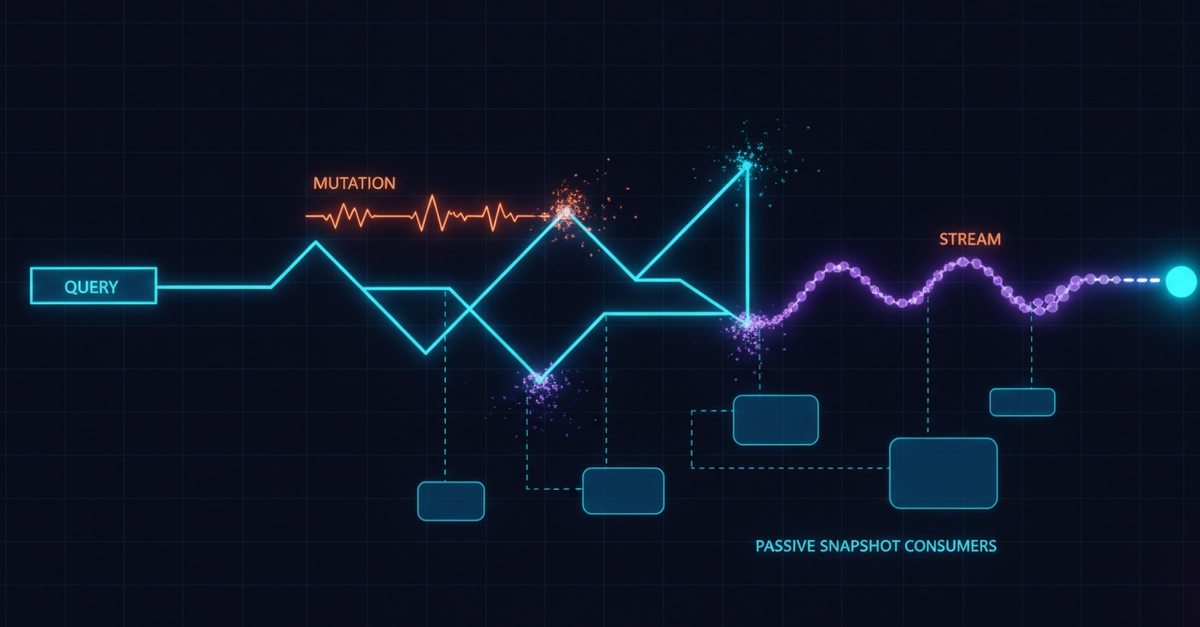
The Danger of Async Oversimplification
A common, yet dangerous, oversimplification in modern development is the idea that all asynchronous work can be treated as a single, uniform operation. Developers frequently fall into the trap of reducing complex asynchronous processes to a simple pattern: initiate an async task, wait for its completion, and then update the UI state. While this might seem efficient on the surface, it masks fundamental differences in data flow semantics that can lead to subtle bugs and brittle applications.
The core issue isn't that updating UI state with setState() is inherently wrong. It's the assumption that every asynchronous result is the same kind of data or operation. Consider these common scenarios:
API request completed       → write to state
Form submitted successfully → write to state
WebSocket message received  → write to state
Background job updated      → write to state
From a user interface's perspective, all these actions eventually result in something changing on the screen. However, when we examine the underlying data flow and the nature of the operation, they are not equivalent. Some asynchronous tasks are primarily about reading data, others are about changing the state of a remote or local system, and still others involve continuous streams of data. Treating them identically ignores these critical distinctions.
Understanding the Core Asynchronous Operations
To build more resilient and predictable applications, we must differentiate between the primary types of asynchronous work:
Queries: Reading Data
Queries are operations designed to fetch data from a source without altering that source. Think of them as asking a question. When a user clicks a button to load a list of products, or when a component mounts and needs initial data, it's performing a query. The expected outcome of a query is a dataset. The data returned should be consistent with the state of the system at the time of the request, assuming no concurrent mutations interfere. The UI should reflect this fetched data, but the query itself doesn't change anything remotely.
A common mistake is treating a query result as an event that requires immediate state mutation. While the UI needs to update with the queried data, the operation is fundamentally read-only. This distinction matters for caching, optimistic updates (where applicable), and error handling. A failed query should typically result in an error state being displayed, not an attempt to retry an operation that might have side effects.
Mutations: Changing State
Mutations are operations that intentionally change the state of a system. This could be creating a new record, updating an existing one, or deleting data. When a user submits a form, saves a document, or performs an action that modifies data, they are executing a mutation. The key characteristic of a mutation is its side effect: it alters the state of the data source.
Handling mutations asynchronously requires careful consideration. Unlike queries, the success of a mutation often implies a change that needs to be reflected across the application. This might involve updating local state, invalidating caches, or triggering other dependent operations. Developers often use optimistic updates for mutations: the UI immediately reflects the intended change, and if the mutation succeeds, the optimistic state is confirmed. If it fails, the UI reverts to the previous state. This technique provides a snappier user experience but adds complexity to state management and error handling.
The danger here is treating a mutation like a simple query. If a mutation fails, simply writing an error to the state without a mechanism to revert or inform the user can lead to corrupted data or a confusing user experience. The system's state is now in an indeterminate or incorrect condition.
Streams: Continuous Data Flow
Streams represent a continuous flow of data over time. This is fundamentally different from the single-response nature of queries and mutations. WebSockets, Server-Sent Events (SSE), or even long-polling mechanisms that deliver updates as they happen exemplify stream-based asynchronous work. Each incoming message on a stream is an event, and the application needs to react to it.
Treating a stream as a single event is a recipe for disaster. Each message on a stream might represent a new piece of information, a status update, or a notification. The application must be prepared to handle these incoming events in real-time, often updating parts of the UI incrementally rather than performing a full re-render. For example, a live chat application receives messages via a stream. Each new message is appended to the chat log. The system doesn't query for new messages; it receives them. Similarly, stock tickers or real-time analytics dashboards rely on streams.
Failure to distinguish streams can lead to performance issues. If every incoming message triggers a full state re-evaluation, the application can become sluggish or unresponsive. Proper stream handling involves efficient processing of individual events and targeted UI updates.
Why the Distinction Matters
The oversimplification arises because, at a high level, all these operations eventually lead to a UI update. However, their underlying semantics, error handling strategies, caching behaviors, and performance implications are vastly different.
Consider a real-world analogy: Imagine you're managing a library.
- Queries are like asking the librarian, "Where can I find a book on astrophysics?" You get information, but the library's collection doesn't change.
- Mutations are like checking out a book. You change the state of the library's inventory (the book is now out) and your personal borrowing record.
- Streams are like a live feed from the library's security cameras, showing new visitors entering and leaving in real-time. You're not asking for a specific piece of information, nor are you changing anything; you're observing a continuous flow of events.
Treating these three as the same would be nonsensical. You wouldn't try to "check out" the answer to where a book is, nor would you expect the camera feed to stop after one person walks in. Similarly, in software, conflating queries, mutations, and streams leads to flawed architecture.
This nuanced understanding is critical for building robust, scalable, and maintainable applications. It enables developers to implement appropriate patterns for data fetching, state management, error recovery, and real-time updates, ultimately leading to a better user experience and a more stable codebase.