
The Problem: US-Centric Conversion Tools
The internet's conversion tools often fall short for users outside the United States. This isn't just an inconvenience; it's a fundamental mismatch in cultural and technical context. Consider the humble oven temperature. In the UK, cookers use 'gas marks,' a legacy measurement system that baffles anyone accustomed to Celsius or Fahrenheit. Similarly, UK shoe sizing differs significantly from US standards. Even seemingly universal units like gallons have distinct UK and US imperial measures. Value Added Tax (VAT) in the UK also operates with multiple rates—standard, reduced, and zero—a complexity often overlooked by global tools.
The author, frustrated by landing on ad-laden, US-centric sites for simple searches like 'gas mark 4 to celsius,' decided to build a solution. The goal was to create a resource that accurately served a UK audience without the usual clutter of intrusive advertising and SEO spam that plagues many utility sites.
The core issue is a lack of niche localization. Many sites attempt broad coverage but fail to implement the specific nuances required by regional users. This results in a poor user experience, where users must sift through irrelevant information or incorrect conversions, all while navigating a barrage of advertisements.
The Stack: Astro, React, and Tailwind
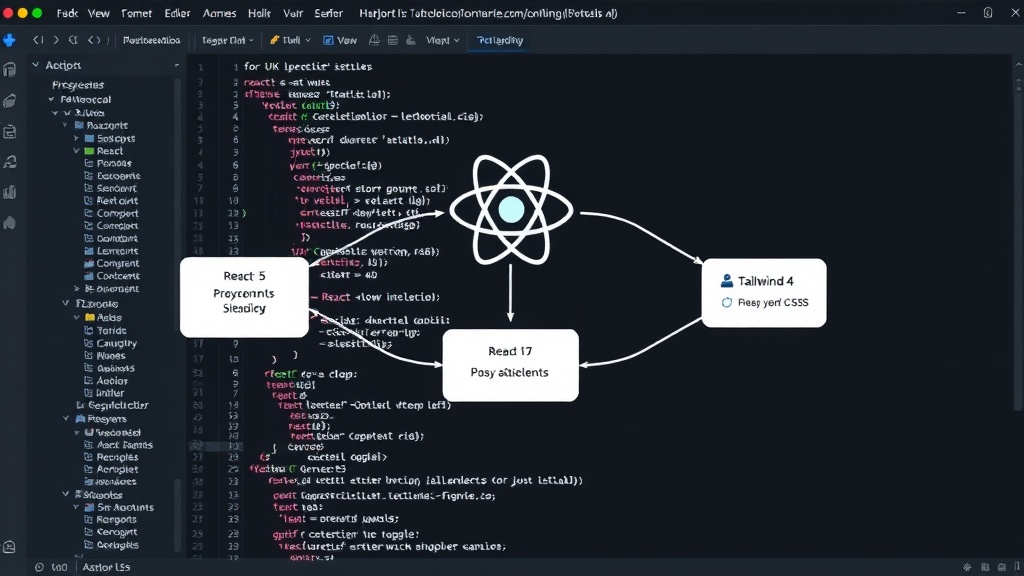
To address these issues and build a performant, private, and user-friendly site, a deliberate technology stack was chosen. The foundation is Astro 5, selected primarily for its 'zero JS by default' philosophy. This means that for most pages, Astro renders entirely as static HTML. This approach leads to near-instantaneous load times and excellent scores on performance metrics like Google Lighthouse. Static sites require no client-side JavaScript to render content, significantly reducing the amount of data users need to download and process.
Where interactivity is essential, React 19 is integrated using Astro's island architecture. This powerful combination allows developers to use React components for specific, dynamic elements—such as interactive calculators or input fields—while keeping the surrounding page static. Astro manages the hydration of these React islands on the client-side, ensuring that JavaScript is only loaded and executed where it's strictly necessary. This selective interactivity is key to maintaining high performance without sacrificing user experience for dynamic features.
For styling, Tailwind CSS 4 was the choice. Tailwind's utility-first approach enables rapid UI development by providing low-level utility classes that can be composed directly in the markup. This avoids the need for custom CSS files and component-scoped styles for many elements, streamlining the styling process and ensuring consistency. The author also noted that Tailwind 4's configuration and build process were straightforward, contributing to the overall development efficiency.
Prioritizing Privacy and Performance
A significant design principle for this converter site was user privacy. By serving static HTML by default and only selectively hydrating interactive React components, the site minimizes its reliance on client-side JavaScript. This reduction in JavaScript inherently limits the attack surface for potential privacy leaks and reduces tracking vectors. Unlike single-page applications (SPAs) that often rely heavily on JavaScript for routing, data fetching, and rendering, this Astro-based site keeps the core content delivery lean and private.
Performance was another critical factor. The 'zero JS by default' strategy directly contributes to superior loading speeds. Static HTML pages are delivered directly from the server, requiring no complex client-side processing before content is visible. This is crucial for utility sites where users often need information quickly. Tools like Google Lighthouse are designed to measure various aspects of web page quality, including performance, accessibility, SEO, and best practices. Achieving high scores in these areas not only indicates a better user experience but also improves search engine rankings, making the site more discoverable.
The choice of Astro 5, React 19, and Tailwind 4 forms a synergy that supports these goals. Astro provides the static-first framework. React 19, with its modern features and Astro's island architecture, allows for controlled interactivity. Tailwind 4 ensures efficient and consistent styling. Together, they enable the creation of a fast, private, and effective utility website that directly addresses the shortcomings of existing solutions.
Building for a Niche Audience
The UK-focused nature of the site is its defining characteristic. Instead of trying to be a catch-all for every unit conversion imaginable, it hones in on specific needs of the British user: gas marks for ovens, UK shoe sizes, multi-band VAT calculations, and UK imperial gallons. This targeted approach ensures that the information provided is accurate, relevant, and immediately useful to the intended audience.
This niche focus also simplifies the development process. Fewer conversion types mean a smaller, more manageable codebase. It allows the developer to concentrate on the accuracy and presentation of the specific data points that matter most to UK users. The site effectively becomes a specialized tool rather than a general-purpose information repository, which often leads to a more satisfying user experience and higher engagement for the target demographic.
The decision to avoid ad-heavy designs is a deliberate choice to enhance user experience and reinforce privacy. Many conversion sites have become almost unusable due to aggressive advertising. By opting for a clean, ad-free interface, this site prioritizes content and utility. This commitment to a better user experience, combined with technical excellence in performance and privacy, sets it apart in a crowded digital landscape.
The success of such a niche site hinges on understanding the specific pain points of its target audience. In this case, it was the frustration with generic, ad-ridden, US-centric tools. By building a solution tailored to UK-specific measurements and user needs, and by leveraging a modern, performant, and privacy-conscious tech stack, the developer has created a valuable resource that stands out for its utility and user-centric design.