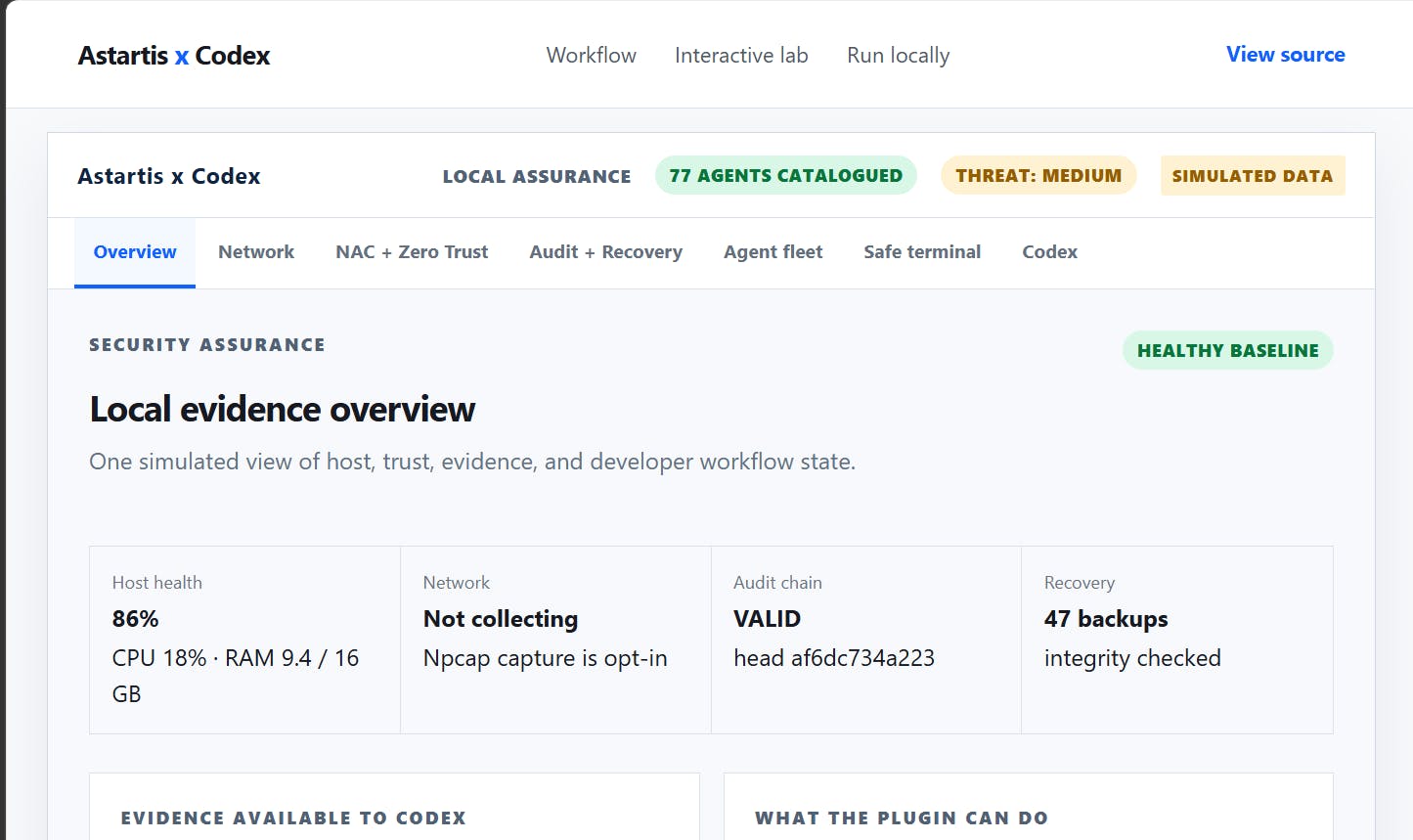
Astartis x Codex: A New Approach to Developer Security
Astartis has launched Astartis x Codex, a new product targeting enterprise developer security. The platform positions itself as a control plane built around evidence, aiming to bring a more rigorous, data-driven approach to securing the software development lifecycle (SDLC). In an era where development teams are under increasing pressure to deliver faster, security often becomes an afterthought. Astartis x Codex seeks to integrate security controls directly into the developer workflow, making it an intrinsic part of the process rather than a bottleneck.
The core concept of Astartis x Codex is to provide developers and security teams with actionable insights derived from evidence. This means moving beyond theoretical security policies to concrete, verifiable data points. For enterprise environments, this is crucial for compliance, risk management, and maintaining a robust security posture. The platform aims to automate the collection and analysis of security-related evidence, allowing organizations to understand their security status with greater clarity and confidence.
Key Features and Functionality
While detailed technical specifications are still emerging, the product description highlights a focus on providing an "enterprise developer security control plane around evidence." This suggests a system that can:
- Automate Evidence Collection: Integrate with existing development tools and infrastructure (CI/CD pipelines, code repositories, cloud environments) to automatically gather relevant security data.
- Policy Enforcement with Evidence: Allow security teams to define policies that are enforced not just by rules, but by verifiable evidence of compliance. This could include checks on code quality, dependency vulnerabilities, configuration settings, and access controls.
- Risk Assessment and Prioritization: Analyze the collected evidence to identify security risks, quantify their impact, and help teams prioritize remediation efforts. This moves security from a reactive to a proactive stance.
- Auditing and Compliance: Provide a clear audit trail of security controls and evidence, simplifying compliance reporting for internal and external auditors.
The emphasis on "evidence" is a critical differentiator. Instead of simply flagging a vulnerability, Astartis x Codex likely aims to provide context and proof. For instance, it might not just report a vulnerable dependency but also demonstrate that the specific code path using that dependency is not executed in production, thereby adjusting the risk score. This level of granularity is essential for enterprises managing complex codebases and large numbers of developers.
The Need for Evidence-Based Security
Traditional security approaches in development often rely on static analysis tools that generate numerous alerts, many of which can be false positives or low-priority issues. Developers can become desensitized to these alerts, leading to genuine threats being overlooked. Furthermore, manual security reviews are time-consuming and expensive, creating a bottleneck that slows down development velocity. Astartis x Codex aims to address these pain points by providing a more intelligent, automated, and evidence-driven system.
Consider the analogy of a building inspector. Instead of just looking at blueprints (theoretical policies) or randomly checking walls (ad-hoc scans), an evidence-based approach is like the inspector meticulously checking every electrical connection, plumbing joint, and structural beam, documenting each step with photos and measurements. This documentation forms the evidence that the building meets code. Astartis x Codex aims to provide this same level of verifiable assurance for software development.
The platform's success will likely hinge on its ability to integrate seamlessly into existing developer workflows without causing significant disruption. If it becomes another tool that developers have to constantly work around or ignore, it will fail to achieve its objective. The promise of actionable, evidence-based security controls integrated into the SDLC is compelling, especially for organizations operating under strict regulatory scrutiny.
Market Context and Potential Impact
The developer security market is rapidly evolving, with increasing focus on DevSecOps and shifting security left. Companies like Snyk, Veracode, and Checkmarx have established presences in this space, offering various tools for vulnerability scanning, code analysis, and dependency management. Astartis x Codex appears to be carving out a niche by focusing specifically on the control plane aspect, emphasizing evidence as the foundation for security decisions. This could appeal to larger enterprises that require a centralized, auditable system for managing security across distributed development teams and complex infrastructures.
The challenge for Astartis x Codex will be demonstrating tangible ROI to enterprises. This means showing how it reduces security incidents, improves compliance efficiency, and potentially even accelerates development by reducing false alarms and streamlining security validation. The effectiveness of its evidence-gathering and analysis engine will be paramount. If the platform can accurately assess risk based on concrete data, it could significantly enhance the security posture of its users.
What remains to be seen is the depth of integration and the breadth of evidence sources Astartis x Codex can leverage. Can it correlate findings from static analysis, dynamic analysis, infrastructure as code, and runtime security tools into a unified, evidence-based risk profile? The platform's ability to synthesize information from disparate sources will be key to its value proposition in complex enterprise environments.