
The Problem with Complexity in Growing Applications
As ASP.NET Core applications scale, a common pain point emerges: complexity. Features become arduous to implement, debugging transforms into a time-consuming ordeal, and modifications in one module ripple unexpectedly, breaking seemingly unrelated parts of the system. This entanglement is a natural consequence of tightly coupling business logic with specific frameworks like ASP.NET Core or Entity Framework Core. The result is an application that is brittle, difficult to maintain, and expensive to evolve.
Introducing Clean Architecture: A Solution to Tangled Code
Clean Architecture offers a robust solution to these challenges by promoting a layered design where each layer adheres to a single responsibility. The fundamental principle is to isolate your core business rules, ensuring they remain independent of external concerns such as web frameworks, databases, or UI technologies. In this paradigm, dependencies always point inward, towards the application's core. This inversion of control means your business logic doesn't need to know about ASP.NET Core; instead, ASP.NET Core knows about your business logic.
Understanding the Layered Structure
A typical Clean Architecture project structure for an ASP.NET Core application can be visualized as follows:
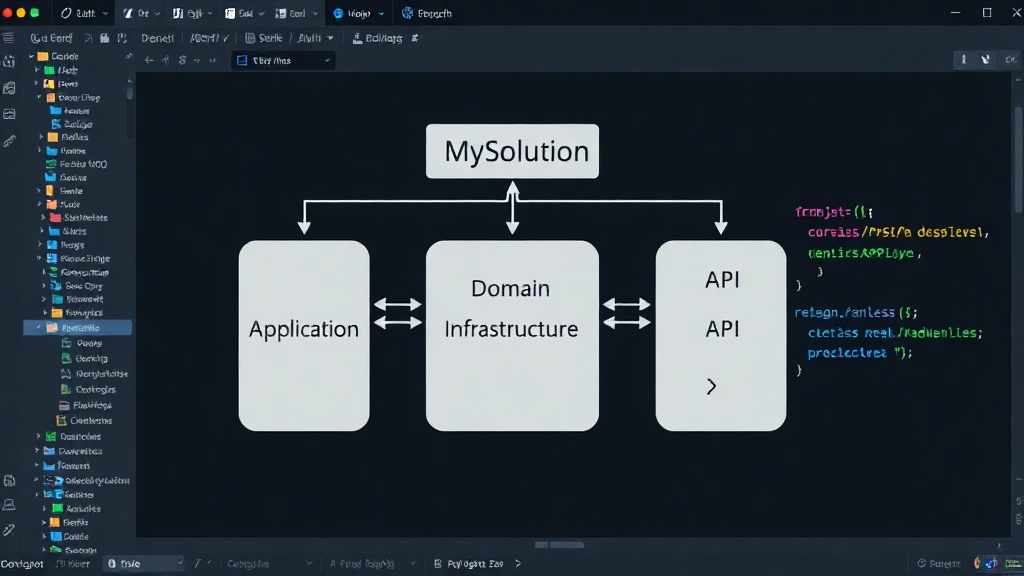
Each project within this solution serves a distinct purpose, contributing to the overall maintainability and scalability of the application.
The Domain Layer: The Heart of Your Business
The Domain layer is the innermost circle and the most critical. It encapsulates the core business logic, entities, enums, and value objects that define the business domain itself. This layer should have no dependencies on any other layer. It represents the business rules and concepts in their purest form, independent of how they are persisted or presented.
- Entities: These are objects with an identity that transcends time and various changes in their attributes. They represent core business concepts.
- Enums: Used to define a set of named constants, often representing distinct states or categories within the domain.
- Value Objects: Objects that describe a characteristic or attribute, defined by their value rather than their identity (e.g., a monetary amount, a date range).
- Business Rules: The fundamental logic that governs how entities and value objects interact and change.
The Application Layer: Orchestrating Business Processes
The Application layer sits just outside the Domain layer. It orchestrates the use cases and business processes defined in the Domain layer. This layer contains application-specific business rules and logic that don't belong in the Domain layer because they depend on external concerns. It defines interfaces for repositories and other services that the Domain layer needs, but it doesn't implement them.
- Use Cases/Interactors: Classes that implement specific application features by coordinating calls to the Domain layer and other services.
- Application Services: Services that orchestrate domain logic to fulfill specific use case requirements.
- Interfaces for Repositories and External Services: Abstract definitions of data access and external integrations required by the use cases.
The Infrastructure Layer: External Concerns and Implementations
The Infrastructure layer is responsible for implementing the interfaces defined in the Application layer. This is where concrete technologies and external services come into play. It handles concerns like data persistence, external API integrations, message queuing, and email services. This layer depends on the Application and Domain layers.
- Data Access Implementations: Concrete classes for repositories (e.g., using Entity Framework Core or Dapper) that interact with the database.
- External Service Clients: Implementations for calling third-party APIs or services.
- Message Queue Publishers/Subscribers: Concrete implementations for interacting with message brokers.
- Email Service Implementations: Logic for sending emails.
The Presentation/API Layer: User Interface and Entry Point
The outermost layer is the API (or Presentation) layer. In an ASP.NET Core context, this layer is responsible for handling HTTP requests, routing, controllers, and presenting data to the user or client. It depends on the Application layer to execute use cases and may use the Infrastructure layer for data retrieval or other operations, but it should ideally delegate business logic execution to the Application and Domain layers.
- Controllers: Handle incoming HTTP requests and responses.
- ViewModels/DTOs: Data Transfer Objects used to serialize and deserialize data between the API and clients.
- Configuration: Application setup and startup logic.
Benefits of Adopting Clean Architecture
The adoption of Clean Architecture yields significant advantages:
Testability
By decoupling the core business logic (Domain and Application layers) from external frameworks and infrastructure, testing becomes dramatically simpler. You can unit test your business rules and use cases without needing to spin up a web server or a database. This leads to faster feedback loops and more reliable tests.
Maintainability and Scalability
A well-defined layered structure makes the codebase easier to understand and navigate. Changes are localized, reducing the risk of introducing regressions. As the application grows, new features can be added without compromising the integrity of existing logic. This makes the system more scalable and adaptable to evolving business requirements.
Framework Independence
The core business logic is not tied to any specific framework. This means you can swap out the web framework (e.g., move from ASP.NET Core to a different technology) or the data access technology (e.g., switch from Entity Framework Core to Dapper or a different ORM) with minimal impact on your business rules. This agility is invaluable in the long run.
Team Collaboration
Clear separation of concerns allows different team members to work on different layers concurrently with less conflict. Developers focused on business logic can work independently of those implementing UI or infrastructure details, streamlining development workflows.
When to Consider Clean Architecture
While Clean Architecture offers substantial benefits, it introduces a degree of initial complexity and boilerplate. It is most advantageous for:
- Medium to Large Applications: Where complexity is a significant concern and long-term maintainability is paramount.
- Applications with Evolving Business Rules: If the core business logic is expected to change frequently or undergo significant evolution.
- Projects Requiring High Testability: When comprehensive unit and integration testing is a critical requirement.
- Long-Term Projects: Where the cost of technical debt can become substantial over time.
For very small, simple applications, the overhead might outweigh the benefits. However, for any project intended to grow or have a long lifespan, understanding and implementing Clean Architecture principles for your ASP.NET Core projects is a worthwhile investment.