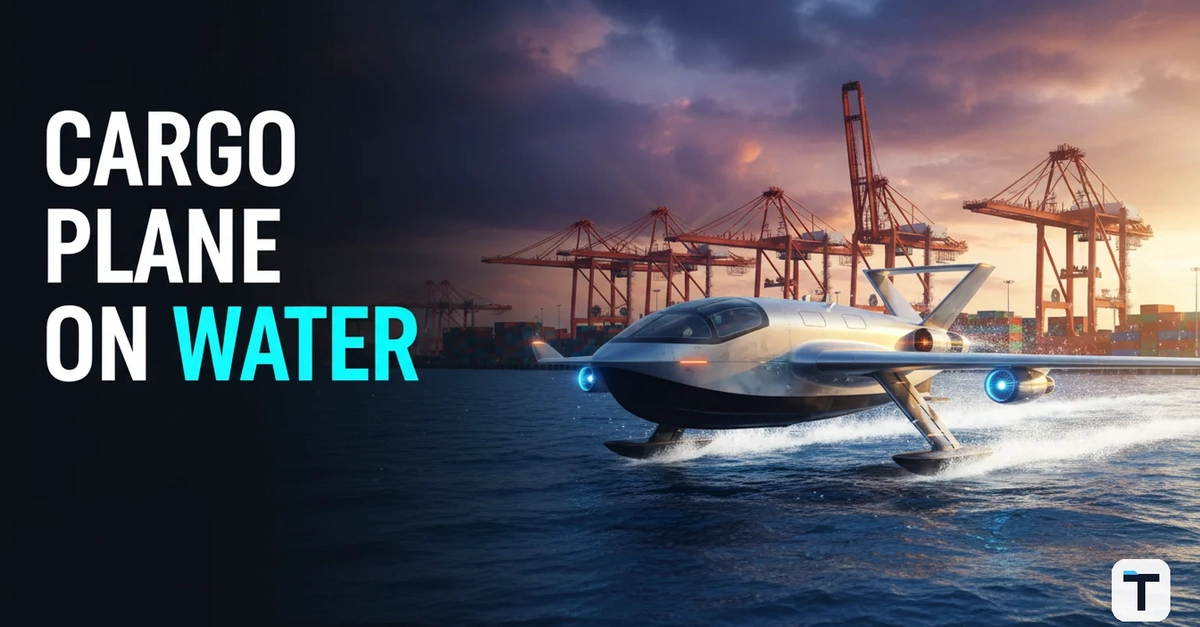
Aspera Eureka: Bridging the Logistics Gap
Aspera Industries, a Bengaluru-based startup founded in June 2025, has introduced Eureka, an autonomous, amphibious cargo aircraft designed to carve out a new niche in the logistics market. The aircraft's core innovation lies in its ability to take off and land on water, utilizing retractable hydrofoils instead of a traditional seaplane hull to minimize drag. This design choice, coupled with its autonomous operation and ambitious cost targets, positions Eureka as a potential disruptor, aiming to operate at costs below $1 per tonne-kilometer.
If Aspera Industries can achieve these figures, Eureka could effectively bridge the gap between slow, inexpensive shipping methods and the rapid, costly air freight options currently available. The aircraft boasts a payload capacity of 1,000 kg and a stated range of 2,000 km, cruising at an altitude of approximately 6,500 feet, according to the company and reports from ITLN.
Engineering a Novel Solution
The engineering behind Eureka is a significant bet. By opting for retractable hydrofoils, Aspera aims to achieve better aerodynamic efficiency compared to conventional flying boats or floatplanes. These hydrofoils lift the aircraft's fuselage out of the water during takeoff and landing, drastically reducing water resistance and enabling higher speeds and more efficient operation. This is a critical distinction from designs that rely on a full seaplane hull, which inherently create significant drag in both water and air.
Eureka is constructed from carbon fiber, contributing to its lightweight yet robust structure. The autonomous flight systems are designed to manage the entire mission profile, from takeoff and navigation to landing and docking, without human intervention in the cockpit. This pilotless operation not only reduces operational costs by eliminating the need for a pilot but also allows for potentially longer flight durations and optimized flight paths.
The target operating cost of under $1 per tonne-kilometer is particularly aggressive. For context, traditional air cargo typically costs upwards of $3 to $5 per tonne-kilometer, while ocean freight can be as low as $0.10 to $0.20 per tonne-kilometer. Eureka's proposed cost would place it squarely between these two extremes, offering a speed advantage over sea shipping without the premium price of air cargo. This could be transformative for time-sensitive but not extremely high-value goods, or for reaching remote locations with limited or no traditional runway infrastructure.
Market Opportunity and Challenges Ahead
The potential market for Eureka is substantial. Regions with extensive coastlines, numerous lakes, and river systems could become viable operational hubs. This includes archipelagos, developing nations with underdeveloped land infrastructure, and even specialized industrial applications requiring transport over water bodies. The ability to use natural water bodies as landing strips bypasses the need for expensive airport construction and maintenance, significantly lowering the barrier to entry for air cargo operations in many areas.
However, Aspera Industries faces significant hurdles. The primary challenges lie in proving the aircraft's capabilities, securing necessary certifications for autonomous operation and amphibious flight, and demonstrating the economic viability of a fleet at scale. The transition from a prototype to a certified, mass-produced, and commercially operated aircraft is a long and arduous process. Regulatory frameworks for autonomous cargo aircraft, particularly those operating in amphibious roles, are still evolving, and Aspera will need to navigate these complex requirements.
Furthermore, the long-term durability and maintenance of the hydrofoil system in various water conditions, from freshwater lakes to saltwater coastlines, will need to be rigorously tested and proven. The company's success hinges not only on the engineering prowess displayed in Eureka but also on its ability to scale production, build a robust operational network, and gain the trust of customers who rely on predictable and safe cargo delivery.
The ambition to operate at such a low cost per tonne-kilometer also implies a highly optimized operational model, potentially involving automated cargo loading and unloading, efficient energy management, and predictive maintenance. Aspera's journey from a June 2025 founding to unveiling Eureka highlights rapid development, but the path to widespread adoption will require sustained innovation and execution across all facets of the business.