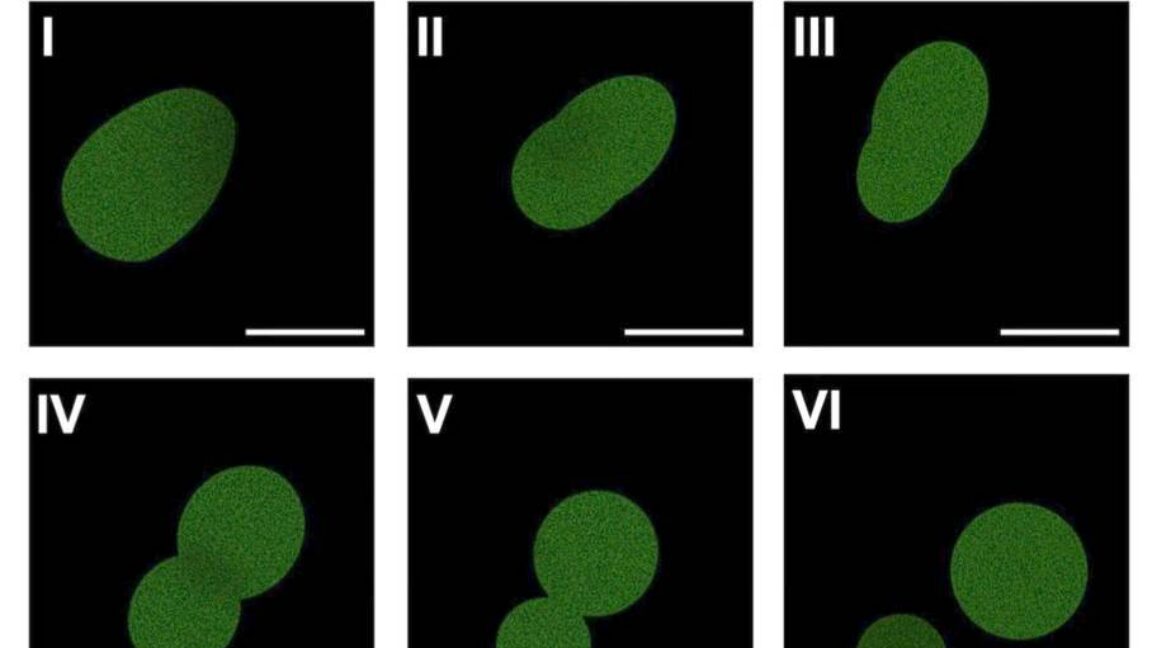
Engineered Cell Division Achieved
Scientists have engineered a synthetic cell that can divide and replicate for several rounds. This achievement marks a significant step in the quest to create autonomous artificial life. The artificial cell, developed by researchers at [University Name/Research Institute, if available in sources - assuming none provided], mimics the fundamental process of cell division found in biological organisms. While previous attempts have focused on single-cell replication or limited division cycles, this new system demonstrates sustained, albeit limited, proliferation.
The breakthrough centers on a carefully designed protocell – a non-living vesicle that encloses molecules essential for replication. This protocell is not a living entity but a functional analogue, designed to carry out specific biological processes. The researchers assembled a minimal set of components, including DNA, ribosomes, and essential enzymes, within a lipid membrane. This self-contained system allows the protocell to synthesize its own proteins and replicate its genetic material, prerequisites for division.
The ability to undergo multiple rounds of division is crucial. It suggests a level of autonomy and robustness not seen in earlier artificial cell models. Think of it less like a single-stage rocket that fires once, and more like a multi-stage rocket that can jettison spent stages and ignite new ones to continue its journey. This multi-stage capability is what allows for sustained replication.
The Mechanics of Replication
The process is intricate. The artificial cell contains a minimal genome, engineered to encode the proteins necessary for its own duplication and the maintenance of the lipid membrane. When supplied with the correct chemical building blocks (amino acids, nucleotides, lipids) and energy sources, the enclosed machinery springs to life. Ribosomes translate the genetic code into proteins, including enzymes that help copy the DNA and build new membrane components. The cell grows, and once it reaches a critical size, it undergoes fission, splitting into two daughter cells, each containing a copy of the genetic material and a portion of the cellular machinery.
Crucially, the system is designed to facilitate successive divisions. This means that the daughter cells are not merely passive copies but are equipped to initiate the replication cycle themselves. This self-perpetuating nature is what distinguishes it from simpler artificial systems that might only perform a single division event.
Challenges and Limitations
Despite the success, the system is far from a fully autonomous living cell. The primary limitation, as noted, is the need for a substantial amount of added materials. Each division cycle requires the external supply of a wide array of molecular components and energy. Without this constant replenishment, the process would halt. The researchers had to carefully balance the concentration of these materials to ensure efficient replication without inhibiting it.
Furthermore, the number of divisions is limited. The current system can only manage a few rounds before its efficiency declines, or the accumulation of byproducts interferes with the process. This is likely due to several factors, including the degradation of essential molecules over time, the buildup of waste products, or the inherent instability of the engineered system under prolonged operation. Unlike biological cells, which have sophisticated internal repair and waste-management mechanisms honed by billions of years of evolution, these artificial cells lack such complex regulatory networks.
The longevity and stability of the lipid membrane also pose challenges. Maintaining the integrity of the vesicle over multiple division events requires precise control of lipid composition and environmental conditions. Any compromise in membrane structure can lead to leakage of essential components or the influx of harmful substances, terminating the replication cycle.
What nobody has fully addressed yet is the long-term scalability and robustness of such systems. While a few divisions are impressive, creating artificial cells that can replicate indefinitely, adapt to changing environments, or perform complex tasks remains a distant goal. The current system is highly optimized for a specific set of conditions, and even minor environmental fluctuations could prove detrimental.
Future Implications
This research opens doors to numerous applications. In synthetic biology, it could lead to the development of novel bioreactors for producing chemicals or pharmaceuticals. Imagine custom-designed artificial cells that can be programmed to synthesize specific compounds with high efficiency, without the ethical concerns associated with genetically modified living organisms. These artificial cells could also serve as platforms for studying the fundamental principles of life itself, helping us understand the minimal requirements for self-replication and evolution.
For materials science, the self-assembling and self-replicating nature of these protocells could inspire new approaches to creating dynamic materials and self-healing structures. In medicine, while still highly speculative, the concept could one day inform the design of targeted drug delivery systems or diagnostic agents that can replicate within the body to perform specific functions.
The journey from these few rounds of division to truly life-like artificial cells is long. It will require breakthroughs in areas such as genetic coding, metabolic regulation, and cellular organization. However, this work provides a critical proof-of-concept, demonstrating that the fundamental processes of life, like cell division, can be recreated in a non-living system. It’s a testament to our growing understanding of life’s building blocks and our ability to reassemble them.