The Imperative for Real-Time Data
In today's software landscape, simply knowing *what* happened is often insufficient. The critical insight lies in knowing *when* it happened. Consider the cascade of events that demand immediate attention: a customer's payment confirmation, an order status update from 'pending' to 'shipped', a new user account creation, or even an AI workflow triggered by a new request. The fundamental challenge for developers is enabling applications to detect these changes as they occur. For years, two primary methodologies have vied for this task: polling and webhooks.
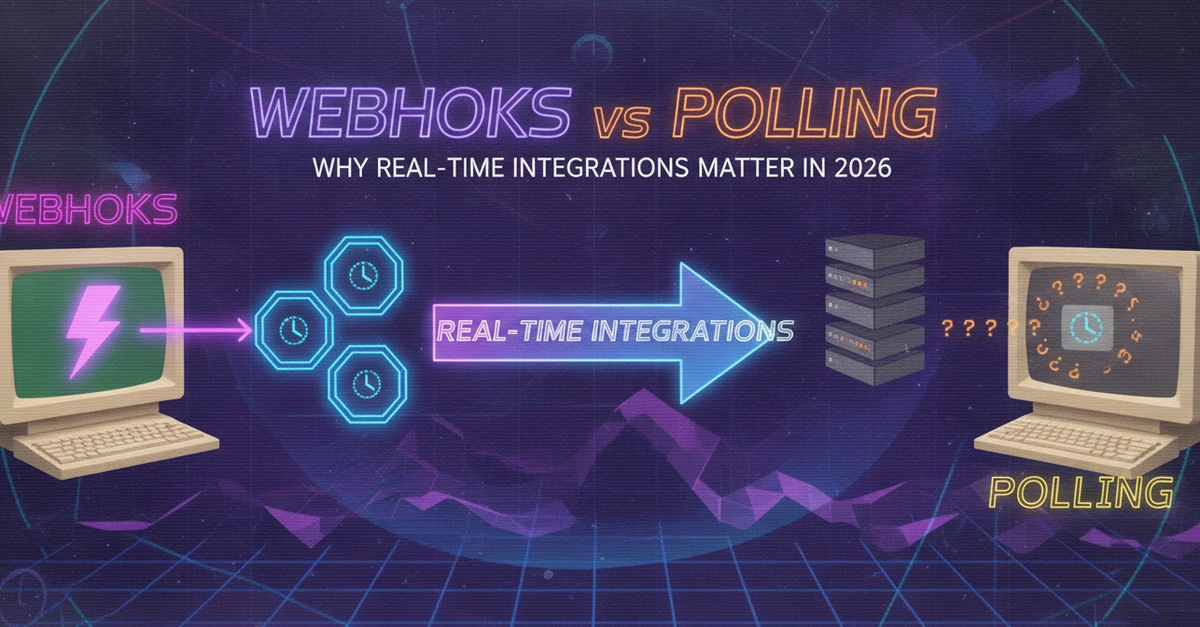
Polling operates on a simple, yet often inefficient, principle: the application repeatedly queries an external API, asking, "Has anything changed since my last check?" This constant questioning, while straightforward, can lead to significant overhead. Imagine a concierge repeatedly asking every guest in a hotel if they've checked out yet, instead of waiting for the guest to inform them. This analogy highlights the inherent wastefulness of polling when events are infrequent.
Webhooks, conversely, flip this model. Instead of the application asking, the external system actively *notifies* the application when a specific event transpires. This is akin to the concierge receiving an alert the moment a guest approaches the front desk to check out. The system pushes the relevant data to a pre-defined URL within your application, enabling immediate processing.
The Mechanics of Polling
Polling involves a client application making periodic requests to a server's API endpoint. The server, in turn, responds with the current state of the requested resource. If the state has changed since the last poll, the client can then take appropriate action. This is often implemented using timers or scheduled jobs within the client application.
For example, an e-commerce application might poll a shipping provider's API every 15 minutes to check the status of all active orders. If an order's status changes from 'processing' to 'shipped', the polling request will return this new information, allowing the e-commerce app to update its own records and potentially notify the customer.
The primary drawback of polling is its inherent inefficiency. If events occur sporadically, the application will spend most of its time making unnecessary requests, consuming bandwidth, server resources, and potentially incurring API rate limits. Conversely, if events happen very frequently, the polling interval might be too long to capture them in a timely manner, leading to delays in data synchronization and application responsiveness.
The Power of Webhooks
Webhooks, also known as reverse APIs or HTTP callbacks, provide a more efficient and immediate solution. When an event occurs in a source system (e.g., a new payment processed by Stripe, a code commit to a GitHub repository), that system sends an HTTP POST request containing event data to a pre-configured URL (the webhook endpoint) in your application. Your application then receives this data and can act upon it instantly.
Consider the same e-commerce example. Instead of polling the shipping provider, the provider can be configured to send a webhook to your e-commerce platform the moment an order ships. This notification arrives almost instantaneously, allowing your application to update its status, send an email to the customer, and trigger any subsequent fulfillment processes without delay.
The benefits of webhooks are substantial: reduced server load, lower bandwidth consumption, and near real-time data synchronization. This makes them ideal for applications that require up-to-the-minute information, such as financial trading platforms, real-time dashboards, IoT data ingestion, and critical business process automation.
When to Choose Which
The choice between polling and webhooks is not always binary, and context is crucial. Polling remains a viable option in several scenarios:
- Low Event Frequency: If events are rare and predictable, polling at a sufficiently long interval can be simpler to implement and manage than setting up and maintaining webhook infrastructure.
- No Webhook Support: Some older or simpler APIs may not offer webhook capabilities. In such cases, polling is the only option to retrieve data updates.
- Idempotency Concerns: While webhooks can be designed for idempotency, ensuring that duplicate events are handled gracefully, polling might sometimes be perceived as inherently safer if strict event ordering or exactly-once processing is paramount and difficult to guarantee with webhooks.
- Client-Side Polling: For certain browser-based applications, polling might be used to update UI elements without requiring server-side webhook infrastructure.
However, as we look towards 2026 and beyond, the trend is overwhelmingly towards real-time data. Webhooks are becoming the de facto standard for integrations where timeliness is critical. They offer a more scalable, efficient, and responsive architecture. The key considerations for adopting webhooks include:
- Security: Webhook endpoints must be secured to prevent unauthorized access and malicious payloads. This typically involves signature verification, SSL/TLS encryption, and input validation.
- Reliability: Ensuring that webhooks are delivered reliably is paramount. This may involve implementing retry mechanisms, dead-letter queues, and monitoring systems.
- Scalability: The webhook endpoint in your application must be able to handle a potentially large volume of incoming requests, especially during peak times.
- Event Ordering: For some applications, the order in which events are received is critical. Designing webhook handlers to manage out-of-order or duplicate events is essential.
The Future is Real-Time
The increasing complexity and interconnectedness of software systems demand more efficient data synchronization methods. As applications become more event-driven and rely on immediate data for decision-making, the limitations of polling become more pronounced. The overhead, latency, and resource consumption associated with frequent polling are simply not sustainable for modern, high-throughput systems.
Webhooks represent a fundamental shift towards a more reactive and efficient integration paradigm. They align with the growing adoption of microservices, event-driven architectures, and serverless computing, where immediate feedback loops and minimal latency are key design principles. By allowing systems to communicate asynchronously and reactively, webhooks unlock new possibilities for automation, personalization, and operational efficiency.
For developers and architects building applications today and looking towards 2026, embracing webhook-based integrations is not just a best practice; it's increasingly becoming a necessity for building responsive, scalable, and cost-effective systems. The question is no longer *if* real-time matters, but *how* effectively you can implement it.
What nobody has fully addressed yet is the long-term maintenance cost and complexity of managing a vast network of disparate webhook endpoints across a growing microservices ecosystem. As systems evolve, ensuring these endpoints remain secure, up-to-date, and resilient will require robust tooling and standardized practices that are still emerging.