Arcovia: AI for Architectural Intelligence
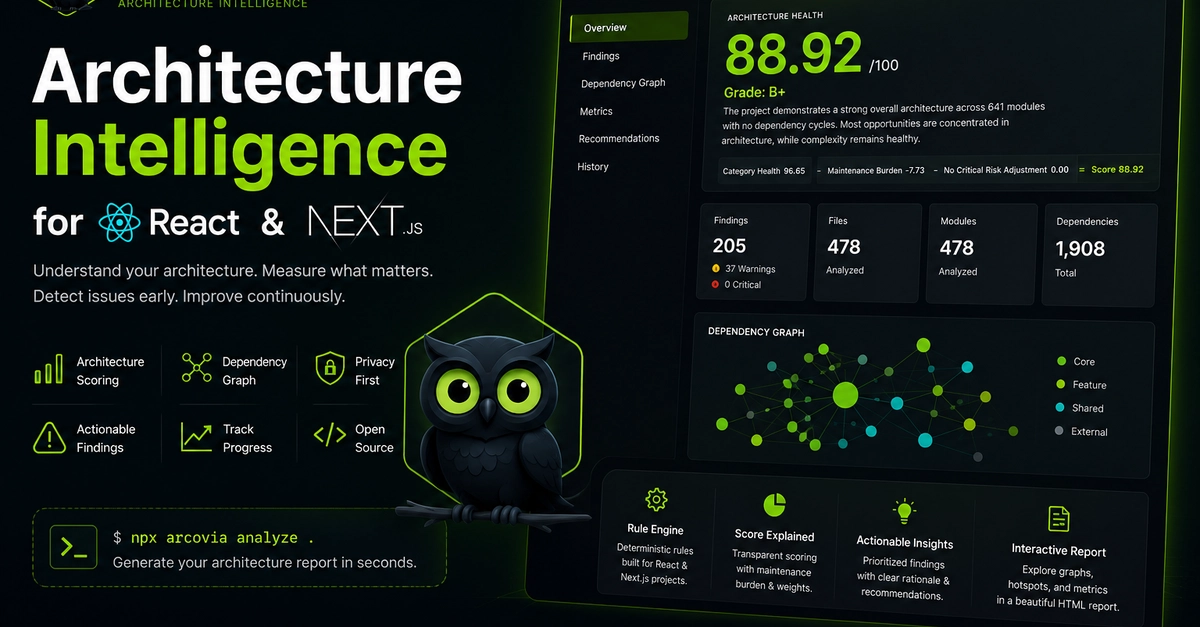
The OpenAI Build Week Hackathon became the birthplace for Arcovia, an open-source project born from a developer's long-standing frustration with managing complex React and Next.js applications. Developed over a single weekend, Arcovia aims to provide insights into software architecture health, a domain largely untouched by existing code quality tools.
While tools like ESLint, Prettier, and SonarQube excel at identifying code smells, formatting issues, and general bugs, they fall short when addressing higher-level architectural concerns. Developers often grapple with questions such as: Is the architecture healthy? Which modules are becoming bottlenecks? Where is technical debt accumulating? And crucially, which files should be refactored first to yield the most impact?
Arcovia was conceived to fill this gap. It leverages AI to analyze codebases and provide actionable intelligence on architectural patterns, potential performance issues, and areas ripe for refactoring. Unlike static analysis tools that focus on syntax and style, Arcovia delves into the structure and interdependencies within a project, offering a more holistic view of its maintainability and scalability.
The AI-Powered Approach
The core of Arcovia's functionality lies in its AI-driven analysis. The tool processes React and Next.js projects, understanding the relationships between components, modules, and pages. This allows it to identify complex dependency chains, pinpoint modules that are disproportionately large or frequently modified, and flag potential performance bottlenecks before they significantly impact user experience or development velocity.
Think of it less like a spell checker for your code and more like a seasoned architect walking through your building blueprints. The architect doesn't just point out a crooked nail; they identify load-bearing walls that are under stress, inefficient routing of utilities, or areas where future expansion would be problematic. Arcovia aims to provide that same high-level, strategic assessment for software architectures.
By analyzing these structural elements, Arcovia can generate reports that highlight:
- Module Bottlenecks: Identifying components or directories that are central to many operations, potentially slowing down development or introducing single points of failure.
- Technical Debt Accumulation: Pinpointing areas where complexity is high, code churn is excessive, or outdated patterns are prevalent, indicating where refactoring efforts would be most beneficial.
- Refactoring Prioritization: Providing data-driven recommendations on which files or modules to refactor first, based on their impact on overall architecture health and potential for improvement.
- Architectural Health Score: Offering a quantifiable metric to gauge the overall well-being of the codebase's structure, allowing teams to track improvements over time.
Addressing the Developer Pain Point
The problem Arcovia addresses is deeply felt by developers working on large, long-lived projects. As codebases grow, understanding the intricate web of connections between different parts of the application becomes increasingly challenging. Without clear visibility into architectural health, teams often resort to reactive refactoring, addressing issues only when they cause significant problems. This can lead to slower development cycles, increased bugs, and a general decline in developer morale.
Existing tools provide valuable micro-level insights, but they don't offer a macro view of architectural integrity. A project might pass all ESLint checks and have perfectly formatted code, yet still suffer from an unhealthy, unmaintainable architecture. Arcovia's ambition is to provide that missing macro perspective, enabling proactive architectural management.
The open-source nature of Arcovia means it can be integrated into existing development workflows. Teams can run it as part of their CI/CD pipeline to continuously monitor their architecture, or use it ad-hoc to diagnose specific issues. The goal is to empower developers with the intelligence needed to build more robust, scalable, and maintainable applications.
The Future of Arcovia
While Arcovia was built rapidly during a hackathon, its potential extends far beyond a proof-of-concept. The underlying AI models can be further trained and refined to understand a wider array of architectural patterns and anti-patterns. Future development could include:
- Support for more JavaScript frameworks and libraries.
- Deeper integration with popular IDEs for real-time feedback.
- Advanced analytics on code churn and developer productivity linked to architectural complexity.
- Automated refactoring suggestions based on identified issues.
The surprising detail here is not the speed of development, but the immediate recognition of a critical, unmet need in the developer tooling landscape. Arcovia taps into the growing demand for AI-assisted development, moving beyond code generation to offer intelligence on the fundamental structure of software.
What nobody has addressed yet is how to effectively measure and communicate the ROI of architectural improvements identified by tools like Arcovia to non-technical stakeholders. Bridging this gap will be crucial for widespread adoption in enterprise environments.