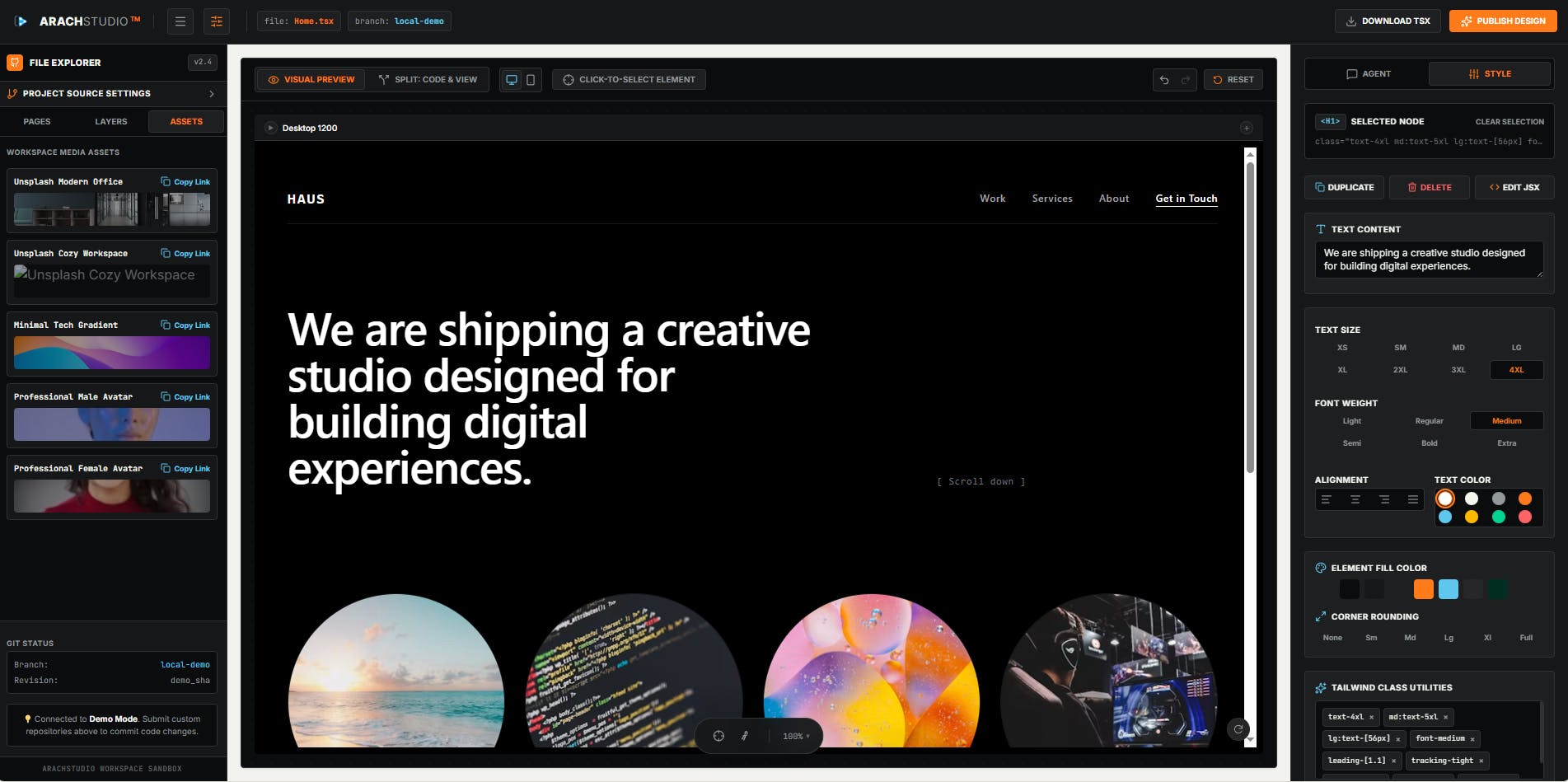
Live Component Editing for GitHub
ArachStudio emerges as a novel tool designed to simplify the process of developing and iterating on GitHub components. The core promise of ArachStudio is to allow developers to edit their components directly within their web browser, with changes reflected in real-time. This approach bypasses the need for extensive local setup and immediate rebuild cycles, aiming to accelerate the feedback loop in component-driven development.
Traditional component development often involves cloning repositories, setting up local development environments, making changes, and then committing and pushing them to a remote repository like GitHub. This can be a time-consuming process, especially for small adjustments or quick tests. ArachStudio seeks to flatten this workflow by providing an integrated, browser-based environment. Developers can connect their GitHub repositories, select the components they wish to work on, and then modify them directly. The tool handles the underlying synchronization and rendering, presenting the developer with an immediate visual and functional representation of their changes.
The platform positions itself as a way to streamline the workflow for teams building reusable UI elements, design systems, or any modular code hosted on GitHub. By enabling live editing, ArachStudio aims to reduce the friction associated with component iteration, making it easier for developers to experiment, refactor, and collaborate on shared codebases. This could be particularly beneficial for front-end developers, UI/UX designers working closely with developers, and teams that rely heavily on component libraries for consistency and efficiency across projects.
Bridging the Gap Between Code and Preview
The key innovation of ArachStudio lies in its ability to provide a live, interactive preview of components as they are being edited. Instead of relying on a separate preview environment or waiting for a build process to complete, developers see their code changes manifest instantly in the browser. This immediate feedback loop is crucial for efficient development, akin to how live-reloading works in many modern front-end frameworks, but applied specifically to the context of managing and editing components hosted on GitHub.
Consider the process of fine-tuning a button component. With ArachStudio, a developer could open the button's code, adjust a CSS property like `border-radius`, and see the button's corners immediately round in the browser window. This direct manipulation and instant visual confirmation allows for rapid prototyping and precise styling. The tool handles the connection to the GitHub repository, fetching the relevant component files and setting up the necessary environment for live preview and editing. This abstraction of the setup process is a significant value proposition.
The platform’s integration with GitHub means that changes made within ArachStudio can be committed and pushed back to the repository, maintaining a clear version history and facilitating collaboration through standard Git workflows. This avoids creating a disconnected editing experience and instead aims to enhance the existing developer ecosystem. The ability to work directly from a remote repository also simplifies onboarding for new team members, as the complex local environment setup is largely eliminated for component editing tasks.
Workflow Enhancements and Potential Impact
ArachStudio targets a specific pain point in modern software development: the overhead associated with managing and iterating on modular code. As software projects grow in complexity, the reliance on well-defined components and design systems increases. Tools that can accelerate the development and refinement of these components are therefore valuable.
The tool's potential impact extends to various aspects of the development lifecycle. For design systems teams, it could mean faster iteration cycles for new components or updates to existing ones, leading to quicker adoption across product teams. For individual developers, it offers a more fluid and less interruptive way to experiment with code and fix bugs. The browser-based nature of ArachStudio also opens up possibilities for simpler collaboration, where team members can easily share live editing sessions or review proposed changes without needing to clone entire projects.
What remains to be seen is how ArachStudio handles more complex component dependencies, build processes, or integrations with various front-end frameworks. While the core functionality of live editing is compelling, the robustness of its environment for diverse project needs will be a critical factor in its long-term adoption. If ArachStudio can effectively abstract away the complexities of different build tools and dependency management systems, it could become an indispensable part of the component development toolkit.
Future Considerations
As ArachStudio evolves, developers will likely look for features such as improved support for different JavaScript frameworks (React, Vue, Angular, Svelte), enhanced debugging capabilities within the browser environment, and more sophisticated collaboration features like real-time pair editing or commenting on components. The ability to manage multiple repositories or branches within the same session would also be a significant enhancement. The success of such a tool hinges on its ability to seamlessly integrate into existing developer workflows without introducing new complexities or limitations.