
Apple's On-Device Speech-to-Text Ascends
Apple's recent WWDC announcements included the introduction of SpeechAnalyzer, a new on-device API for speech recognition. While Apple has offered speech-to-text capabilities for years, this new API appears to represent a significant leap forward, particularly for developers building applications that require accurate and efficient transcription. Early benchmarks suggest SpeechAnalyzer holds its own, and in some cases surpasses, established models like OpenAI's Whisper, especially when considering on-device processing and specific language pairs.
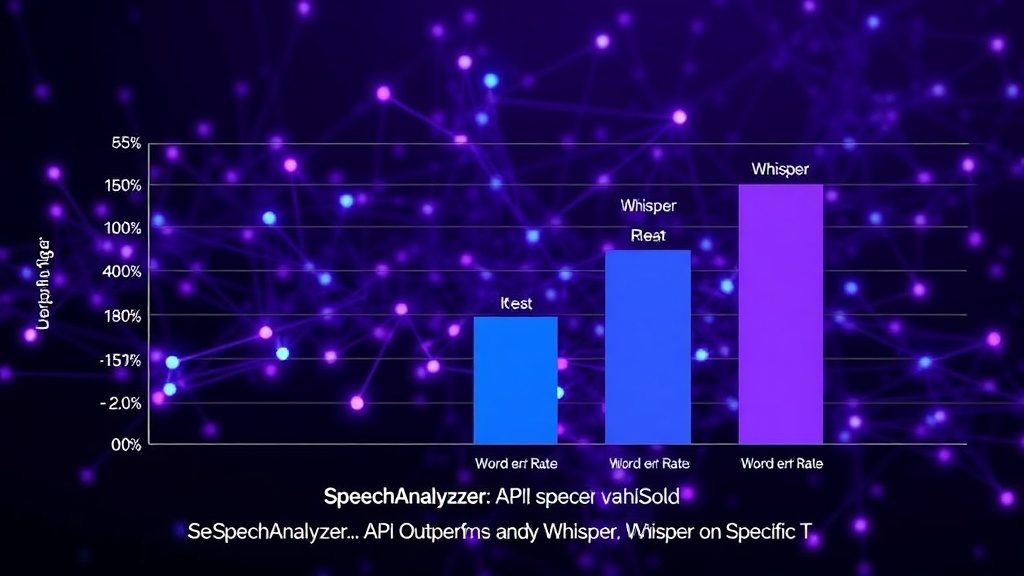
The benchmark, conducted by Inscribe, focused on comparing the accuracy and speed of SpeechAnalyzer against OpenAI's Whisper (specifically the `large-v3` model) and Apple's previous generation speech recognition engine. The results indicate that for English, SpeechAnalyzer achieves a Word Error Rate (WER) of 6.7%. This is notably better than Whisper's `large-v3` model, which logged a WER of 8.3% on the same dataset. Furthermore, SpeechAnalyzer significantly outperforms Apple's older engine, which had a WER of 12.1%.
Performance Across Languages and Contexts
The advantage of SpeechAnalyzer isn't limited to English. The benchmark also tested the API with Spanish, where it achieved a WER of 9.2%, again outperforming Whisper's `large-v3` (10.5% WER). This suggests that Apple's model may be particularly well-tuned for common Western languages, a crucial detail for developers targeting global markets.
Speed is another critical factor for on-device processing. SpeechAnalyzer reportedly processes audio 2.5x faster than Whisper for English audio. This speed advantage is crucial for real-time transcription applications, live captioning, and any scenario where immediate feedback is required. The ability to perform this processing locally on the device also brings significant privacy benefits, as audio data does not need to be sent to external servers for transcription. This is a major selling point for applications handling sensitive information.
Technical Underpinnings and Developer Implications
While the exact architectural details of SpeechAnalyzer are not fully public, its on-device nature implies a highly optimized model designed to run efficiently on Apple's silicon. This contrasts with Whisper, which, while powerful, often requires significant computational resources and is typically run on servers or more powerful local machines. For developers, integrating SpeechAnalyzer means leveraging Apple's native frameworks, which often leads to more seamless user experiences and easier deployment across the Apple ecosystem (iOS, macOS, iPadOS).
The benchmark's methodology involved transcribing a diverse set of audio clips, including podcasts, YouTube videos, and general conversations. The dataset was designed to represent real-world usage, featuring varied accents, background noise, and speaking styles. This comprehensive testing approach lends credibility to the reported performance gains.
One of the most surprising details is the magnitude of the performance gap on certain language pairs, particularly English and Spanish. While Whisper has been the de facto standard for many developers due to its open-source nature and strong performance, Apple's push for on-device intelligence with SpeechAnalyzer presents a compelling alternative. The company's investment in optimizing its models for its own hardware is clearly paying dividends.
What Does This Mean for the Future?
The introduction of SpeechAnalyzer by Apple is more than just another API; it signals a strategic move towards more powerful, privacy-preserving on-device AI. For developers, this offers a compelling reason to prioritize native Apple platforms for speech-intensive applications. The improved accuracy and speed, coupled with the inherent privacy advantages of on-device processing, could reshape the landscape of mobile application development.
Competitors in the ASR (Automatic Speech Recognition) space will need to watch closely. While Whisper remains a formidable open-source option, especially for cross-platform needs or when server-side processing is acceptable, SpeechAnalyzer sets a new bar for on-device performance within the Apple ecosystem. The question now is how quickly other platforms will be able to offer comparable on-device capabilities, and whether developers will embrace a more fragmented approach to AI model selection based on target hardware.
If you're building an iOS or macOS application that relies heavily on speech transcription, you should immediately investigate integrating SpeechAnalyzer. The potential gains in accuracy, speed, and user privacy are too significant to ignore. Understanding its limitations, particularly for less common languages or highly specialized audio, will be key to a successful implementation.