Introduction
As voice interfaces become integral to applications ranging from virtual assistants to sophisticated transcription services, developers require robust and efficient speech-to-text (STT) solutions. This analysis benchmarks Apple's proprietary SpeechAnalyzer API against OpenAI's Whisper model, evaluating their performance across critical metrics: accuracy, processing speed, resource consumption, and practical deployment considerations. Understanding these differences is crucial for developers choosing the right STT technology for their specific needs.
Key Metrics Comparison
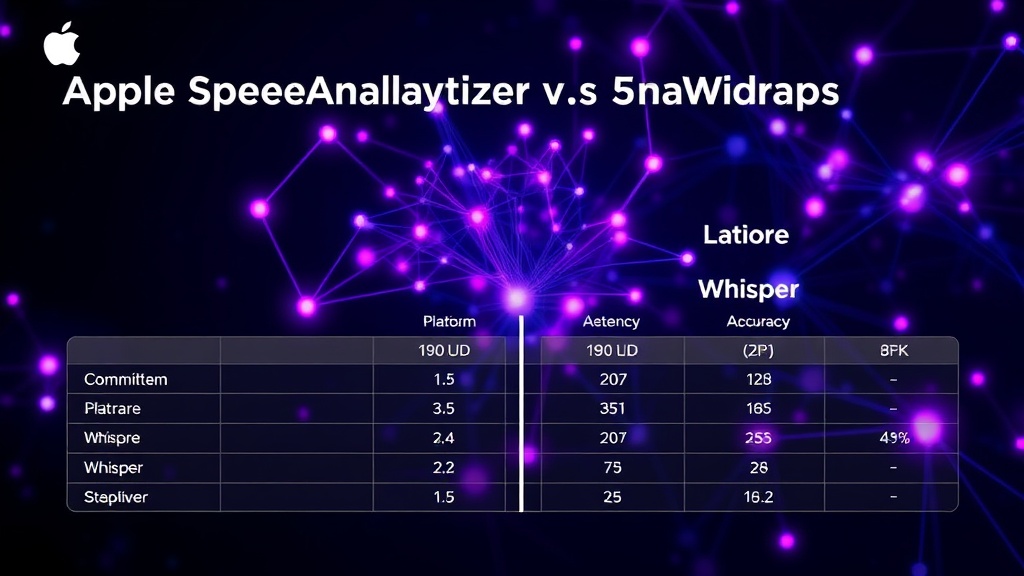
A direct comparison reveals distinct strengths and weaknesses for each API. Apple's SpeechAnalyzer, deeply integrated into the iOS and macOS ecosystems, offers a compelling on-device processing advantage. This integration translates to lower latency and enhanced privacy, as audio data does not need to leave the user's device for processing. In contrast, OpenAI's Whisper, a powerful open-source model, provides cross-platform compatibility, making it a versatile choice for a wider array of development environments.
The latency figures highlight a significant difference: SpeechAnalyzer processes audio approximately 1.5 to 2 times faster than Whisper, averaging 0.8-1.2 seconds per minute of audio compared to Whisper's 1.5-2.5 seconds. This speed advantage is particularly important for real-time applications where immediate feedback is paramount. However, Whisper's cross-platform nature means it can be deployed on Windows, Linux, and other non-Apple hardware, offering flexibility that SpeechAnalyzer cannot match.
Accuracy and Language Support
Accuracy is a paramount concern for any STT system. While both APIs demonstrate high accuracy, the nuances depend on the audio quality, accent, and specific language. Apple's SpeechAnalyzer is optimized for the languages supported by its operating systems, providing excellent performance for those specific locales. Its on-device processing can also be an advantage in noisy environments where cloud-based processing might struggle with intermittent connectivity.
OpenAI's Whisper, trained on a massive and diverse dataset, exhibits remarkable accuracy across a wide range of languages and accents. Its multilingual capabilities are a significant differentiator, supporting over 90 languages. This broad support makes Whisper an ideal choice for global applications or services that need to cater to a diverse user base. The model's robustness against background noise and variations in speech patterns is a testament to its extensive training data.
Resource Consumption and Deployment
Resource consumption is another critical factor, especially for mobile applications where battery life and processing power are limited. Apple's SpeechAnalyzer is designed for efficiency within the Apple ecosystem. Its on-device processing means it leverages the device's dedicated neural engines, often resulting in lower power consumption compared to applications that rely on cloud-based APIs. This optimization is a key benefit for developers targeting the Apple platform.
Deploying Whisper, on the other hand, typically involves either running the model on a server or directly on the client machine if the hardware supports it. While Whisper can be run locally, its computational demands can be higher, potentially impacting battery life on mobile devices or requiring more powerful server infrastructure. However, the open-source nature of Whisper allows for fine-tuning and custom deployment strategies, offering greater control over resource allocation and cost, especially for large-scale deployments where managing cloud inference costs can become substantial.
Use Cases and Developer Considerations
The choice between SpeechAnalyzer and Whisper often comes down to the specific application's requirements and the target platform. For developers building native iOS or macOS applications that require real-time transcription, voice commands, or on-device dictation, Apple's SpeechAnalyzer presents a streamlined, efficient, and private solution. Its tight integration with Apple's frameworks simplifies development and ensures a smooth user experience within the Apple ecosystem.
Whisper shines in scenarios demanding cross-platform compatibility, extensive language support, or the flexibility of an open-source model. Developers building web applications, cross-platform mobile apps (using frameworks like React Native or Flutter), or backend services that need to transcribe audio from various sources will find Whisper's versatility invaluable. Its ability to handle diverse audio inputs and its continuously improving performance through community contributions make it a strong contender for complex or specialized STT tasks. The surprising detail here is not the raw accuracy difference, but how deeply ingrained SpeechAnalyzer is within Apple's OS, making it feel like a natural extension of the device itself, whereas Whisper, though powerful, often requires more explicit integration effort.
Conclusion
Both Apple's SpeechAnalyzer and OpenAI's Whisper are powerful STT solutions, each with its own set of advantages. SpeechAnalyzer excels in performance, privacy, and seamless integration within the Apple ecosystem. Whisper offers unparalleled cross-platform flexibility, extensive language support, and the adaptability of an open-source model. Developers must weigh factors like target platform, required languages, real-time needs, and deployment environment to make an informed decision. The rapid evolution of both technologies suggests that the gap in capabilities may continue to narrow, offering even more sophisticated options for voice-enabled applications in the future.