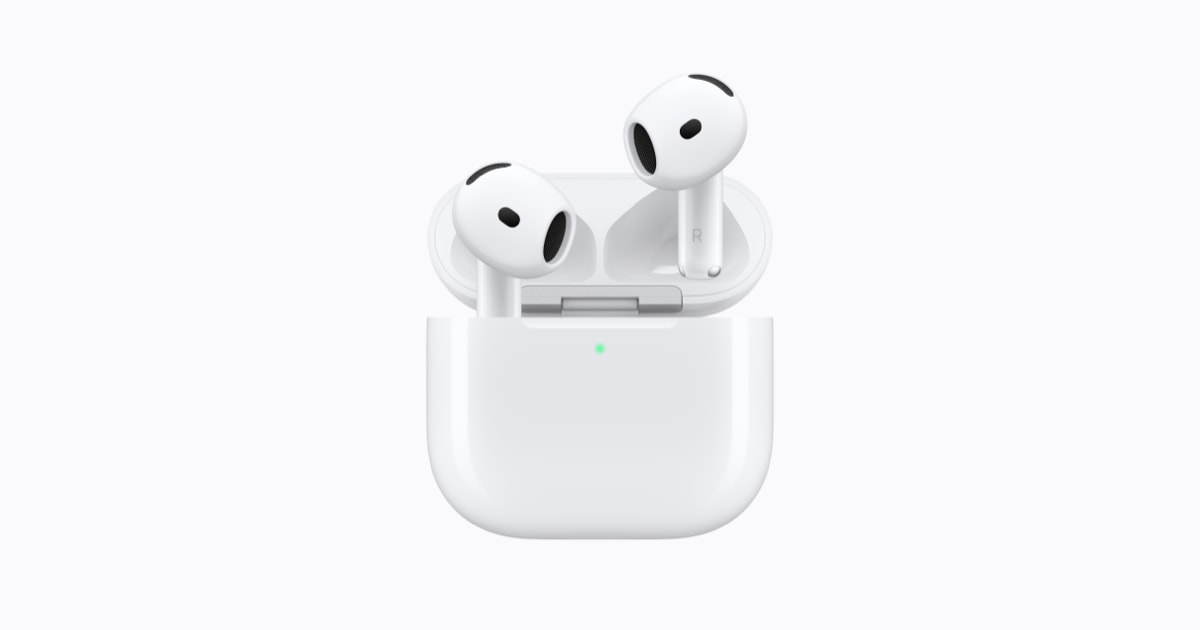
AirPods 5: A New Era of Auditory Experience
Apple today announced the AirPods 5, a significant leap forward in personal audio technology. The company has integrated what it calls "best-in-class open-ear Active Noise Cancellation (ANC)" into its latest earbuds, a feature that challenges conventional wisdom in noise-cancelling audio. Traditionally, effective ANC relies on a seal to block external sound. AirPods 5, however, employ a novel approach that filters and cancels ambient noise without physically isolating the user, promising a more natural and aware listening experience.
This new open-ear ANC technology is designed to allow users to remain aware of their surroundings – crucial for safety in urban environments or for those who prefer not to be completely cut off from the world. Apple claims this system achieves a level of noise reduction previously unseen in non-isolating earbuds. The technology likely involves sophisticated beamforming microphones and advanced digital signal processing to identify and counteract ambient sounds like traffic, conversations, or office chatter, all while preserving the clarity of desired audio playback.
Beyond ANC, the AirPods 5 introduce enhanced Spatial Audio with dynamic head tracking. This feature, which has been a hallmark of Apple's premium audio devices, is now refined to offer an even more immersive soundstage. Whether listening to music, watching movies, or participating in spatial audio calls, users will experience audio that seems to originate from all around them, adapting realistically as they move their heads. This creates a cinema-like or live-concert feel, bringing content to life in a way that standard stereo audio cannot.
A major upgrade for audiophiles is the inclusion of lossless audio support. For the first time in the AirPods line, users can stream and listen to music in its original, uncompressed format. This capability is critical for high-fidelity listening, ensuring that the nuances and details intended by artists and producers are delivered directly to the listener. This feature, combined with the improved Spatial Audio and open-ear ANC, positions the AirPods 5 as a compelling option for serious music enthusiasts.
Technological Innovations Under the Hood
The engineering behind AirPods 5's open-ear ANC is a key differentiator. Unlike the passive noise isolation provided by silicone tips in traditional earbuds, Apple has developed an active system that works dynamically. This system likely uses outward-facing microphones to capture ambient noise and then generates an inverse sound wave to cancel it out. However, the challenge with open-ear designs is maintaining the effectiveness of this cancellation without creating an uncomfortable pressure sensation or interfering with the desired audio. Apple's proprietary algorithms are key here, finely tuning the cancellation to specific frequencies and amplitudes of external sound, while simultaneously ensuring the integrity of the music or call.
The integration of lossless audio is also a significant technical feat, especially given the Bluetooth limitations that have historically plagued wireless audio quality. While Apple has not detailed the specific codec or transmission method used, it is highly probable that they are leveraging a proprietary, high-bandwidth Bluetooth solution or an alternative short-range wireless protocol to achieve this. This would allow for bit-for-bit reproduction of audio files, a capability that has long been the domain of wired headphones or specialized high-resolution audio players.
Furthermore, the computational power required to drive advanced ANC, Spatial Audio, and lossless playback simultaneously necessitates a new generation of processing. Apple has equipped the AirPods 5 with an updated H-series chip, likely the H3 or a variant thereof. This chip is responsible for managing all these complex audio processes in real-time, ensuring low latency, high fidelity, and efficient power consumption. The adaptive nature of the ANC, which adjusts to different environments, also points to sophisticated on-device machine learning capabilities.
Impact and User Experience
The implications for users are substantial. For commuters, the ability to hear important announcements while still enjoying their music or podcasts without a drastic reduction in audio quality is a significant benefit. Fitness enthusiasts can stay aware of traffic or other environmental cues, enhancing safety during outdoor workouts. Professionals can participate in calls with reduced background noise interference, even in busy environments, without feeling cut off from their colleagues or surroundings.
The combination of lossless audio and enhanced Spatial Audio promises a premium listening experience that rivals high-end home audio setups. This could shift consumer expectations for what portable audio devices are capable of, pushing the entire market towards higher fidelity and more immersive soundscapes. The focus on an open-ear design also addresses a long-standing concern for some users who find traditional ANC earbuds uncomfortable or disorienting.
Apple's strategy with the AirPods 5 appears to be about offering choice and adaptability. They are not forcing users into a fully isolating experience but providing a sophisticated tool that can be tuned to different situations. This nuanced approach to noise cancellation, coupled with top-tier audio features, makes the AirPods 5 a formidable contender in the premium earbud market.
The surprising detail here is not the introduction of new AirPods, but the specific focus on a feature that seems counterintuitive to noise cancellation: an open-ear design. Apple has managed to marry the desire for ambient awareness with the benefits of active noise reduction, a feat that many in the audio industry considered a significant engineering hurdle, if not an impossibility, for true ANC.
What's Next?
With the AirPods 5 setting a new benchmark for open-ear ANC and lossless audio, the industry will undoubtedly respond. Competitors will need to innovate rapidly to match Apple's technological advancements. We can expect to see a surge in research and development focused on adaptive audio filtering and high-fidelity wireless transmission. For developers, this opens up new avenues for audio applications that leverage spatial awareness and lossless quality, from enhanced gaming experiences to more realistic virtual collaboration tools.
The question remains how Apple will price these advanced earbuds, given the significant technological investment. Furthermore, the long-term impact on hearing health and user perception of ambient sound needs to be observed. Will this open-ear ANC become the new standard, or will it remain a premium niche, alongside traditional isolating designs?