The Illusion of Uptime
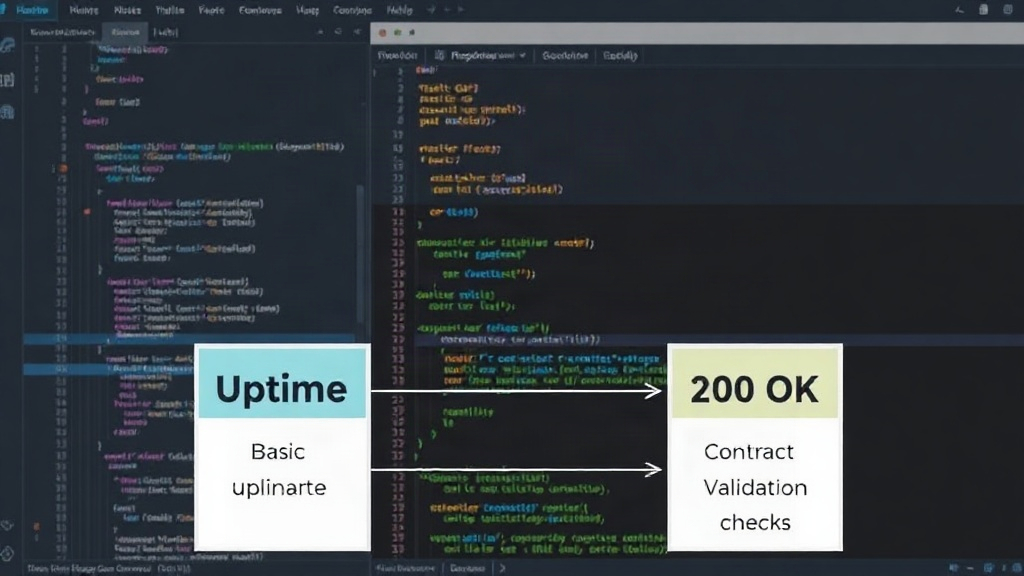
Your API is up. Your server responded in milliseconds. The uptime check shows a solid green light. Yet, your integration is broken. This isn't a hypothetical scenario; it's a silent killer of developer trust and application stability. Standard uptime checks, while essential, only verify that a server responded. They do not, and cannot, verify that the response payload conforms to the expected contract your client applications rely on.
Consider a simple API response from yesterday:
{
  "customer": {
    "id": "cus_42",
    "status": "active"
  }
}
This payload is straightforward. Your client code expects a customer object with an id and a status field. If your monitoring system only checks for a 200 OK status code, it would report success. But what if, overnight, the API provider made a change?
When Contracts Break Silently
The problem arises when the API's structure or data types change. Imagine the same customer endpoint now returns this:
{
  "customer": {
    "id": "cus_42",
    "status": ["active", "verified"]
  }
}
The status field, which was previously a string (e.g., "active"), is now an array of strings (e.g., ["active", "verified"]). Your client code, expecting a string, will likely throw a type error when it tries to access properties or methods on an array as if it were a string. This error doesn't originate on the server; the server is technically functioning correctly by returning a 200 OK. The failure occurs entirely within the client's interpretation of the response.
Other common breaking changes include:
- Field Renaming: An API might rename a field from
userIdtocustomerId. Clients hardcoded to look foruserIdwill fail to find it. - Optional Field Removal: A previously optional field, which your client might not always expect but handles gracefully when absent, could be removed entirely. If your client code has a fallback that assumes the field might be null or undefined, but instead gets a 404 or an unexpected structure, it can break.
- Data Type Changes: A numeric ID might become a string ID, or a boolean flag might become a string enum.
- Object Structure Changes: A nested object might be flattened, or a field might move from the top level into a nested object.
- Array to Object/Object to Array: As in the example, a single item might become a list, or a list might become a single item.
These are not edge cases; they are fundamental shifts in the API's contract. When such changes occur without proper communication or versioning, they can cascade through dependent systems, causing widespread, hard-to-diagnose outages.
Beyond Basic Uptime: Contract Monitoring
The fundamental limitation of basic uptime checks is that they treat the API response as a black box. As long as the box is present and arrives on time, it's considered successful. What’s missing is a way to verify the contents of that box against a known schema or contract. This is where contract testing and response validation come in.
To address this gap, developers need to implement more sophisticated monitoring. This involves:
- Schema Validation: Define the expected structure and data types of API responses using a schema definition language like JSON Schema. Then, implement checks that validate incoming responses against this schema. Tools like
ajvfor Node.js or built-in validation in many API gateways can perform this. - Contract Testing: Tools like Pact or Dredd can verify that the API provider and consumer adhere to a shared contract. This is often done in a CI/CD pipeline but can be adapted for runtime monitoring.
- Response Content Assertions: Beyond just schema validation, specific assertions can be made. For example, checking that a specific status field contains one of the expected values, or that a critical identifier is present and in the correct format.
- Monitoring Key Fields: Identify the most critical fields in your integrations and set up specific alerts if their data types change or if they disappear unexpectedly.
Think of it less like a security guard checking if the building is standing (uptime), and more like a quality control inspector checking if the delivered goods match the order form (contract validation). Both are vital, but only the latter ensures the goods are usable.
The Unanswered Question for API Providers
What is the responsibility of API providers when making backward-incompatible changes? While many adhere to semantic versioning (SemVer) for their APIs, breaking changes can still slip through, especially in internal APIs or less mature ecosystems. The core problem is the gap between the server's operational status and the client's functional status. API providers often focus on server health and response times, assuming clients are resilient or will raise issues. However, the silent nature of contract violations means clients can be broken for extended periods before any alert is raised, if at all. This places a significant burden on consumers to meticulously monitor every critical field and structure, rather than relying on the provider to maintain a stable contract.
For developers integrating with third-party APIs, this means treating API responses with the same rigor as critical code. Every integration should have a layer of validation that goes beyond a simple HTTP status code check. The cost of a silent failure—debugging, downtime, lost revenue—far outweighs the effort required to implement robust response validation.