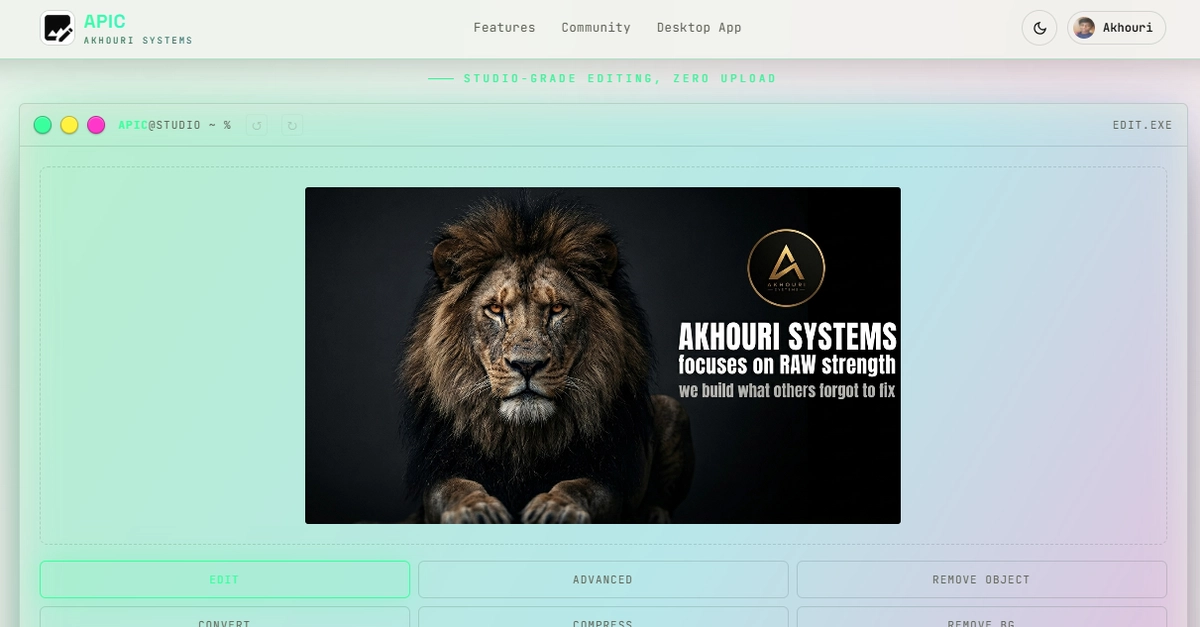
APIC: The Local-First Image Processing Engine
Most web-based image editors operate with a fundamental trade-off: convenience for control. Users upload their precious pixels to a remote server, trusting that the platform will handle them with care. This often means enduring lengthy upload times, risking unwanted compression that degrades image quality, and navigating complex data privacy concerns. The common refrain is that your pixels become someone else's problem.
APIC, short for Advanced Image Processing Center, takes a radical departure from this model. Its core philosophy is encapsulated by the mantra, "Architecture over anecdotes. Performance over promises." The team behind APIC has effectively "deleted the cloud" from the image processing workflow, offering a local-first solution that prioritizes user control, privacy, and raw performance. APIC is available as a browser-based tool and a native desktop application, aiming to deliver studio-grade image editing without the need for any uploads.
Zero Round-Trips: The APIC Stack
APIC is not merely a frontend interface to a cloud-based API. It functions as a fully on-device computational engine. This architectural choice is central to its value proposition, eliminating the latency and security concerns inherent in cloud processing. The engine leverages a stack built on four key protocols, ensuring that all image processing happens locally. This means that data never leaves the user's machine, offering a significant advantage in terms of both speed and privacy.
The technical implementation relies on a combination of WebAssembly (Wasm) for browser-based operations and native code for the desktop application. This allows APIC to achieve near-native performance within the browser environment, a feat often difficult to accomplish with traditional JavaScript-based solutions. The choice of Wasm is critical here, as it enables computationally intensive tasks like image manipulation to be executed efficiently, directly on the user's hardware. For the desktop version, native compilation further optimizes performance, making it a robust tool for professionals who demand speed and reliability.
Bridging Browser and Desktop Workflows
One of APIC's most compelling features is its seamless transition between browser and desktop environments. Users can start editing an image in their web browser, perhaps for quick edits or collaborative reviews, and then seamlessly move to the native desktop application for more intensive, professional-grade work. This hybrid approach caters to a wide range of users, from hobbyists to professional photographers and designers, who require flexibility in their workflow. The consistent experience across platforms ensures that users can rely on APIC regardless of their preferred working environment.
The engine's architecture is designed to handle complex image operations with minimal latency. Instead of sending image data back and forth to a server, APIC processes pixels directly on the user's machine. This local processing model drastically reduces the time spent waiting for operations to complete. For tasks such as batch processing, color correction, or applying filters, the difference in speed compared to cloud-based solutions can be substantial. This performance gain is particularly valuable for users working with large, high-resolution images, where upload and download times can become significant bottlenecks.
Privacy and Security by Design
In an era where data privacy is paramount, APIC's local-first approach offers a compelling solution. By keeping all image data on the user's device, APIC inherently minimizes the risk of data breaches or unauthorized access that can plague cloud services. Users do not need to worry about their sensitive images being stored on third-party servers, potentially being accessed by the service provider or falling victim to a security incident. This focus on privacy is not an afterthought but a foundational principle of APIC's design.
The implications for professional users, such as photographers handling client work or businesses dealing with proprietary visual assets, are significant. APIC provides a secure environment where sensitive images can be processed and manipulated without compromising confidentiality. This level of control over one's data is a critical differentiator in a market increasingly scrutinized for its data handling practices. The engine's commitment to zero-upload processing directly addresses the growing user demand for privacy-respecting digital tools.
The "Anti-Cloud" Advantage: Performance and Control
The "anti-cloud" advantage of APIC is multifaceted. Firstly, it offers unparalleled performance. By eliminating network latency and server load, APIC ensures that image processing operations are executed as quickly as the user's hardware allows. This is crucial for demanding professional workflows where time is a critical factor. Secondly, it provides complete control. Users retain full ownership and control over their image data at all times. They are not subject to the terms of service of a cloud provider regarding data usage or storage, nor are they dependent on the provider's uptime or infrastructure.
This architectural choice also has implications for accessibility and cost. While cloud services often involve subscription fees tied to usage or storage, APIC's local processing model potentially reduces ongoing costs for users. Furthermore, it allows for offline functionality, meaning users can continue to process images even without an active internet connection. This makes APIC a reliable tool in environments with intermittent or no connectivity, such as remote locations or during travel.
APIC's approach challenges the prevailing trend of cloud-centric software development. It demonstrates that high-performance, feature-rich applications can be built and delivered through local-first architectures, offering tangible benefits in performance, privacy, and user control. For developers and users alike, APIC represents a return to fundamental principles of computing: processing data where it resides, with maximum efficiency and minimal external dependencies.