The Fundamental Challenge of Deleting Data in Data Lakes
Deleting a single row in a data lakehouse environment is surprisingly complex, a fact that often catches newcomers off guard. While inserting billions of rows or scanning petabytes of data are routine operations, executing a simple DELETE statement against a table composed of files in object storage presents a fundamental architectural challenge. Object storage systems like Amazon S3 are built on the principle of write-once, read-many. You cannot simply open an existing file and modify a specific byte. Instead, files are written, read, and eventually replaced or deleted entirely. This immutability is the bedrock of data lake systems, but it complicates transactional operations like row deletion.
Apache Iceberg, a popular open table format for large analytic datasets, has evolved its approach to handling these row-level changes across its specification versions. This evolution showcases a significant engineering journey. Version 2 of Iceberg introduced delete files, which made row-level modifications feasible by creating separate files that marked rows for deletion. However, this approach could lead to a proliferation of small files and added overhead. Version 3 represents a major leap forward with the introduction of deletion vectors, a mechanism designed to make row-level changes not only practical but also fast and stable, even under heavy transactional loads.
Evolution of Deletion: From Delete Files to Deletion Vectors
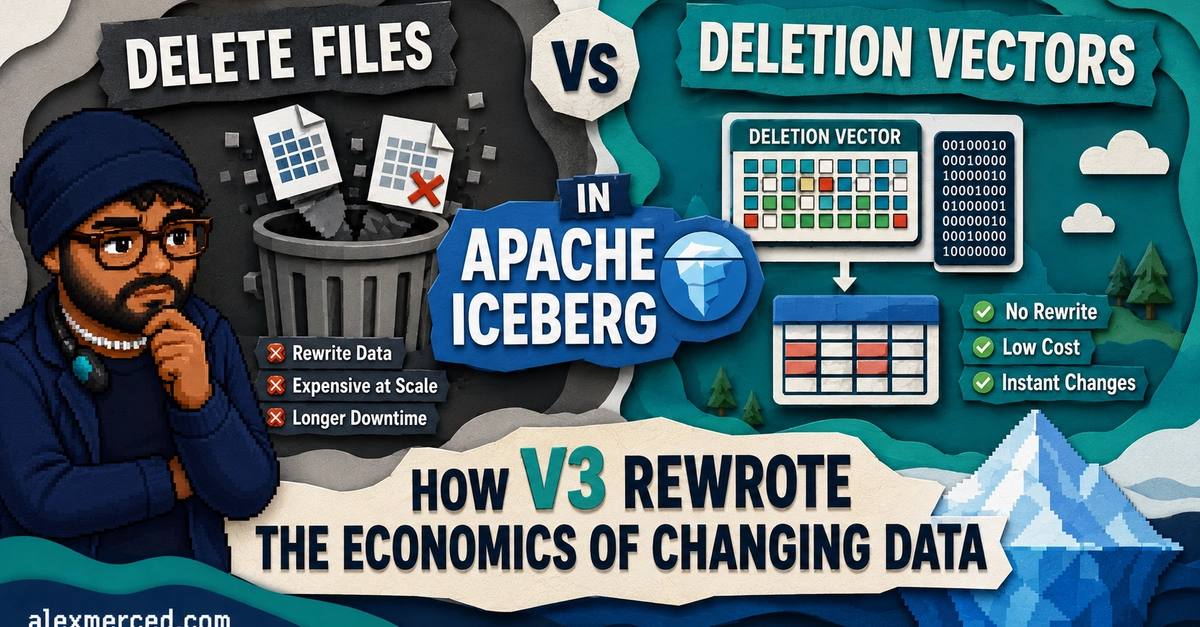
Iceberg's journey to efficiently handle data modifications began with delete files in version 2. When a row needed to be deleted, Iceberg didn't modify the original data file. Instead, it wrote a new, separate file – a delete file. This delete file contained information about the rows to be removed, typically referencing them by their position within their original data file or by their unique identifier. When a query was run, Iceberg would consult these delete files alongside the data files. During query planning, the engine would identify which rows were marked for deletion and exclude them from the results. This was a significant improvement, enabling transactional capabilities on immutable data files. However, it had drawbacks. Frequent deletions could result in a large number of small delete files, increasing metadata overhead and potentially slowing down queries as the system had to read and process more files.
The introduction of deletion vectors in Iceberg version 3 marks a paradigm shift. Instead of creating separate files for each deletion operation, deletion vectors are integrated more tightly. A deletion vector is essentially a compact representation of the rows that have been deleted within a specific data file. Think of it less like a separate list of "bad apples" and more like a compact set of instructions stamped directly onto the "barrel" of apples, indicating which ones to ignore. These vectors are stored within the metadata of the Iceberg table, not as standalone files that need to be discovered and read. This consolidation dramatically reduces metadata bloat and improves query performance. For a data file that has undergone several deletions, the deletion vector efficiently captures all the deleted rows without needing to create multiple small files.
How Deletion Vectors Enhance Performance and Stability
The architectural change from delete files to deletion vectors has profound implications for the economics of data modification. Deletion vectors are designed to be highly compact. They can represent deletions using row positions, row IDs, or even more sophisticated techniques like Bloom filters or sketches for larger-scale deletions. This compactness means less metadata to manage and process. When a query engine reads a data file, it can quickly check the associated deletion vector. If the vector indicates that a particular row should be deleted, it is skipped. This process is significantly faster than enumerating and reading through numerous separate delete files.
Furthermore, deletion vectors contribute to greater stability under pressure. The proliferation of small files, a common issue with delete files, can strain the performance of object storage systems and the query engines that interact with them. By consolidating deletion information, deletion vectors alleviate this problem. This leads to more predictable query performance, especially in environments with high rates of data modification. The overhead associated with managing and applying deletions is substantially reduced, making operations that were once costly and complex now far more efficient. This allows data engineers and analysts to treat data in data lakes with a level of transactional agility previously only seen in traditional relational databases.
Rewriting the Economics of Data Changes
The impact of deletion vectors extends beyond mere technical efficiency; they fundamentally alter the economic equation of managing data in a data lake. Previously, frequent row-level updates or deletes could incur significant costs, not just in terms of compute for rewriting files but also in metadata management and query latency. The introduction of deletion vectors makes these operations economically viable for a much wider range of use cases. For businesses that rely on frequently updated datasets – such as customer profiles, inventory levels, or real-time analytics dashboards – this is a critical development.
Consider a scenario where a company needs to update millions of customer records daily due to changes in preferences, contact information, or purchase history. With older systems or even Iceberg v2, this could involve complex processes of rewriting large data files or managing a growing number of delete files. Iceberg v3, with its deletion vectors, handles these changes much more gracefully. The cost per deletion is significantly lower, both in terms of infrastructure resources and engineering effort. This means that data teams can afford to maintain more up-to-date and accurate datasets without being penalized by prohibitive operational costs. It democratizes the ability to perform fine-grained data manipulation, bringing the flexibility of traditional databases to the scalability and cost-effectiveness of data lakes.
What's Next for Data Lake Transactions?
The advancements in Apache Iceberg, particularly with the introduction of deletion vectors in v3, highlight a broader trend in data lake technology: bridging the gap between the flexibility of cloud-native object storage and the transactional demands of enterprise applications. While deletion vectors offer a powerful solution for row-level modifications, the quest for optimal data management continues. Future iterations might explore even more efficient ways to represent and apply deletions, perhaps through more advanced indexing techniques or tighter integration with underlying storage layers. The ability to perform ACID transactions, including efficient deletes, on data lakes is crucial for many advanced analytics and AI/ML workloads. Iceberg's progress here is a strong indicator of the direction the industry is heading.