Anthropic's Claude Agent Skills Redefine AI Integration
Anthropic's October 16th announcement of Agent Skills represents a seismic shift in how developers can integrate custom functionality into large language models. This isn't just another model update; it's a fundamental re-architecture of agentic AI development, moving away from cumbersome server-side processes towards a radically simplified, file-based approach. The implications are profound, potentially rendering much of the existing infrastructure for custom AI tools redundant.
Traditionally, enabling an AI model to perform specific tasks or access external data required significant engineering effort. Developers would set up dedicated servers, implement complex communication protocols like JSON-RPC or WebSockets, and manage containerized environments. This overhead was a major bottleneck, increasing development time, deployment complexity, and operational costs. Agent Skills obliterates this paradigm.
The Simplicity of Markdown-Based Skills
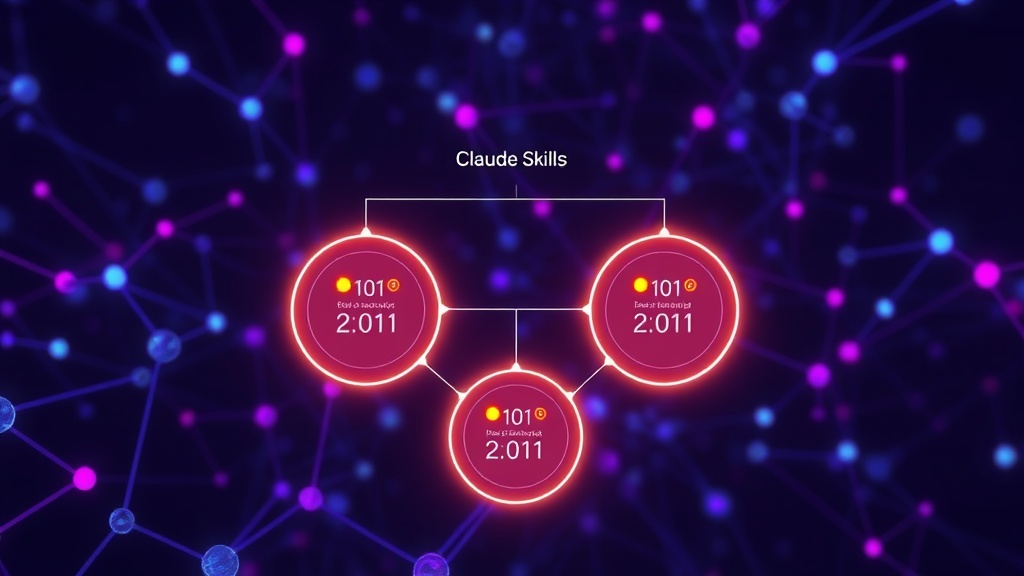
At its core, an Agent Skill is simply a markdown file. This file is augmented with YAML frontmatter, which contains the essential metadata for the skill. This metadata includes the skill's name, a concise description of its purpose, and crucially, trigger conditions. These elements are designed to be lightweight, consuming a minimal number of tokens (typically 30 to 100) and remaining consistently available within the model's context window.
The markdown file itself is divided into distinct levels. Level 1, the metadata, is always loaded. Level 2 contains the actual instructions—the step-by-step logic or procedural knowledge required to execute the skill. This content is loaded dynamically, only when the model determines it is relevant to the user's current task, keeping token usage efficient and under a 5,000-token limit. Level 3 encompasses any necessary resources, such as referenced files, example code snippets, or configuration data. These resources are also pulled on demand, only when explicitly referenced by the instructions in Level 2.
Token Efficiency and Context Management
The genius of this system lies in its token efficiency and intelligent context management. By organizing skills into these three levels, Anthropic allows developers to potentially house hundreds of distinct skills within the model's context without incurring prohibitive token costs. The metadata layer alone for 100 skills might only consume between 3,000 and 10,000 tokens. This means the Claude model can have a vast repertoire of capabilities readily accessible, and it intelligently decides which skills to invoke and load the necessary components only when needed. This is a stark contrast to older systems that might load entire tool definitions or server states into memory, regardless of their immediate applicability.
Consider the alternative: a traditional RAG (Retrieval Augmented Generation) system might involve embedding large chunks of documentation or code into a vector database. While effective for information retrieval, it's less suited for functional execution or procedural logic. The Agent Skills approach bridges this gap, allowing the LLM to directly understand and execute defined procedures as if they were native functions. This is akin to giving the AI a set of highly organized, context-aware function manuals that it can consult and use seamlessly.
Implications for Developers and Infrastructure
The immediate impact is on the infrastructure that developers have built to support AI agents. The need for dedicated microservices, complex API gateways, and intricate state management systems for tool usage is significantly diminished. For teams that have invested heavily in building custom toolkits or integrating external APIs via custom agents, this announcement necessitates a re-evaluation of their architecture. The cost savings in terms of reduced server instances, lower operational overhead, and faster development cycles could be substantial.
This shift is not merely about convenience; it's about democratizing advanced AI agent capabilities. By abstracting away the complexities of infrastructure, Anthropic empowers developers to focus on the core logic and value proposition of their AI applications. Building a sophisticated AI assistant that can interact with multiple services or perform complex multi-step tasks now requires less systems engineering and more domain expertise. The