Anthropic's Astonishing Revenue Trajectory
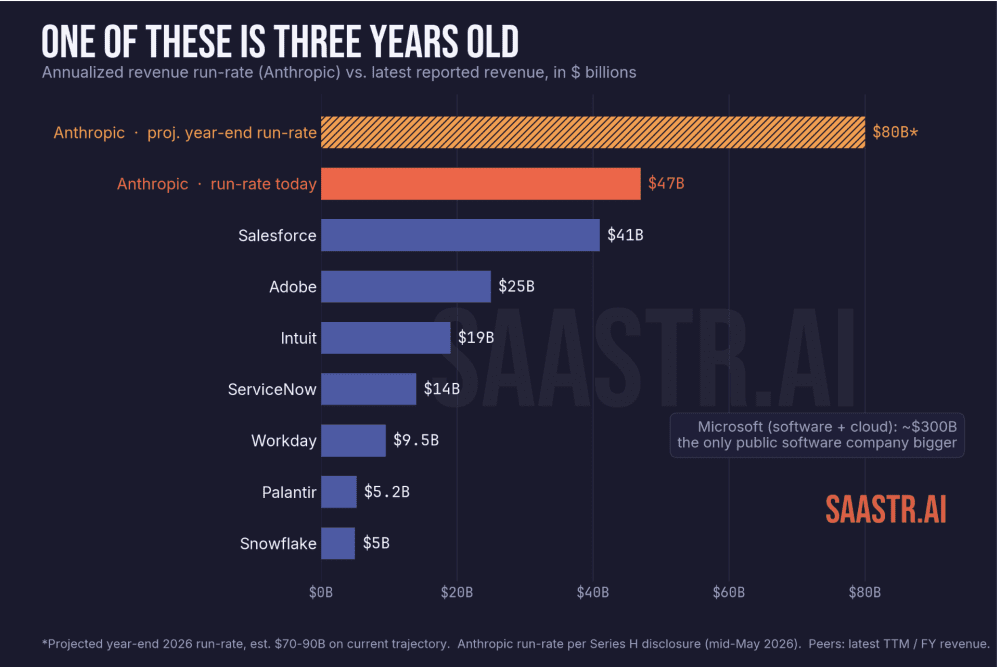
Anthropic's revenue growth is not just fast; it's operating on a different plane of existence compared to traditional software companies. The AI research lab, founded by former OpenAI researchers Dario Amodei and Daniela Amodei, has achieved revenue run rates that are staggering. Exiting 2025, Anthropic was reportedly at a $9 billion run-rate revenue. Within months, this figure has seen exponential increases: $14 billion by February 2026, $19 billion in March, and a colossal $30 billion by April. This trajectory, if sustained, positions Anthropic to out-earn virtually every public software company by the end of the current year, with only Microsoft's vast software empire remaining as a potential peer in terms of revenue scale.
This rapid ascent is a testament to the insatiable demand for advanced AI capabilities and Anthropic's strategic positioning in the market. While many AI startups are still finding their footing, Anthropic has seemingly bypassed the typical growth curves, akin to a sprinter who doesn't just win the race but shatters the world record in the process. The key driver is undoubtedly the deployment of its large language models, particularly Claude, which are being integrated into enterprise workflows and consumer-facing applications at an aggressive pace. Companies are not just experimenting with AI; they are betting significant portions of their operational budgets on it, and Anthropic is capturing a substantial share of that investment.
Understanding the Scale: Beyond Typical SaaS Metrics
To grasp the magnitude of Anthropic's achievement, it's crucial to contextualize these numbers against the backdrop of the public software market. Companies like Salesforce, Oracle, and Adobe, which have spent decades building massive recurring revenue streams, operate in the tens of billions of dollars annually. Yet, Anthropic, a company founded relatively recently, is projecting to reach revenue figures that rival or exceed these established giants within a remarkably short timeframe. This isn't merely about revenue; it's about the efficiency and speed with which Anthropic is converting its technological advancements into financial scale.
The underlying technology – sophisticated LLMs capable of complex reasoning, content generation, and code understanding – is the engine. However, the business model appears to be a hybrid of API access, direct enterprise contracts, and potentially cloud-based service offerings. This multi-pronged approach allows Anthropic to cater to a wide spectrum of customers, from individual developers experimenting with its models to large corporations seeking to embed AI into their core operations. The company's focus on AI safety, while a core tenet, also serves as a differentiator, potentially appealing to enterprises with stringent compliance and ethical AI requirements. Think of it less like a traditional software subscription and more like securing access to a foundational, rapidly evolving utility that underpins future innovation.
The Competitive Landscape and Future Implications
Anthropic's meteoric rise intensifies the competition in the generative AI space. While OpenAI, Google, and Meta are also investing heavily, Anthropic's projected revenue scale suggests it has carved out a significant, defensible market position. The question for competitors is not just how to match Anthropic's technical capabilities, but how to replicate its speed of commercialization and revenue generation. For public software companies, this presents a dual challenge: they must either accelerate their own AI integrations or risk becoming a commoditized layer beneath increasingly powerful AI platforms.
The implications extend beyond direct competitors. Investors are recalibrating their valuations of AI companies, and the market is clearly signaling a premium for entities that can demonstrate not just technological prowess but also a clear path to massive revenue. Anthropic's performance is a strong indicator that the AI gold rush is real, and companies that can effectively monetize their models are poised for unprecedented financial success. What nobody has fully addressed yet is how this rapid concentration of AI revenue and power into a few key players will reshape the broader software ecosystem and potentially create new forms of vendor lock-in for enterprises reliant on these foundational models.
Microsoft as the Benchmark
The persistent mention of Microsoft as the only entity expected to out-earn Anthropic by year-end speaks volumes about Microsoft's diversified and entrenched position in the software industry. Microsoft's annual revenue runs into hundreds of billions of dollars, a scale built over decades across operating systems, cloud computing (Azure), productivity software (Microsoft 365), gaming, and more. Anthropic's projection, while astounding, is still a fraction of Microsoft's total software revenue. However, the fact that it's even in the same conversation highlights the disruptive potential of AI and Anthropic's success in capturing a significant portion of the emerging AI economy.
This comparison underscores that while AI is a transformative technology, existing market leaders with strong cloud infrastructure and enterprise relationships, like Microsoft, are exceptionally well-positioned to capitalize on it. Microsoft's partnership with and investment in OpenAI further solidifies its role in the AI landscape, allowing it to integrate cutting-edge models into its existing product suite and leverage its vast customer base. For Anthropic, being the second-largest software earner would be an unparalleled achievement, validating its strategy and setting a new benchmark for AI-native companies.