Anthropic Unveils Claude Cookbook to Empower Developers
Anthropic, the AI safety and research company, has launched the Claude Cookbook, a comprehensive online resource designed to help developers and users maximize the potential of their Claude large language models. This initiative provides a structured approach to prompt engineering, offering practical examples, detailed explanations, and best practices for a wide range of applications.
The Cookbook addresses a critical need in the rapidly evolving AI landscape: how to effectively communicate with and harness the power of advanced AI models. While models like Claude are increasingly capable, their utility is directly tied to the quality of the input prompts. The Cookbook aims to bridge this gap by demystifying prompt engineering and making sophisticated AI interactions accessible to a broader audience.
Core Concepts and Practical Applications
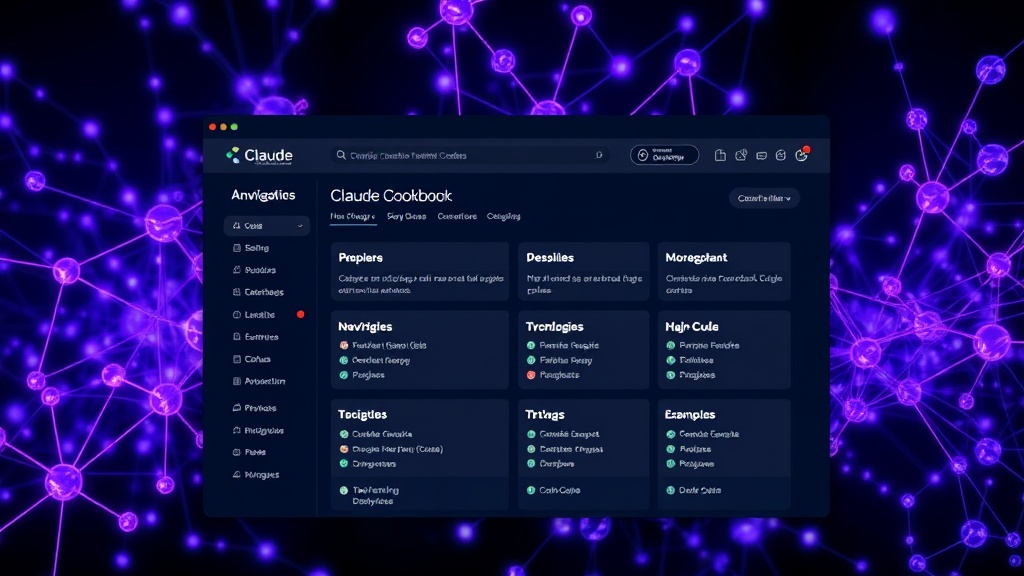
The Claude Cookbook is organized into several key sections, each focusing on different aspects of interacting with Claude. It moves beyond simple question-and-answer formats to explore more advanced use cases, such as:
- Basic Interaction: Demonstrations of how to perform fundamental tasks like summarization, extraction, and classification.
- Advanced Reasoning: Techniques for guiding Claude through complex problem-solving, including chain-of-thought prompting and logical deduction. This section is crucial for developers building applications that require sophisticated analytical capabilities.
- Creative Generation: Examples for generating various forms of content, from marketing copy and code snippets to creative writing and dialogue.
- Tool Use: Guidance on how to enable Claude to interact with external tools and APIs, expanding its functionality significantly. This is a cornerstone for integrating Claude into existing workflows and applications.
- Safety and Guardrails: Best practices for ensuring responsible AI deployment, including methods for detecting and mitigating harmful outputs.
Each example within the Cookbook includes the prompt itself, a clear explanation of the technique being used, and the expected output. This hands-on approach allows users to experiment directly and understand the nuances of prompt design. The Cookbook also emphasizes Anthropic's commitment to safety, providing examples of how to build robust and ethical AI applications.
The Importance of Prompt Engineering
Prompt engineering has emerged as a vital skill for anyone working with large language models. It's not just about asking a question; it's about structuring that question, providing context, and defining the desired output format to elicit the most accurate and useful response. Think of it less like talking to a search engine and more like briefing a highly intelligent, but literal, assistant who needs precise instructions to perform complex tasks.
The Claude Cookbook acts as a training manual for this 'assistant.' For instance, a developer looking to build a sentiment analysis tool might initially try a simple prompt like "Analyze this text: [text]". The Cookbook, however, would guide them towards more effective prompts that specify the desired output format (e.g., JSON with 'positive', 'negative', 'neutral' scores) and perhaps even provide a few examples of correctly labeled text to bootstrap Claude's understanding. This iterative refinement is the essence of good prompt engineering.
Broader Implications for AI Development
The release of the Claude Cookbook signals a maturing phase for large language models. As the technology becomes more powerful, the focus shifts from mere access to effective utilization. Resources like this are critical for democratizing AI capabilities, enabling a wider range of developers and organizations to build sophisticated applications without needing to be AI research pioneers themselves.
For founders, this means that integrating advanced AI features into their products is becoming more feasible. The Cookbook provides a clear pathway to leverage Claude for tasks ranging from customer support automation to content generation and data analysis. For security professionals, the emphasis on safety and guardrails within the Cookbook is a welcome addition, highlighting Anthropic's proactive approach to responsible AI deployment.
The availability of such detailed guides also sets a new benchmark for AI model documentation. It moves beyond technical specifications to offer practical, actionable advice. This empowers users to unlock novel applications and push the boundaries of what's possible with Claude, fostering innovation across various industries. The success of such resources will likely influence how other AI providers approach developer enablement and community building in the future.
What's Next for Claude Users?
The Claude Cookbook is not a static document; it is expected to evolve with new models and techniques. Developers are encouraged to explore its examples, adapt them to their specific needs, and contribute their own findings. The platform's structure suggests an ongoing effort to curate and share best practices, making it a living repository of knowledge for the Claude ecosystem.
This initiative underscores a broader trend in AI: the growing importance of the developer experience. As AI models become more integrated into everyday tools and workflows, the ease with which developers can learn, experiment, and build with them will be a key differentiator. Anthropic's Cookbook is a strong step in this direction, providing the essential blueprints for unlocking Claude's full potential.