
Anthropic's Public Market Ambitions
Anthropic, the AI safety and research company, is reportedly preparing for a significant move toward public markets. Sources suggest the company is eyeing an Initial Public Offering (IPO) as early as October. This potential listing comes at a critical juncture for the AI industry, characterized by rapid innovation and escalating competition. While the specifics of the IPO valuation and scale remain under wraps, the timing indicates Anthropic's readiness to leverage its advancements and market position for public investment.
The company, known for its Claude family of large language models (LLMs), has been a key player in the generative AI race. Founded by former OpenAI researchers, Anthropic has emphasized ethical AI development and safety, distinguishing itself in a field often criticized for its unchecked growth. Its flagship model, Claude, has garnered attention for its strong performance in various benchmarks and its focus on helpful, honest, and harmless AI interactions. The prospect of an IPO suggests a maturing business model and a desire to fuel further research and development through substantial capital infusion.
The Challenge from Kimi K3
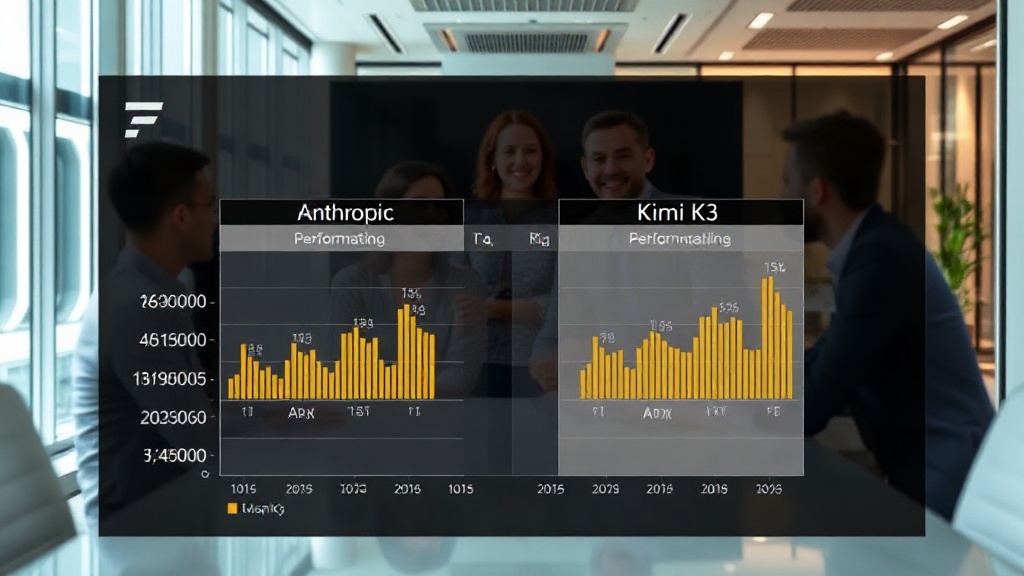
However, Anthropic's strategic positioning is being tested by emerging competitors, most notably from China. The recent performance of Kimi K3, developed by Moonshot AI (a Beijing-based startup), has drawn considerable attention. Reports indicate that Kimi K3 has surpassed Claude in certain benchmarks, particularly those involving long context windows and complex reasoning tasks. This development is significant, as the ability to process and understand extensive amounts of text is becoming a crucial differentiator in LLM capabilities.
Kimi K3's advancements, especially its claimed ability to handle context windows of up to 2 million tokens, position it as a formidable contender. For many developers and researchers, the capacity to feed and analyze massive documents, codebases, or entire books into an AI model without losing coherence is a game-changer. This capability opens up new avenues for applications in legal document review, scientific research, and complex software development. The rapid progress of models like Kimi K3 underscores the global nature of AI development and the intense pressure on Western AI labs to maintain their lead.
Market Dynamics and Investor Sentiment
The AI sector has seen unprecedented investor interest, with companies like OpenAI, Midjourney, and Anthropic itself attracting billions in funding. However, the market is also becoming increasingly crowded, and investor expectations are sky-high. For Anthropic, a successful IPO would not only provide capital but also validate its valuation and business strategy against a backdrop of intense scrutiny. The company's ability to demonstrate a clear path to profitability and sustained technological advantage will be paramount.
The rise of Kimi K3 also signals a shifting geopolitical landscape in AI. While US-based companies have largely dominated headlines, Chinese AI firms are rapidly closing the gap and, in some areas, taking the lead. This competition is not just about technological prowess; it also reflects different approaches to AI development, data governance, and market penetration. For global investors, understanding these dynamics is crucial. The success of Kimi K3 suggests that the future of AI will be a multi-polar one, with significant innovation emerging from various global hubs.
What This Means for the AI Landscape
Anthropic's potential IPO in October, juxtaposed with the impressive performance of Kimi K3, highlights several key trends. Firstly, the pace of innovation in LLMs is accelerating, with new capabilities and benchmarks emerging at an astonishing rate. Secondly, the competitive landscape is becoming increasingly global, with China emerging as a significant force. This global competition is likely to spur further advancements and potentially lead to greater specialization in AI models tailored to different market needs and regulatory environments.
For developers, the implications are clear: access to a wider array of powerful AI models, each with its own strengths and weaknesses. The ability to choose the best model for a specific task—whether it's long-context understanding, creative text generation, or coding assistance—will become increasingly important. The ongoing advancements from both established players like Anthropic and rising stars like Moonshot AI ensure that the tools available to build the next generation of AI-powered applications will continue to evolve rapidly.
The question for the industry is how this intensified competition and the emergence of strong regional players will shape the future of AI development and deployment. Will it lead to greater fragmentation or foster new forms of collaboration? What nobody has fully addressed yet is the long-term impact of these regional AI ecosystems on global interoperability and the potential for AI governance standards to diverge significantly.