Cutting LLM Prefix Computation Costs on Mobile
Local Large Language Model (LLM) inference on devices like Android phones suffers from a performance bottleneck: redundant computation of already-processed input prefixes. Every time an LLM processes a prompt, system message, retrieved document, or few-shot example, it performs a costly "prefill" operation to generate the Key-Value (KV) cache state for that prefix. If the same prefix is encountered again, this prefill step is repeated, wasting processing power and increasing Time To First Token (TTFT).
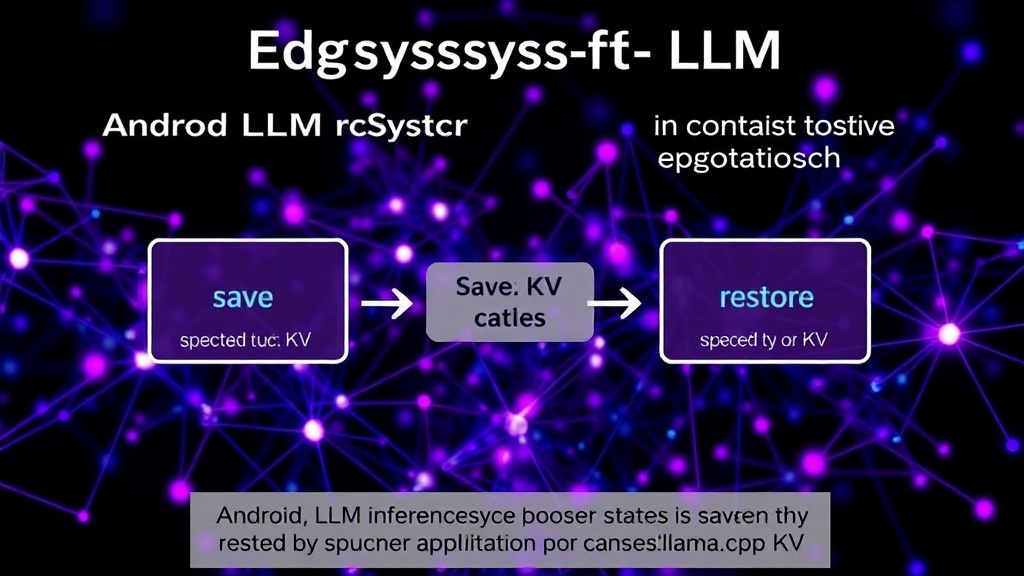
This is precisely the problem tackled by EdgeSync-LLM, a technique that enables the reuse of KV cache states across multiple inference requests. The core idea is simple: when a prompt consists of a shared prefix and a new suffix, the system can avoid recomputing the prefix. On the initial request, the prefix is processed, and its resulting KV cache state is saved. For subsequent requests that use the exact same prefix, the saved state is restored, and the LLM only needs to process the new suffix. This dramatically reduces the computational overhead.
Crucially, this optimization does not require forking or patching the llama.cpp library. Instead, it leverages the existing public APIs: llama_state_seq_get_data to retrieve the KV cache state and llama_state_seq_set_data to restore it. This makes the implementation significantly more accessible and maintainable for developers working with llama.cpp on embedded systems.
Performance Gains on a Real Android Device
To validate the effectiveness of this approach, measurements were conducted on a real Android ARM64 phone. The test setup utilized the Qwen2.5-0.5B-Instruct model, quantized to Q4_K_M. A shared prefix of 123 tokens was used across 40 inference requests. The inference was configured to use 4 threads, and a release build of the application was employed to ensure performance reflected real-world conditions.
The results demonstrated a substantial reduction in TTFT. While the exact p50 (50th percentile) TTFT figures are not fully detailed in the excerpt, the claim of achieving a "9.9x lower TTFT" implies a significant speedup. This type of optimization is critical for delivering responsive LLM experiences on resource-constrained mobile devices, where latency directly impacts user perception and engagement.
The implications extend beyond simple speed improvements. Faster inference means LLMs can be used more effectively in interactive applications, such as real-time chatbots, on-device summarization tools, or intelligent assistants. By minimizing the prefill cost, the model can dedicate more resources to generating the actual output, leading to a more fluid and natural user experience. This approach is akin to a chef preparing common ingredients in advance for multiple dishes, rather than chopping the same vegetables from scratch for every single order. The saved time and effort allow for quicker service and better overall efficiency.
Broader Implications for Edge AI
The success of EdgeSync-LLM highlights a critical area for optimization in edge AI: state management. As LLMs become more capable and are deployed on a wider range of devices, efficient handling of context and computation becomes paramount. Techniques that reduce redundant work, especially for common or repeated patterns, offer a clear path to better performance and reduced power consumption.
This method is particularly relevant for applications involving Retrieval Augmented Generation (RAG), where a user's query often shares common context with previously processed queries or documents. By caching and reusing the KV state of retrieved documents, the system can quickly append the new query and generate a relevant response without re-processing the entire document. Similarly, for chatbots that maintain a conversation history, reusing the KV state of past turns can significantly speed up responses.
The reliance on public llama.cpp APIs is a significant advantage. It means that this optimization can be integrated into existing projects without the need for complex modifications to the core inference engine. Developers can focus on application-level logic to manage the caching and restoration of KV states. This democratizes access to performance gains, allowing a broader range of developers to implement efficient LLM inference on mobile and other edge devices.
What remains to be explored is the scalability of this approach with larger models and longer prefixes. While the Qwen2.5-0.5B model and a 123-token prefix show promising results, understanding the memory overhead and potential performance degradation with significantly larger KV caches is essential for widespread adoption. Furthermore, the impact of different quantization methods and hardware architectures on the effectiveness of KV state reuse warrants further investigation.