The Energy Drain of Digital AI
The insatiable hunger of modern artificial intelligence for computational power has created an energy crisis. Training and running large AI models consume vast amounts of electricity, straining power grids and contributing to carbon emissions. This reality is forcing a re-evaluation of traditional computing paradigms, pushing researchers and engineers to explore alternatives that offer greater energy efficiency. One such alternative, long considered a promising but flawed concept, is analog computing, specifically for AI workloads.
Analog Computing: A Physics-Based Approach
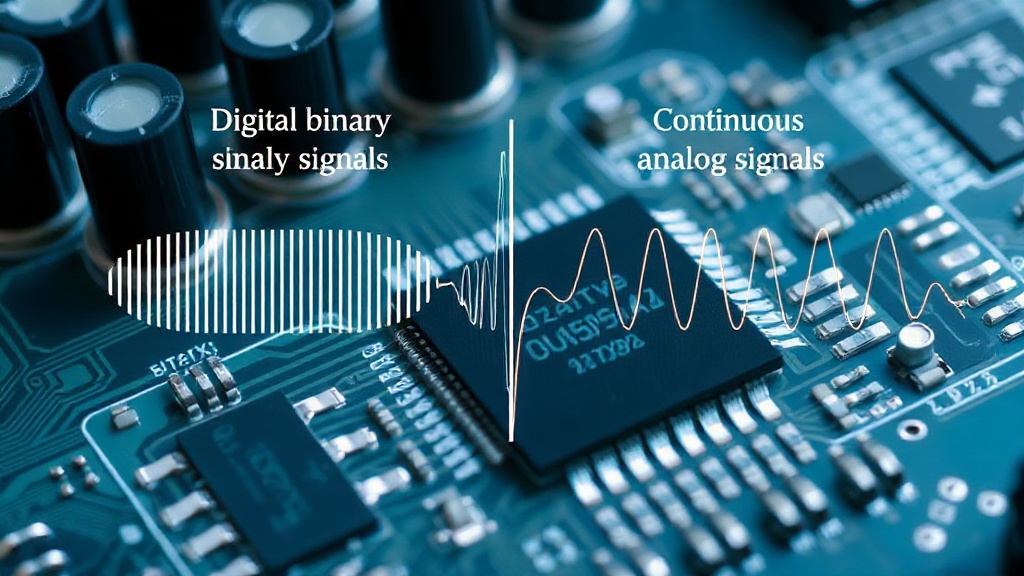
Analog computing operates on a fundamentally different principle than the digital computing that dominates today's technology. Instead of representing data as discrete binary digits (0s and 1s), analog systems use continuous physical quantities, such as voltage or current, to represent information. For AI, this translates to using the physical properties of electronic components, like transistors, to perform computations directly. For instance, the resistance of a material or the charge stored in a capacitor can directly represent the weights and activations in a neural network. This approach bypasses the need for energy-intensive digital-to-analog and analog-to-digital conversions inherent in current AI hardware.
The Promise of Energy Efficiency
The primary allure of analog AI is its potential for dramatic energy savings. Digital processors, with their discrete logic gates switching on and off, require significant power. Analog circuits, by mimicking physical phenomena, can perform computations with orders of magnitude less energy. This is crucial for deploying AI at the edge, in devices with limited power budgets, and for scaling up massive AI data centers more sustainably. Imagine a future where complex AI tasks can run on a smartphone for days, or where AI-powered sensors can operate autonomously for years without recharging. This is the vision analog AI promises.
The Persistent Problem of Noise
However, analog computing has a critical Achilles' heel: noise. In analog systems, every component is susceptible to small, random fluctuations in its physical state. These fluctuations, collectively known as noise, can corrupt the continuous signals representing data, leading to computational errors. Historically, this inherent noisiness was a major hurdle that prevented analog computers from achieving the precision and reliability required for many tasks, particularly complex computations like those found in AI. While digital systems can employ error correction codes to mitigate noise, the continuous nature of analog signals makes such corrections far more challenging.
Simulating Noise: A Path to Robustness?
Recognizing that noise is an unavoidable characteristic of analog hardware, researchers are now exploring strategies to not only tolerate but also leverage this phenomenon. One approach involves developing advanced simulation techniques to accurately model and predict the impact of noise on analog AI computations. By understanding the precise nature and magnitude of noise in a given analog circuit, it becomes possible to design AI models that are more robust to these imperfections. This could involve training AI models with simulated noise injected into their parameters, essentially teaching them to perform reliably despite inherent hardware inaccuracies.
The Trade-off: Accuracy vs. Efficiency
This pursuit of noise resilience inevitably leads to a fundamental trade-off: accuracy versus efficiency. To achieve higher accuracy in the face of noise, one might need to employ more complex analog circuits, potentially increasing power consumption, or use larger, more redundant systems, diminishing some of the initial efficiency gains. Conversely, pushing for maximum energy efficiency might mean accepting a certain level of computational error. The challenge for analog AI is to find the optimal balance point where the energy savings are substantial enough to be worthwhile, without sacrificing the accuracy required for practical AI applications. This is akin to tuning a sensitive instrument; too much fiddling can introduce unintended distortions.
What Happens When Noise Wins?
The critical question remains: can analog AI truly overcome its intrinsic noise problem to become a viable alternative to digital computing for AI? If noise proves too pervasive, or if the methods to combat it negate the energy advantages, the resurgence of analog AI could be short-lived. The success of this technology hinges on developing novel circuit designs, robust training methodologies, and potentially entirely new AI architectures that are inherently resilient to analog imperfections. The path forward requires not just innovation in hardware but also a deep understanding of the interplay between physical computation and algorithmic robustness. Without this, analog AI risks becoming an interesting theoretical concept rather than a practical solution to the energy crisis in AI.