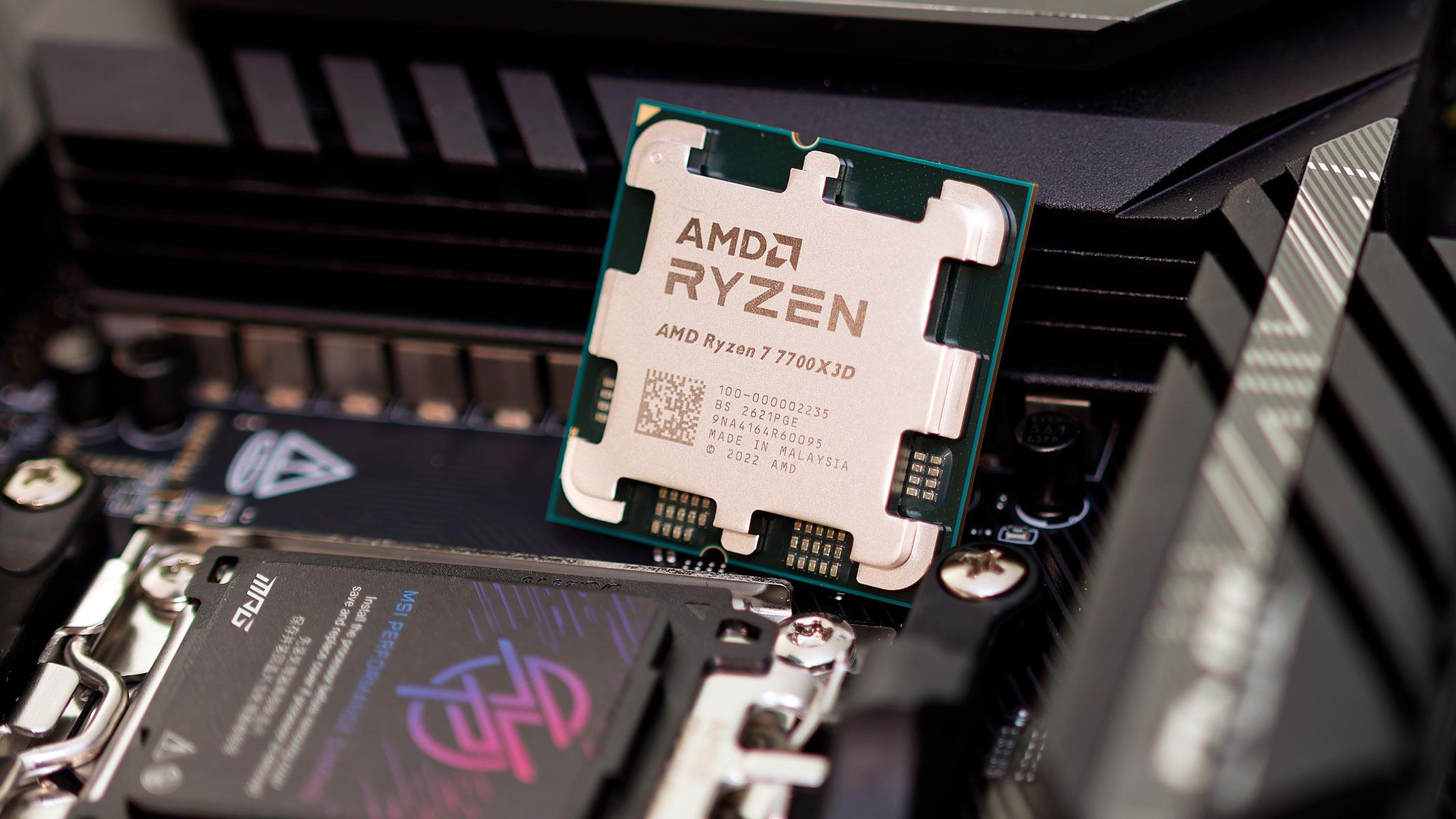
Introducing the Ryzen 7 7700X3D
AMD has extended its 3D V-Cache technology, previously reserved for its flagship Ryzen 9 processors, to a more mainstream offering with the Ryzen 7 7700X3D. This new chip aims to democratize high-end gaming performance by bringing the benefits of its massive L3 cache to a lower price point. For gamers seeking a significant uplift in frame rates without resorting to the top-tier Ryzen 9 7950X3D or 7900X3D, the 7700X3D presents a compelling argument.
At its core, the 7700X3D is a derivative of the Ryzen 7 7700X, but with a crucial addition: AMD's 3D V-Cache technology. This involves stacking an additional 64MB of L3 cache directly on top of one of the CPU's two Core Complex Dies (CCDs). The result is a substantial increase in total L3 cache, bringing the 7700X3D's cache capacity to a massive 96MB (32MB on the base CCD + 64MB on the V-Cache enabled CCD). This is in stark contrast to the standard 7700X's 32MB L3 cache.
The unique implementation of 3D V-Cache on the 7700X3D means that only one of its two CCDs is enabled for this cache expansion, while the other remains a standard CCD. This design choice is critical for managing power consumption and heat, as well as for optimizing performance. AMD's approach typically involves directing games and applications to the CCD with the larger cache, while the other CCD can be used for general system tasks or other workloads. This hybrid design is key to achieving both gaming prowess and reasonable efficiency.
Performance: Gaming Nirvana for Less
The primary draw of the Ryzen 7 7700X3D is its gaming performance, and in this regard, it largely delivers. Thanks to the gargantuan L3 cache, games that are sensitive to cache latency and size see dramatic improvements in frame rates. This is particularly noticeable in CPU-bound scenarios, where the processor is the bottleneck. Titles that benefit from the 3D V-Cache include many popular esports games and AAA titles that push the limits of current hardware.
Compared to its non-3D V-Cache sibling, the Ryzen 7 7700X, the 7700X3D often pulls ahead by a significant margin in gaming benchmarks. In some titles, the uplift can be as high as 20-30%, putting it in contention with, or even surpassing, more expensive CPUs. This performance leap is not universal; games that are not heavily reliant on cache size or are already GPU-bound will show smaller gains, but the overall gaming experience is undeniably smoother and more robust.
What makes the 7700X3D particularly interesting is its positioning against the higher-end Ryzen 9 7950X3D and 7900X3D. While those chips offer more cores, the 7700X3D's gaming performance, particularly in single-CCD-benefiting scenarios, can be remarkably close. This suggests that for a purely gaming-focused build, the 7700X3D offers a more cost-effective route to elite-level frame rates. The surprise here is not that 3D V-Cache works wonders, but that AMD has managed to bring this level of gaming performance into a more accessible segment of the market, challenging the notion that top-tier gaming requires a top-tier price tag.
Productivity and Efficiency Considerations
While the 7700X3D is engineered with gaming as its priority, its performance in productivity tasks is also worth examining. With eight Zen 4 cores, it remains a capable processor for everyday tasks, content creation, and moderate multitasking. However, the trade-offs made for 3D V-Cache become apparent here. The 7700X3D features lower clock speeds compared to the standard 7700X, especially on the V-Cache enabled CCD, which can result in slightly lower performance in heavily threaded productivity applications that don't benefit from the extra cache.
The hybrid CCD design, where one CCD has 3D V-Cache and the other does not, requires careful management by the operating system and drivers. AMD's chipset drivers and Windows' scheduler work in tandem to direct gaming workloads to the V-Cache CCD and other tasks to the standard CCD. This ensures that users don't sacrifice too much productivity performance while still reaping the gaming benefits. In benchmarks, the 7700X3D generally falls between the 7700X and the standard Ryzen 7 7800X3D (which uses a single CCD with 3D V-Cache, offering a more unified approach for gaming). For users who primarily game but also dabble in content creation, the 7700X3D offers a balanced compromise.
Power consumption is another area where the 7700X3D shows its strengths. By design, the 3D V-Cache technology, especially when implemented on a single CCD, tends to be more power-efficient during gaming workloads than higher-clocked, non-cached CPUs. This means that while it delivers exceptional gaming performance, it does so without necessarily demanding an exorbitant amount of power, making it a viable option for builds where thermal management is a concern, or for those who prefer a more energy-conscious system.
Platform and Pricing
The Ryzen 7 7700X3D utilizes the AM5 platform, benefiting from support for DDR5 memory and PCIe 5.0. This ensures that users are building on a modern and future-proof platform, capable of handling the latest in storage and graphics technology. Motherboard compatibility is broad, with B650 and X670 chipsets being common choices for AM5 builds. The platform's longevity, with AMD promising support through at least 2025, is a significant advantage for those looking to upgrade components down the line without needing a new motherboard.
Pricing is where the 7700X3D truly shines. Positioned below the flagship Ryzen 9 models with 3D V-Cache, it offers a more palatable entry point for gamers who want the absolute best gaming performance without breaking the bank. This strategic pricing makes it a direct competitor to high-end Intel offerings and a significant upgrade path for users coming from older generations of AMD or Intel CPUs.
Conclusion: A Smart Choice for Gamers
The AMD Ryzen 7 7700X3D is a calculated move by AMD to broaden the appeal of its 3D V-Cache technology. It successfully translates the gaming performance benefits of its higher-end brethren into a more accessible package. For gamers who prioritize frame rates and smooth gameplay above all else, and whose primary workload consists of gaming, this CPU is an excellent choice. It offers a potent blend of cutting-edge gaming performance, modern platform support, and competitive pricing. While it may not be the absolute fastest CPU for every productivity task, its gaming prowess and overall efficiency make it a standout option in the current CPU market.
The question that remains is how this fits into AMD's broader strategy. By offering a strong gaming performer at a lower tier, AMD might be aiming to capture a larger share of the gaming PC market, potentially drawing users away from competitors who cannot match the specific gaming uplift provided by 3D V-Cache. The success of the 7700X3D could also signal a future where 3D V-Cache becomes a more common feature across AMD's CPU lineups, further solidifying their gaming performance leadership.