
AMD's Latest Budget CPUs Emerge Above Suggested Retail Price
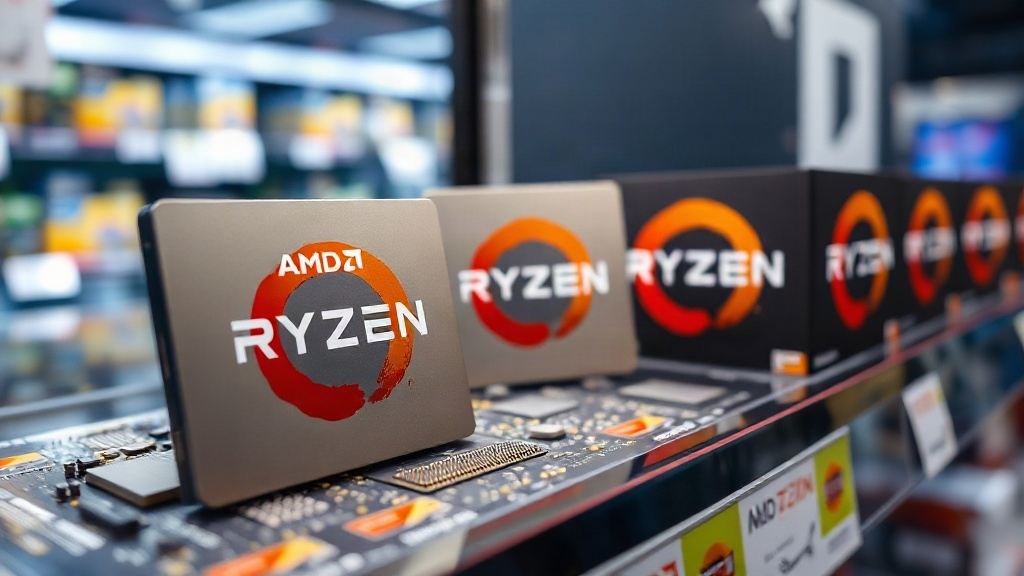
AMD's Ryzen 5 5500F and Ryzen 5 7500 processors, announced nearly two weeks ago, have now appeared at various retailers. However, potential buyers are finding that these budget-oriented CPUs are not adhering to their suggested retail prices (MSRP). Both processors are consistently listed for approximately $20 above their official MSRP, a notable increase for components aimed at cost-conscious builders. This pricing anomaly is occurring even with first-party sellers and major online retailers, suggesting a broader market dynamic at play rather than isolated incidents.
The Ryzen 5 5500F is officially priced at $99, but its retail availability sees it listed around $119. Similarly, the Ryzen 5 7500, which carries an MSRP of $129, is also appearing on shelves for roughly $149. This situation presents a challenge for consumers looking to build or upgrade entry-level to mid-range systems, as the very CPUs designed for affordability are becoming less accessible. The availability of these processors, particularly the 5500F which appears to be a tray-only variant without a cooler, further complicates the value proposition for builders who might need to factor in additional cooling costs.
Understanding the Ryzen 5 5500F and 7500
The Ryzen 5 5500F is a Zen 3-based processor, essentially a cut-down version of the Ryzen 5 5600. It features 6 cores and 12 threads, with a base clock of 3.6 GHz and a boost clock of up to 4.2 GHz. Crucially, it lacks integrated graphics, making it a CPU-only solution that requires a discrete graphics card. This design is typical for AMD's 'F' suffix processors, which are often targeted at markets where discrete GPUs are already a given, such as DIY PC building or system integrators.
The Ryzen 5 7500, on the other hand, is part of AMD's newer Zen 4 architecture, belonging to the Ryzen 7000 series. It also offers 6 cores and 12 threads, with a base clock of 3.2 GHz and a boost clock reaching up to 5.0 GHz. Unlike the 5500F, the 7500 includes integrated RDNA 2 graphics, making it a more versatile option for users who might not immediately pair it with a discrete GPU or who prioritize a simpler build. However, its reliance on the AM5 platform means it requires a newer, and often more expensive, motherboard and DDR5 RAM, which can offset some of the cost savings compared to older platforms.
Market Dynamics and Pricing Pressures
The consistent $20 price hike above MSRP for both the Ryzen 5 5500F and 7500 suggests that current market demand is outstripping immediate supply, or that retailers are capitalizing on the demand for more affordable CPU options. This phenomenon is not entirely new in the PC hardware space, where component availability and pricing can fluctuate significantly based on manufacturing output, geopolitical factors, and consumer purchasing trends. The recent resurgence in PC building, driven by factors such as the ongoing trend of remote work and a desire for more capable home entertainment systems, has put pressure on the supply chains of essential components like CPUs.
For consumers, this means that building a budget PC might now require a larger investment than initially anticipated. The $20 premium, while seemingly small on a high-end component, represents a significant percentage increase for a sub-$150 CPU. For the Ryzen 5 5500F, a $99 part now costing $119 is a 20% increase. For the Ryzen 5 7500, a $129 part at $149 is nearly a 16% increase. This can force builders to make compromises elsewhere in their system, potentially opting for slower RAM, a less capable motherboard, or a smaller storage drive, thereby impacting the overall performance and user experience of the final build.
The Unanswered Question of Supply Chain Predictability
What remains unclear is whether this pricing is a temporary market reaction or indicative of a more persistent supply constraint for AMD's budget offerings. If it's the former, prices may normalize as more stock becomes available. If it's the latter, consumers might face a prolonged period of elevated pricing for entry-level processors. This unpredictability makes it difficult for system integrators and individual builders to plan their purchases and budget effectively. The situation highlights the delicate balance in the semiconductor market, where even the most anticipated budget components can become victims of supply and demand dynamics, leaving consumers to pay a premium.
The availability of the Ryzen 5 5500F as a tray-only option, as reported, adds another layer of complexity. This typically means it's intended for system builders who will bundle it with other components and potentially a cooler. However, with its retail appearance, individual consumers are left to source their own cooling solution, which adds to the total cost of ownership. For a CPU positioned at the lower end of the market, this extra expenditure can be a significant deterrent. The Ryzen 5 7500, while potentially including a cooler, still faces the platform cost barrier of AM5 and DDR5 memory.
Ultimately, the emergence of these CPUs above MSRP underscores the ongoing challenges in the PC hardware market. While AMD continues to expand its processor lineup, ensuring that these components are accessible at their intended price points is crucial for maintaining a healthy ecosystem of builders and consumers seeking value. The current situation forces a reassessment of what constitutes a 'budget' PC build, as the cost of core components like the CPU is creeping upwards, potentially pushing more users towards older, less performant, or even competitor offerings.