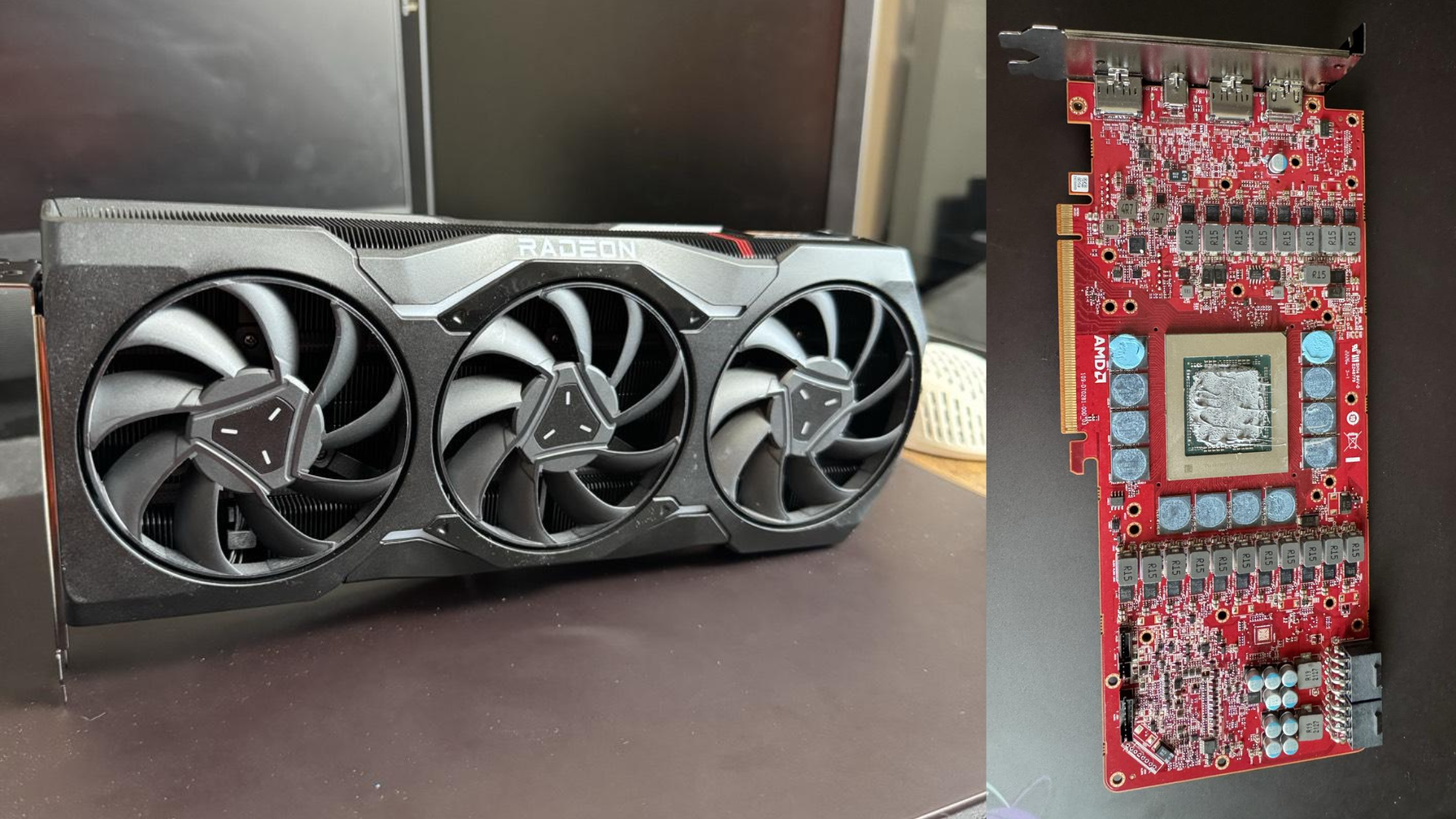
An Unidentified AMD GPU Emerges
A peculiar engineering sample, potentially for AMD's Radeon RX 7900 XTX, has surfaced online, sparking intrigue within the PC hardware community. This prototype, characterized by its distinctive red Printed Circuit Board (PCB) and the absence of a backplate, presents a configuration that deviates from typical retail designs. More significantly, its specifications appear to align closely with those of the Radeon RX 7900 GRE, a card positioned below the original 7900 XTX in AMD's RDNA 3 lineup. This discovery suggests the existence of a binned-down version of the flagship GPU, possibly intended for specific market segments or as a testbed for future configurations.
The engineering sample was reportedly acquired from a third-party seller, and its unique attributes have led to speculation about its origin and purpose. The red PCB is a notable departure from AMD's usual design aesthetics, which often favor black or darker hues for their high-end graphics cards. The lack of a backplate, a common feature on modern GPUs for structural support and thermal management, further sets this sample apart. These omissions might indicate an early-stage prototype where cosmetic and final structural elements were not yet finalized, or they could point to a specific cost-optimization strategy for a particular market.
Matching the RX 7900 GRE
The most compelling aspect of this discovery is the apparent alignment of the sample's specifications with the Radeon RX 7900 GRE. While detailed specifications of the engineering sample are not fully public, available information indicates it features a Navi 31 GPU. The key differentiator appears to be the memory configuration and potentially the number of enabled Compute Units (CUs). The RX 7900 GRE, for context, utilizes a cut-down Navi 31 XT GPU, featuring 5120 stream processors and 16GB of GDDR6 memory on a 256-bit bus, with a memory bandwidth of 576 GB/s. It also typically comes with a Game Clock of 2055 MHz and a Boost Clock of 2333 MHz.
If this engineering sample indeed matches the GRE's specifications, it implies that AMD may have explored or developed a variant of the 7900 XTX that utilized a partially disabled Navi 31 chip. This practice, known as 'binning,' is standard in semiconductor manufacturing. It involves segmenting chips based on their performance and defect rates. Higher-performing chips are sold as top-tier products (like the original RX 7900 XTX), while those with minor defects or lower clock speed ceilings are repurposed for lower-tier models (like the RX 7900 GRE). This particular sample, if it is indeed a 7900 XTX engineering board, suggests that early silicon might have been binned down to GRE-level performance, perhaps to test yields or explore different product tiers.
Custom VBIOS and Future Implications
Adding another layer of intrigue, the sample reportedly comes with a custom Video BIOS (VBIOS). A VBIOS contains the firmware that controls the graphics card's basic functions, including clock speeds, power limits, and fan curves. A custom VBIOS on an engineering sample often signifies that the card was intended for internal testing and validation, possibly with specific performance targets or thermal profiles that differ from retail versions. It could also indicate an attempt to test different power delivery configurations or memory timings.
The existence of such a prototype raises several questions about AMD's product development strategy for the RDNA 3 architecture. Was this a planned product that was ultimately shelved, or is it a precursor to a potential refresh or a new SKU? The RX 7900 GRE was initially launched as a China-exclusive model before seeing broader availability, suggesting AMD is open to market-specific SKUs. This engineering sample could represent an earlier iteration of that strategy, or perhaps an attempt to create a more accessible 'XTX' branded card by using binned silicon. The lack of a backplate, while unusual for a high-end card, might have been a cost-saving measure for a specific market segment where extreme overclocking or demanding thermal loads are less common.
Contextualizing the Discovery
The timing of this revelation is also noteworthy. AMD's RDNA 3 architecture, which powers the RX 7000 series, has been on the market for some time. Engineering samples typically surface much earlier in a product's lifecycle. However, the presence of a 'never-before-seen' sample suggests it might have been held back or was part of a very early, perhaps abandoned, development path. It's possible this sample was created to explore the performance ceiling of the Navi 31 chip when binned down, or to test the viability of a lower-cost high-end card using less-than-perfect silicon. The GPU market is highly competitive, and AMD has historically experimented with various SKUs to capture different market segments and price points. This sample could be another piece of evidence in that ongoing strategy.
For enthusiasts and potential buyers, this discovery doesn't immediately change the current market offerings. However, it provides a fascinating glimpse into the engineering process and the potential product variations that AMD considers. It underscores the fact that many GPUs are not monolithic designs but rather variations on a theme, with performance and features carefully curated through binning and firmware. The question remains: what was the ultimate purpose of this specific engineering sample, and did it influence any subsequent product decisions? Without further information from AMD, it remains a curious artifact of GPU development.