M5Stack Unveils PaperMono: A New E-Ink Terminal for Connected Projects
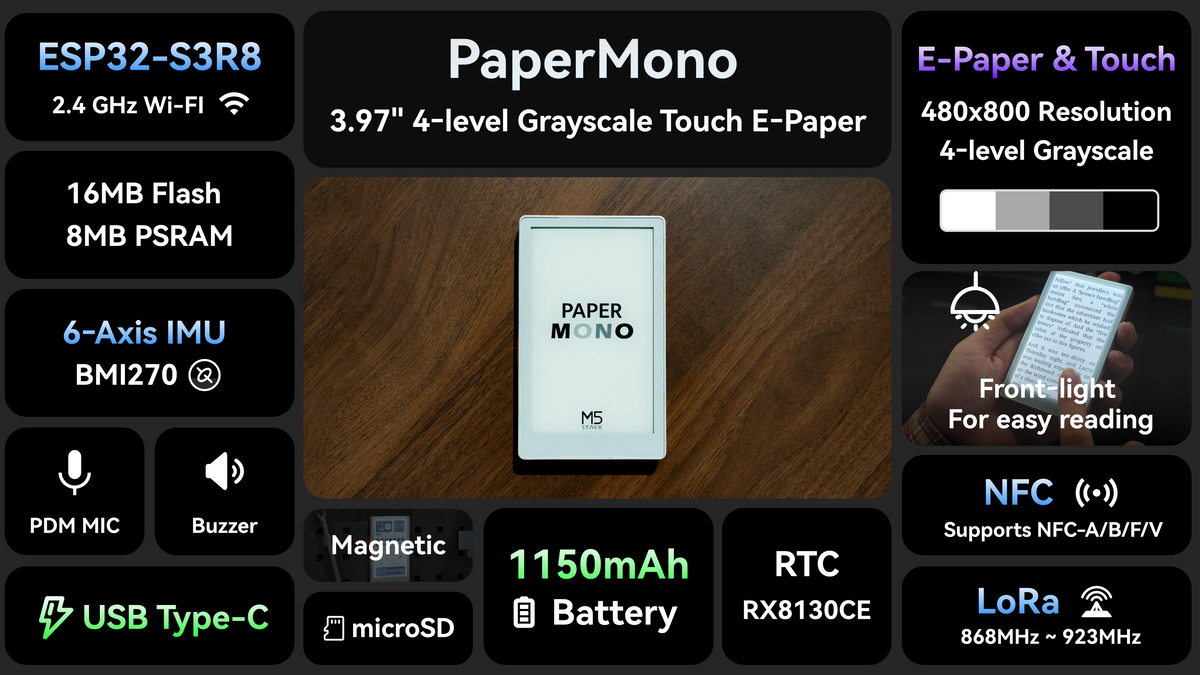
M5Stack, a company known for its modular development kits, has launched PaperMono, a compact development terminal featuring an E-Ink display. This device is designed for developers building connected projects that require an always-on, low-power display. The PaperMono aims to bridge the gap between simple microcontrollers and more complex, power-hungry embedded systems, offering a unique form factor for a variety of IoT applications. At its core, the PaperMono is powered by the Espressif ESP32-S3 chip, a dual-core processor with Wi-Fi and Bluetooth connectivity. This makes it suitable for a wide range of wireless communication tasks, from sending sensor data to receiving updates. The standout feature, however, is its 1.54-inch E-Ink display. Unlike traditional LCD or OLED screens, E-Ink consumes power only when the display content changes, making it ideal for battery-powered devices or applications where power efficiency is paramount. This characteristic is particularly beneficial for projects that need to display information continuously without draining the battery quickly, such as smart home status indicators, simple data loggers, or even minimalist digital signage.
Technical Specifications and Design Philosophy
The PaperMono’s design prioritizes portability and low power consumption. Its compact form factor makes it easy to embed into existing products or carry as a standalone device. The 1.54-inch E-Ink screen offers a resolution of 200x200 pixels, providing sufficient detail for text and simple graphics. The monochrome nature of E-Ink displays, typically black and white or black, white, and red, is a trade-off for extreme power efficiency and excellent readability in bright light conditions, mimicking the appearance of paper. Beyond the ESP32-S3 and the E-Ink display, the PaperMono includes essential components for development. It features a USB Type-C port for programming and power, a reset button, and a boot button for firmware updates. While specific details on battery capacity or expected battery life are not extensively detailed in the initial announcement, the inherent low power draw of E-Ink suggests that users can expect extended operational periods on a single charge, especially for applications with infrequent screen updates. The inclusion of GPIO pins allows for expansion, enabling users to connect external sensors, buttons, or other electronic components to customize the device's functionality. The choice of the ESP32-S3 is significant. This microcontroller offers a powerful platform with integrated Wi-Fi and Bluetooth, enabling seamless connectivity to the internet or local networks. Developers can leverage these capabilities to create applications that fetch data from cloud services, connect to mobile apps, or communicate with other IoT devices. The ESP32-S3 also supports hardware acceleration for AI and machine learning tasks, opening up possibilities for more intelligent edge devices, though the PaperMono's primary focus appears to be on information display.Target Applications and Use Cases
M5Stack positions the PaperMono as a versatile tool for a variety of connected projects. Its low-power, always-on display makes it suitable for applications where constant visibility is required without significant power cost. Potential use cases include:- Smart Home Dashboards: Displaying room temperature, humidity, device status, or upcoming calendar events.
- Inventory Management: Small shelf labels that can be updated wirelessly to show stock levels or pricing.
- Asset Tracking: Attaching PaperMono devices to equipment to display their current status, location, or maintenance history.
- Environmental Monitoring: Small, battery-powered units that report local weather conditions or air quality data.
- Personal Information Displays: Minimalist clocks, to-do lists, or notification panels.
- Educational Tools: A simple platform for learning about microcontrollers, E-Ink technology, and IoT development.