The Challenge: Controlled Progressive Deployments on EKS
Building a robust Kubernetes deployment strategy on AWS EKS demands more than just pushing code. The technical challenge was to architect a system from the ground up for gradual, controlled application deployment across two distinct fronts simultaneously. This involves not only managing rollouts within individual deployment units but also orchestrating promotion between these units with precision.
The core requirement was a GitOps-native approach, leveraging tools like ArgoCD and Argo Rollouts for progressive delivery. This meant treating infrastructure and application configurations as code, managed through Git, and automatically reconciled by ArgoCD on the EKS cluster. The goal was to achieve Canary Releases within each deployment shard and controlled promotion across shards, potentially involving manual approvals or automated decision-making based on observed metrics.
Architecture Overview: GitOps, Canary, and Shard Promotion
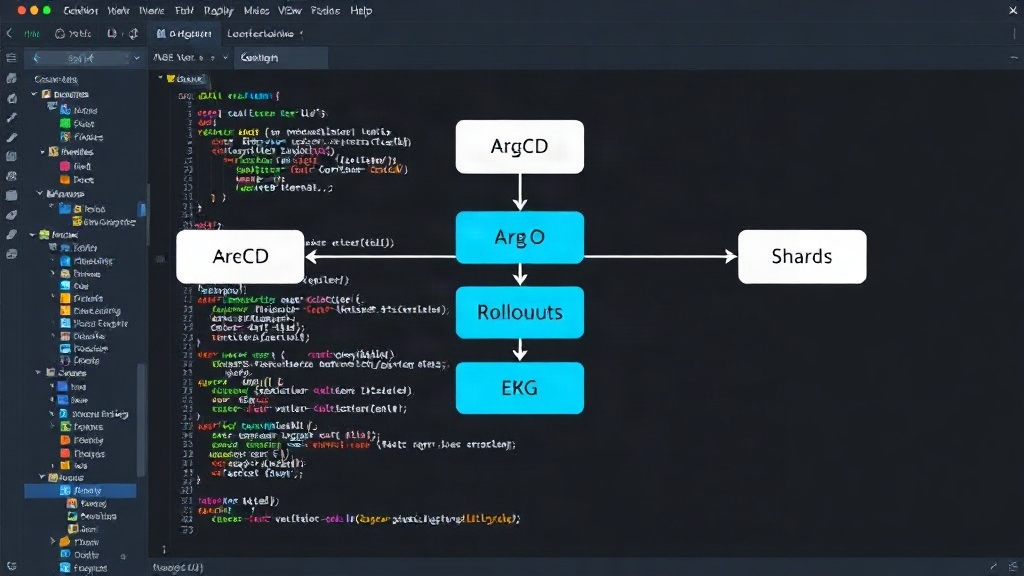
This practical laboratory setup demonstrates a comprehensive progressive deployment pipeline. It integrates Amazon EKS Auto Mode, Argo Workflows, Amazon Elastic Container Registry (ECR), and Amazon CloudWatch. The architecture is designed to isolate deployment environments (shards) and manage application updates through a series of controlled steps.
At its heart, the system relies on ArgoCD for continuous delivery. Developers push application code and configuration changes to Git repositories. ArgoCD monitors these repositories and automatically synchronizes the desired state to the EKS cluster. Argo Rollouts takes over the deployment process itself, enabling sophisticated strategies like Canary deployments. This allows for a small percentage of traffic to be directed to the new version, with automated or manual verification steps before a full rollout.
Implementing Isolated Shards
The concept of isolated shards is crucial for risk mitigation. Instead of deploying a new version to the entire production environment at once, the system deploys to a specific shard first. This shard acts as a controlled environment to test the new release under real-world conditions but with a limited blast radius. If the deployment to this shard is successful, as indicated by monitoring and potentially automated checks, the process can then be extended to other shards.
This isolation is achieved through Kubernetes namespaces, potentially augmented with network policies and RBAC to ensure strict separation. Each shard can represent a distinct deployment target, such as a specific region, a subset of users, or a staging-like environment within production. ArgoCD is configured to manage deployments to these specific namespaces, ensuring that changes are applied only where intended.
Canary Releases within Shards
Within each isolated shard, Argo Rollouts manages the progressive rollout of the application. A typical Canary strategy involves deploying a new version alongside the stable version. Traffic is then gradually shifted to the new version using ingress controllers or service meshes that support advanced traffic splitting capabilities. Metrics such as error rates, latency, and business-specific KPIs are continuously monitored.
Argo Rollouts integrates with monitoring tools like CloudWatch. Automated analysis of these metrics can trigger automated rollbacks if the new version exhibits degraded performance or increased error rates. Alternatively, the system can pause the rollout, awaiting manual approval from an operator or QA team before proceeding. This step-by-step traffic shifting and verification process minimizes the impact of faulty deployments.
Controlled Promotion Between Shards
The ultimate goal is to promote a stable release across all production shards. This is where the second layer of controlled deployment comes into play. Once a new version has been successfully deployed and validated in the first shard, the system facilitates its promotion to subsequent shards.
This promotion can be automated, for instance, by Argo Workflows triggering the next stage of the deployment pipeline once the validation in the previous shard passes. It can also incorporate a manual approval gate. This ensures that a human operator reviews the state of the application in the initial shard before authorizing its deployment to the rest of the production environment. This layered approach, combining intra-shard Canary releases with inter-shard promotion, provides a high degree of confidence in new releases.
Leveraging Argo Workflows for Automation
Argo Workflows plays a vital role in orchestrating complex deployment and promotion processes. It can be used to define custom workflows that include steps for building container images in ECR, running integration tests, performing automated analysis of monitoring data from CloudWatch, and triggering Argo Rollouts to deploy to specific shards. For the inter-shard promotion, Argo Workflows can manage the sequence of deployments, including waiting for manual approvals or executing automated checks before proceeding to the next shard.
This workflow automation is key to achieving a truly GitOps-driven, progressive delivery pipeline. By defining these complex sequences as code within Git, the entire deployment process becomes auditable, repeatable, and version-controlled. It bridges the gap between code commits and stable, production-ready applications across distributed environments.
Observability with CloudWatch
Effective progressive deployment hinges on robust observability. Amazon CloudWatch is essential for collecting and analyzing application and cluster metrics. During Canary deployments, detailed metrics on request latency, error rates (e.g., HTTP 5xx), resource utilization (CPU, memory), and application-specific custom metrics are critical. Argo Rollouts leverages these metrics to make informed decisions about advancing or rolling back a deployment.
For the inter-shard promotion, aggregated metrics from CloudWatch can provide insights into the overall health and performance of the application across different shards. This data informs the decision-making process, whether it's an automated decision by Argo Workflows or a manual review by an operations team. Ensuring that logs and metrics are consistently captured and accessible across all shards is paramount for identifying and resolving issues quickly.
The Broader Impact: Resilient and Reliable Deployments
This architecture provides a blueprint for organizations seeking to implement highly resilient and reliable deployment practices on Amazon EKS. By combining GitOps principles with sophisticated progressive delivery strategies like Canary releases and controlled promotion across isolated environments, teams can significantly reduce the risk associated with deploying new application versions.
The use of tools like ArgoCD, Argo Rollouts, and Argo Workflows, integrated with AWS services like EKS and CloudWatch, offers a powerful, flexible, and automated approach to managing complex release pipelines. This not only improves deployment success rates but also empowers development teams to iterate faster with greater confidence, ultimately delivering value to end-users more efficiently.