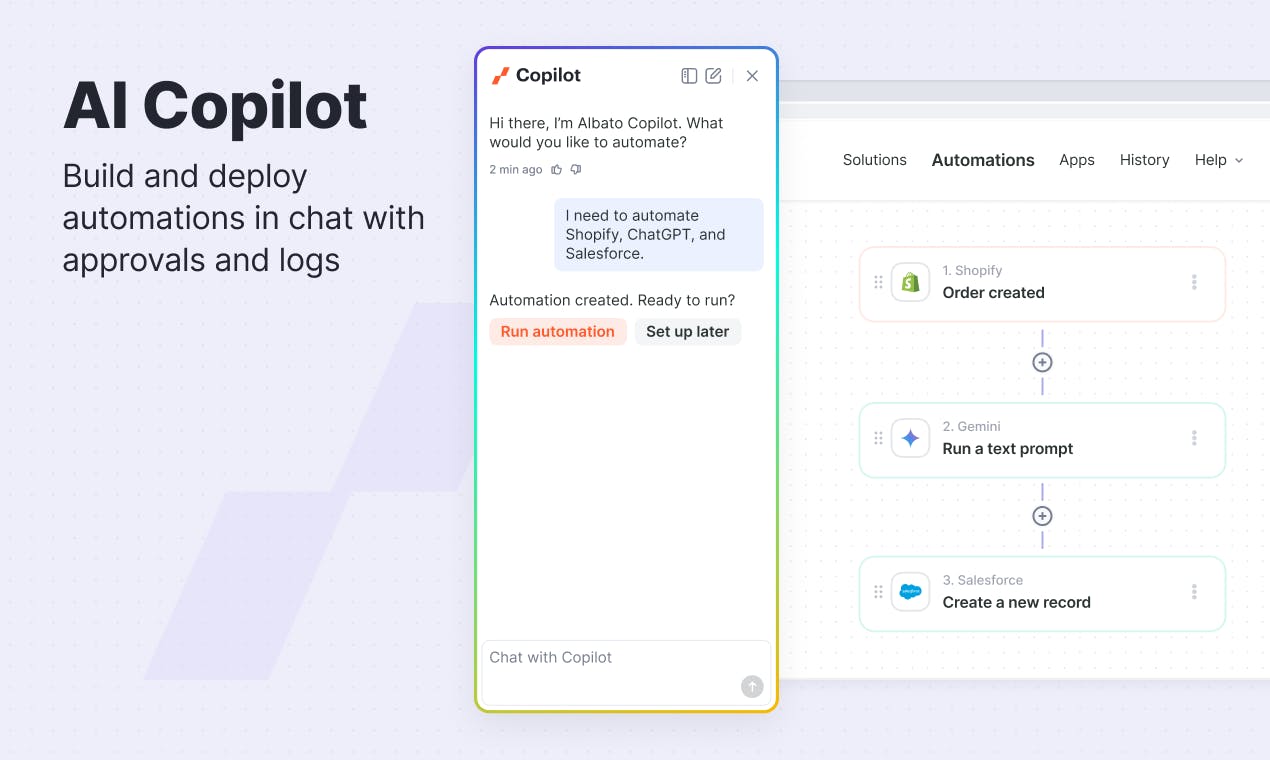
Albato AI: Bridging the Gap in Application Integration
In today's increasingly interconnected digital landscape, businesses often find themselves juggling dozens of applications, each serving a specific function. From customer relationship management (CRM) and project management to marketing automation and communication tools, the data and workflows are often siloed, leading to inefficiencies and missed opportunities. Albato AI emerges with a bold promise: to break down these silos and enable AI-driven workflows across more than 1,000 different applications.
The core challenge Albato AI addresses is the fragmentation of business software. Most companies use a suite of specialized tools, but getting these tools to communicate seamlessly and intelligently is a significant hurdle. Traditional integration platforms often require complex coding or extensive configuration, creating a bottleneck for rapid deployment and adaptation. Albato AI aims to democratize this process by leveraging artificial intelligence to simplify and enhance automation capabilities.

Empowering Automation with AI
Albato AI's value proposition centers on its AI-driven approach. Instead of relying solely on pre-defined triggers and actions, the platform suggests and optimizes workflows based on user data and common business patterns. This means users can potentially build more sophisticated automations with less manual effort. The AI component can analyze existing data flows, identify redundancies, and propose more efficient sequences of actions. For instance, if a sales lead is entered into a CRM, the AI might suggest automatically creating a task in a project management tool, sending a personalized welcome email via a marketing platform, and adding the contact to a relevant communication channel.
The sheer number of supported applications – over 1,000 – is a key differentiator. This extensive library suggests that Albato AI can integrate with a vast majority of the tools businesses commonly use, from giants like Salesforce and HubSpot to more niche productivity apps. This broad compatibility is crucial for organizations that have invested heavily in diverse software stacks and need a unified solution to manage them.
Building Workflows: Simplicity Meets Power
Albato AI is designed to be accessible to a wide range of users, not just seasoned developers. The platform emphasizes a visual, no-code or low-code interface for building automations. Users can typically drag and drop elements, define triggers (events that start an automation), and specify actions (tasks to be performed). The AI layer then augments this process by offering intelligent suggestions, error checking, and optimization recommendations. This blend of user-driven design and AI assistance aims to strike a balance between ease of use and the power to create complex, multi-step automations.
Consider a common scenario: a marketing team needs to track leads generated from various campaigns across different platforms. Traditionally, this might involve manual data entry or setting up multiple, separate integrations. With Albato AI, a user could set up a trigger for a new lead in a form builder, followed by actions to: create a contact in the CRM, add the lead to a specific email nurture sequence, log the conversion in a spreadsheet, and notify the sales team via a chat application. The AI could further refine this by suggesting A/B testing for email subject lines or optimizing the timing of follow-up messages based on engagement metrics.
The Broader Impact on Business Operations
The implications of a robust AI-driven workflow automation platform like Albato AI are significant. For small to medium-sized businesses (SMBs), it can level the playing field by providing sophisticated automation capabilities that were previously only accessible to larger enterprises with dedicated IT resources. For larger organizations, it offers a way to streamline operations, reduce manual errors, and free up employees from repetitive tasks, allowing them to focus on more strategic initiatives. This can lead to increased productivity, faster response times, and ultimately, improved customer satisfaction.
The challenge for Albato AI will be maintaining the reliability and security of these integrations across such a vast ecosystem of applications. Ensuring data privacy, handling API changes from third-party services, and providing robust support will be critical to its long-term success. However, the vision of a unified, intelligent automation layer for business applications is compelling, and Albato AI appears poised to tackle this complex challenge head-on.