The Hidden Thirst of Artificial Intelligence
When discussions turn to the environmental impact of artificial intelligence, the focus invariably lands on the staggering electricity consumption required to power the massive data centers that underpin AI training and inference. We hear about the carbon footprint, the energy-intensive GPUs, and the race to build ever-larger, more powerful computing clusters. Yet, a critical and often unacknowledged resource drain is emerging: water.
The connection between AI, electricity, and water might not be immediately obvious. It stems from a fundamental physical challenge: heat. AI workloads, particularly the training of large language models and complex neural networks, generate immense amounts of heat. This heat must be dissipated to prevent hardware failure and maintain optimal operating temperatures. Data centers, the physical homes of these AI systems, employ sophisticated cooling mechanisms to manage this thermal load. A significant portion of these cooling systems, especially those designed for high-density computing environments, rely on water.
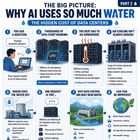
Think of a massive data center as a supercomputer running a marathon. Just like an athlete needs to stay hydrated and cool, the servers within these facilities require constant cooling. While air cooling is used, particularly in smaller or less heat-intensive setups, the sheer scale and power density of modern AI infrastructure often necessitate more robust solutions. Evaporative cooling, which utilizes the phase change of water from liquid to gas to absorb heat, is a common and highly efficient method. This process, however, consumes substantial volumes of water, which is then released into the atmosphere as vapor or discharged as wastewater. The infographic shared on Reddit, while a starting point for understanding, highlights this often-overlooked interplay between AI's computational demands and its hydrological impact.

The Mechanics of AI Cooling and Water Consumption
The primary way AI consumes water is through the cooling infrastructure of the data centers housing the powerful servers and GPUs. These components generate significant thermal energy. To maintain operational efficiency and prevent hardware damage, this heat must be removed. Data center cooling systems can be broadly categorized, but those most relevant to high-performance computing, and by extension AI, include:
- Evaporative Cooling Towers: These are perhaps the most water-intensive systems. Hot air from the data center is passed over water, causing the water to evaporate. This evaporation process absorbs heat, cooling the air, which is then circulated back into the data center. The water lost through evaporation must be continuously replenished.
- Chilled Water Systems: While these systems primarily use refrigerants, they often rely on cooling towers to dissipate the heat absorbed by the refrigerant. These cooling towers, in turn, use water through evaporation.
- Direct Liquid Cooling (DLC): Increasingly, for the most power-dense AI hardware, direct liquid cooling is being employed. This involves circulating a coolant directly over or through components like CPUs and GPUs. While this can be more efficient in terms of energy for cooling, the coolant itself often requires a chilled water loop for heat rejection, which again leads to water consumption in external cooling towers.
The amount of water consumed varies greatly depending on the cooling technology, the efficiency of the data center, the local climate (hotter, drier climates require more water for evaporative cooling), and the intensity of the AI workloads. However, studies are beginning to quantify this demand. For instance, research has indicated that the training of a single large language model can consume hundreds of thousands of liters of water, equivalent to the amount used by hundreds of homes over the same period. This figure is not just for the initial training but also for ongoing inference and the continuous operation of AI services.
Why AI's Water Use Matters
The implications of AI's water consumption are profound, particularly in regions already facing water scarcity. As the demand for AI compute grows exponentially, so too will the demand for water to cool the underlying infrastructure. This puts AI development and deployment in direct competition with other essential water users, such as agriculture, municipal water supplies, and natural ecosystems.
Several factors exacerbate this issue:
- Location of Data Centers: Many large data centers are located in areas with abundant electricity, often near hydroelectric power sources. However, these areas may not always have abundant water resources.
- Efficiency of Cooling Systems: Older or less efficient cooling systems can be particularly wasteful. While newer designs aim for greater water efficiency, the sheer scale of new deployments means overall consumption continues to rise.
- The 'Water Usage Effectiveness' (WUE) Metric: Just as data centers track energy usage with PUE (Power Usage Effectiveness), there's a growing focus on WUE. This metric measures the total water used by a data center in a year, divided by the IT equipment's operational water needs. A low WUE indicates high water consumption for cooling.
What remains largely unaddressed is the long-term sustainability of this water-intensive AI boom. As AI becomes more integrated into every facet of society and industry, can the planet's water resources sustain this demand? The current trajectory suggests a significant environmental challenge that requires immediate attention from both the AI industry and policymakers.
Mitigation and Future Directions
Addressing AI's water footprint requires a multi-pronged approach. Technology providers and data center operators are exploring several avenues:
- Water-Efficient Cooling Technologies: Innovations in cooling, such as closed-loop systems, advanced heat exchangers, and more efficient evaporative cooling designs, aim to reduce water loss.
- Locating Data Centers Strategically: Siting new facilities in regions with ample water resources, or in climates where less water is needed for cooling, can mitigate localized stress. This is complex, as it must be balanced with proximity to renewable energy sources and network infrastructure.
- Recycling and Reuse: Implementing systems to recycle and reuse water within the data center or exploring partnerships with local water treatment facilities for greywater usage are potential solutions.
- Alternative Cooling Methods: While still nascent for large-scale AI, research into entirely different cooling paradigms, such as immersion cooling (where components are submerged in a non-conductive fluid), could reduce reliance on water-based cooling towers.
- Optimizing AI Models: Research into more computationally efficient AI models and hardware could reduce the overall energy and cooling demands.
The rapid growth of AI presents a critical juncture. The industry's focus on the immense power demands is justified, but the equally significant water requirements cannot be ignored. As developers, founders, and users, understanding this hidden cost is the first step toward building a more sustainable AI future. The question is not just how much electricity AI uses, but how much water it will drink to get the job done, and whether we can quench that thirst responsibly.