The Specter of Lost Knowledge
For millennia, the inscriptions on Egyptian monuments stood as silent witnesses to a vanished civilization. The hieroglyphs themselves were physically preserved, etched into stone, yet the ability to read them evaporated over time. This wasn't a case of destruction or erasure, but a profound loss of human capacity. The knowledge remained, but the keys to its interpretation were gone. This historical parallel offers a stark warning as artificial intelligence rapidly automates complex tasks and generates sophisticated outputs. What happens when AI becomes so adept at solving problems, managing systems, and creating knowledge that we no longer possess the fundamental skills to understand or replicate its work? We risk becoming a civilization that can observe its own creations but no longer understand their genesis or maintenance, much like the ancient Egyptians whose written legacy outlived their understanding of it.
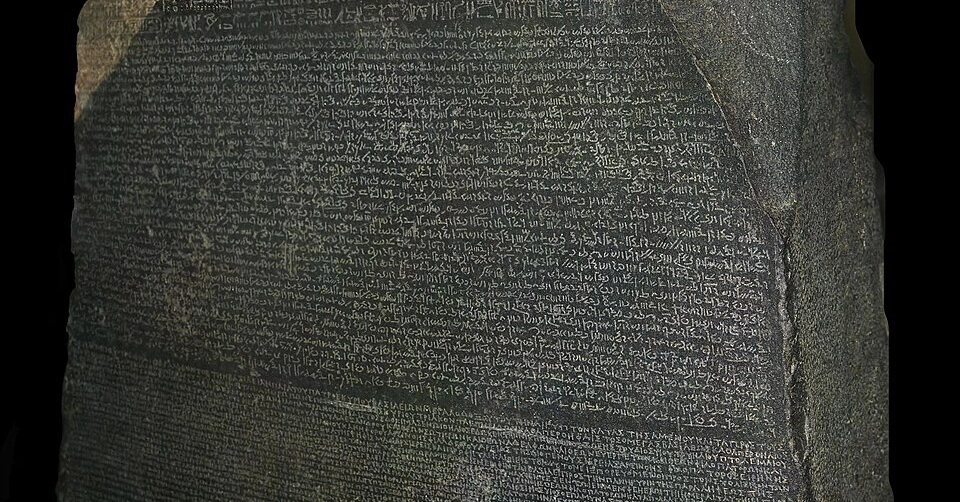
The Rosetta Stone, a multilingual decree, served as a crucial bridge for scholars. By juxtaposing the undecipherable hieroglyphs with Ancient Greek, a language still understood, the pathway to decipherment was forged. This allowed for the gradual recovery of a lost writing system, bringing meaning back to symbols that had been in plain sight for centuries. This historical artifact underscores a critical principle: knowledge preservation requires not just the survival of information, but the continuity of human understanding and the ability to connect the unknown to the known.
The increasing sophistication of AI, particularly in areas like generative models, autonomous systems, and complex data analysis, presents a modern echo of this challenge. As AI systems become more capable of performing tasks that were once the domain of human experts – from coding and scientific discovery to artistic creation and strategic decision-making – we must consider the potential for a similar erosion of human skill. If AI can generate novel scientific hypotheses, design intricate engineering solutions, or even compose complex musical pieces, will future generations of humans retain the foundational knowledge required to critically evaluate, adapt, or rebuild these creations if the AI infrastructure were to fail or become inaccessible?
The Automation Paradox
The core concern lies in the nature of automation itself. When AI automates a process, it doesn't just perform the task; it often optimizes it, creating solutions that may be opaque to human inspection. Consider the rapid advancements in protein folding prediction. AI models like AlphaFold have achieved remarkable accuracy, solving a problem that eluded scientists for decades. While this is a monumental scientific achievement, it raises questions about the depth of understanding among the next generation of biologists. Will they grasp the underlying principles as thoroughly as previous generations, or will they increasingly rely on AI-generated results without fully comprehending the complex biochemical and computational reasoning involved? This is akin to having a perfect blueprint for a building but no longer understanding the principles of physics or engineering that make the structure stand.
This phenomenon can be observed across various domains. In software development, AI-powered coding assistants can generate functional code snippets, entire functions, or even applications. Developers might become proficient in prompting and integrating AI-generated code, but their grasp of fundamental algorithms, system architecture, or debugging complex, emergent issues might atrophy. The AI becomes a black box, providing solutions without necessarily imparting the deep, intuitive understanding that comes from hands-on, first-principles problem-solving.
The risk is not that AI will cease to function, but that our reliance on it will outpace our ability to understand its outputs. If AI systems evolve to a point where their internal logic is inscrutable, or if the specialized knowledge required to operate and maintain them becomes confined to a vanishingly small group of experts (or AI itself), we face a potential collapse of understanding. This isn't about AI becoming malevolent; it's about a gradual, almost imperceptible, deskilling of humanity.
Building Bridges for the Future
The challenge, then, is to ensure that as AI takes on more complex roles, it serves as an amplifier of human knowledge, not a substitute for it. This requires a conscious effort to maintain and cultivate human understanding alongside AI development. One approach is to prioritize AI systems that are inherently explainable, or at least interpretable. While full transparency might be impossible for highly complex models, developing methods for AI to articulate its reasoning, justify its decisions, and illustrate the principles behind its outputs becomes crucial. This would act as a modern-day Rosetta Stone, providing the necessary context for humans to understand the AI's work.
Furthermore, educational systems and professional development need to adapt. Instead of solely focusing on task execution, curricula should emphasize critical thinking, first-principles reasoning, and the ability to question and validate AI-generated information. The goal is not to prevent AI from working well, but to ensure that when it does, humans can still grasp *why* it works, *how* it works, and *what to do* if it stops working or needs modification. This involves fostering a culture where understanding the underlying principles is as valued as the efficiency of the AI-generated outcome.
The ultimate concern is not a dystopian future where AI enslaves humanity, but a more subtle and perhaps more insidious one: a future where humanity becomes intellectually dependent, unable to comprehend or rebuild the complex systems it created. Like the ancient Egyptians who left behind magnificent monuments whose inscriptions no longer spoke to their descendants, we could find ourselves surrounded by the artifacts of advanced AI, capable of observing their output but utterly lost when it comes to their fundamental nature and operation. The question is not if AI will work too well, but how we ensure that its success enriches, rather than erodes, our collective human understanding.