
The Double-Edged Sword of AI Assistance
Artificial intelligence tools are rapidly integrating into professional workflows, promising increased efficiency and productivity. However, emerging evidence suggests a concerning side effect: the potential degradation of fundamental human skills. Early results from studies and anecdotal reports point to a worrying trend where reliance on AI for tasks previously requiring critical thinking, problem-solving, and creativity may be leading to a decline in these very abilities.
The convenience of AI-powered assistants, from coding copilots to sophisticated writing aids and analytical platforms, is undeniable. Developers can generate code snippets in seconds, writers can draft articles with minimal effort, and analysts can process vast datasets with unprecedented speed. This efficiency boost, however, comes at a potential cost. When AI handles the heavy lifting of complex tasks, the human brain may engage less, leading to a gradual atrophy of the cognitive muscles required for independent thought and problem-solving.
Consider the analogy of a GPS system. While incredibly useful for navigation, over-reliance on GPS can diminish a person's innate sense of direction and ability to read maps. Similarly, AI tools, when used as a crutch rather than a supplement, can hinder the development and maintenance of critical cognitive skills.
Evidence of Skill Erosion
Research is beginning to quantify this effect. Studies examining the impact of AI on specific professions are revealing concerning patterns. For instance, early findings suggest that students relying heavily on AI for homework and assignments may struggle with foundational concepts and independent problem-solving when faced with tasks that do not have AI assistance readily available. This isn't just an academic issue; professionals in fields like software development, writing, and even design are reporting a subtle, yet noticeable, dip in their own problem-solving capabilities when AI is their primary tool.
One of the most surprising details emerging is the speed at which this erosion can occur. It’s not a process that unfolds over decades; preliminary observations suggest that even a few months of heavy AI reliance can lead to measurable declines in certain cognitive functions. This rapid deterioration underscores the need for a more conscious and balanced approach to AI integration.
The concern is that we are training ourselves to be prompt engineers rather than deep thinkers. The ability to articulate a problem clearly to an AI is a skill in itself, but it does not replace the rigorous process of dissecting a problem, exploring multiple solutions, and understanding the underlying principles. When AI provides a seemingly perfect answer, the temptation to accept it without critical evaluation is immense, bypassing the learning and skill-building that comes from struggle and discovery.
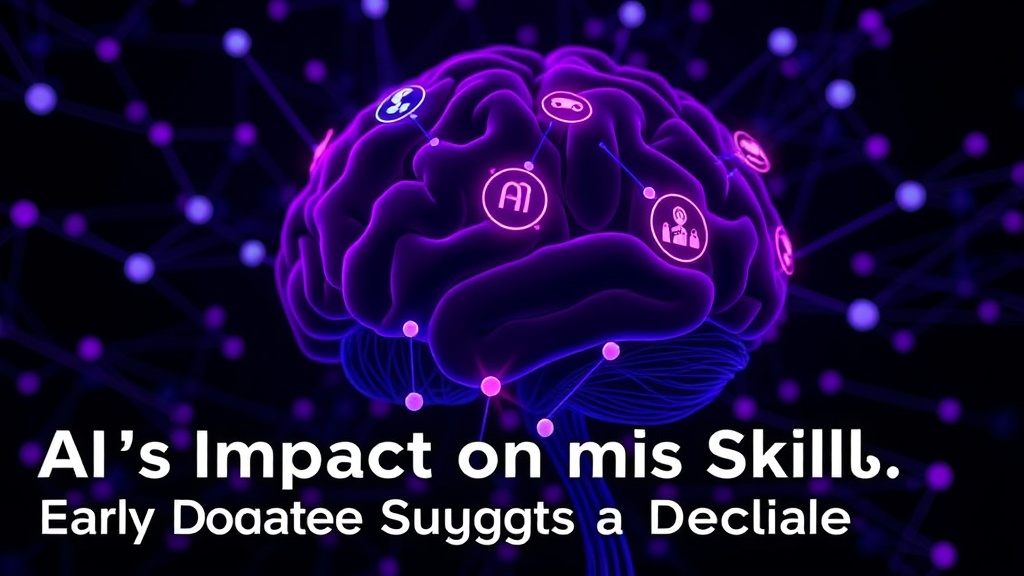
The Role of Critical Thinking
Critical thinking is paramount in navigating the complexities of any advanced field. It involves analyzing information, evaluating arguments, identifying biases, and making reasoned judgments. When AI tools are used to bypass these processes, the capacity for critical thought diminishes. For example, a programmer who habitually uses AI to debug code might lose the ability to trace complex logical errors independently. A writer who relies on AI for sentence construction might struggle to develop their own unique voice and stylistic nuances.
The danger lies in the automation of thought processes. AI can provide answers, but it cannot replicate the human experience of grappling with a problem, the iterative process of trial and error, or the creative leaps that often arise from deep, focused thinking. These are the very skills that drive innovation and allow individuals to adapt to new challenges. If these skills atrophy, the long-term consequences for individual careers and the broader professional landscape could be significant.
Moving Forward: A Balanced Approach
The solution is not to abandon AI, but to integrate it mindfully. Professionals must actively seek ways to use AI as a tool to augment their abilities, not replace them. This means consciously engaging in tasks that require deep thinking, even when AI assistance is available. It involves continuing to practice fundamental skills, seeking out challenges that push cognitive boundaries, and critically evaluating AI-generated outputs rather than accepting them at face value.
Educators and employers have a crucial role to play. Curricula need to adapt, emphasizing critical thinking and problem-solving alongside AI literacy. Companies must foster environments where employees are encouraged to develop their core competencies, using AI as a supplement for efficiency rather than a substitute for skill. The question for us all is whether we can harness the power of AI without sacrificing the human intellect that created it.
What nobody has addressed yet is the long-term societal impact of a workforce whose fundamental cognitive skills have been systematically weakened by automation. Will we see a widening gap between those who can think critically and those who rely solely on AI? The early results are a call to action, urging us to strike a careful balance before the convenience of AI leads to an irreversible decline in our most valuable human capacities.