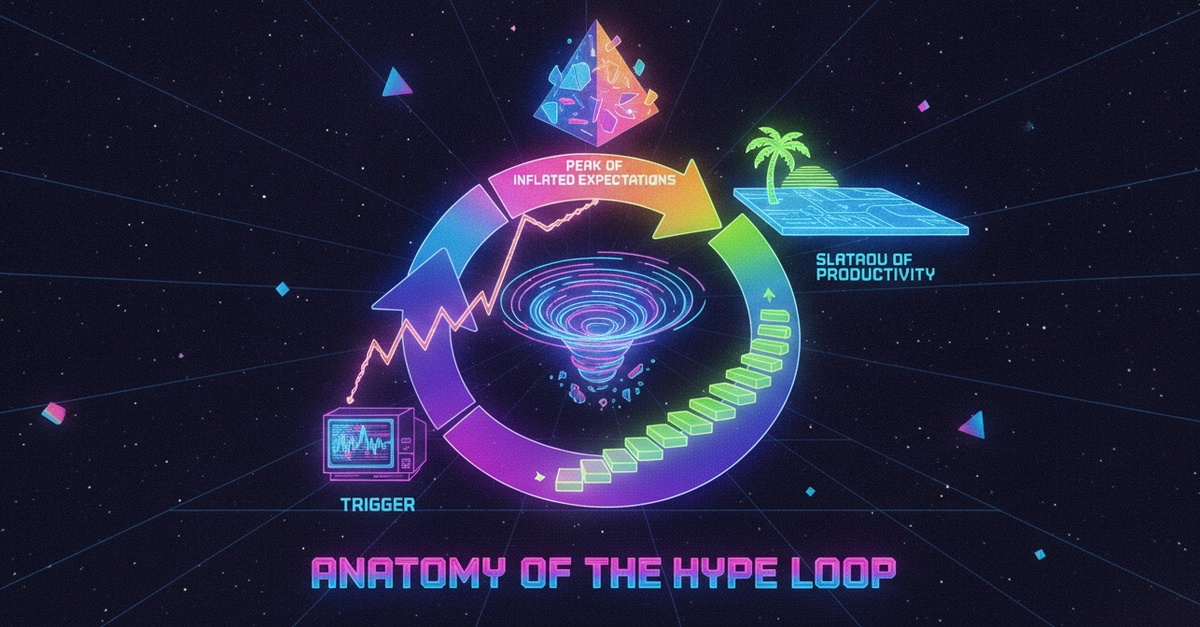
The AI Marketing Playbook: Hijacking the Hype Cycle
The narrative around Artificial Intelligence often feels like a perpetual motion machine of inflated expectations. A common strategy observed in CEO marketing speeches involves overpromising capabilities. Crucially, before the technology reaches its inevitable underdelivery point, a new 'magic' model is released, offering marginal improvements in speed or efficiency. This effectively restarts the overpromise-and-underdeliver loop, creating a mirage of continuous, exponential progress. This tactic is not new; it's a sophisticated manipulation of a well-understood technological adoption curve: Gartner's Hype Cycle.
Gartner's Hype Cycle is a graphical representation that charts the journey of a new technology from its inception through its adoption. It comprises five key phases:
- Innovation Trigger: A potential technology breakthrough kicks things off. Early proof-of-concept stories and media interest.
- Peak of Inflated Expectations: Early publicity produces a host of new stories of success, but also failures. Many companies attempt to be first movers.
- Trough of Disillusionment: Interest wanes as experiments and implementations fail to deliver on expectations. Producers of the technology shake out or fail.
- Slope of Enlightenment: More instances of how the technology can benefit the enterprise start to crystallize and become more widely understood. Second- and third-generation product efforts appear from technology providers.
- Plateau of Productivity: Mainstream adoption starts to take off. Criteria for assessing the technology become more clearly defined. Investment continues only in providers that addressed the early adopter customers.
The AI industry, particularly in the generative AI space, has demonstrated a remarkable ability to navigate and, some would argue, exploit this cycle. When the initial promises of, say, AGI or truly autonomous agents fail to materialize at the predicted pace, instead of dwelling in the Trough of Disillusionment, companies quickly pivot. They might release a larger model, a faster inference engine, or a new set of curated training data. These incremental, though often technically impressive, advancements serve to reignite interest and push the narrative back towards the Peak of Inflated Expectations, effectively bypassing a prolonged period of critical evaluation and realistic expectation setting.

Why This Pattern Emerges in AI
Several factors contribute to AI's tendency to follow this accelerated Hype Cycle pattern. Firstly, the inherent complexity and black-box nature of many advanced AI models make it difficult for the public and even many practitioners to fully grasp their limitations. This opacity allows for a wider range of interpretations and, consequently, more room for overpromise. Secondly, the sheer pace of research and development in AI means that breakthroughs, or at least perceived breakthroughs, are frequent. What might have been considered science fiction a year ago can become a demonstrable, albeit niche, capability today. This rapid iteration provides fertile ground for new 'innovation triggers' that can pull technologies out of the trough and back into the spotlight.
Consider the evolution of large language models (LLMs). Initial excitement focused on their ability to generate human-like text. As the limitations of factual accuracy and reasoning became apparent, leading to a potential dip into disillusionment, the industry responded with efforts to improve factuality, introduce retrieval-augmented generation (RAG), and develop more sophisticated prompting techniques. More recently, the focus has shifted towards multimodal capabilities, allowing models to process and generate not just text, but also images, audio, and video. Each of these advancements, while significant, can be seen as a new 'innovation trigger' or a step along the 'slope of enlightenment' that diverts attention from the persistent challenges of the previous iteration.
The Role of Investment and Competition
The dynamics of venture capital funding and intense market competition play a crucial role in perpetuating this cycle. Investors are eager to back the next big thing, and AI is undeniably that. The potential for massive disruption and market capture means that billions are poured into AI startups and research labs. This influx of capital creates pressure to demonstrate rapid progress and deliver on ambitious visions. Companies that fail to maintain the appearance of forward momentum risk losing funding and market share to competitors who are more adept at generating hype.
This competitive pressure incentivizes a strategy of