The Credibility Gap in Enterprise AI
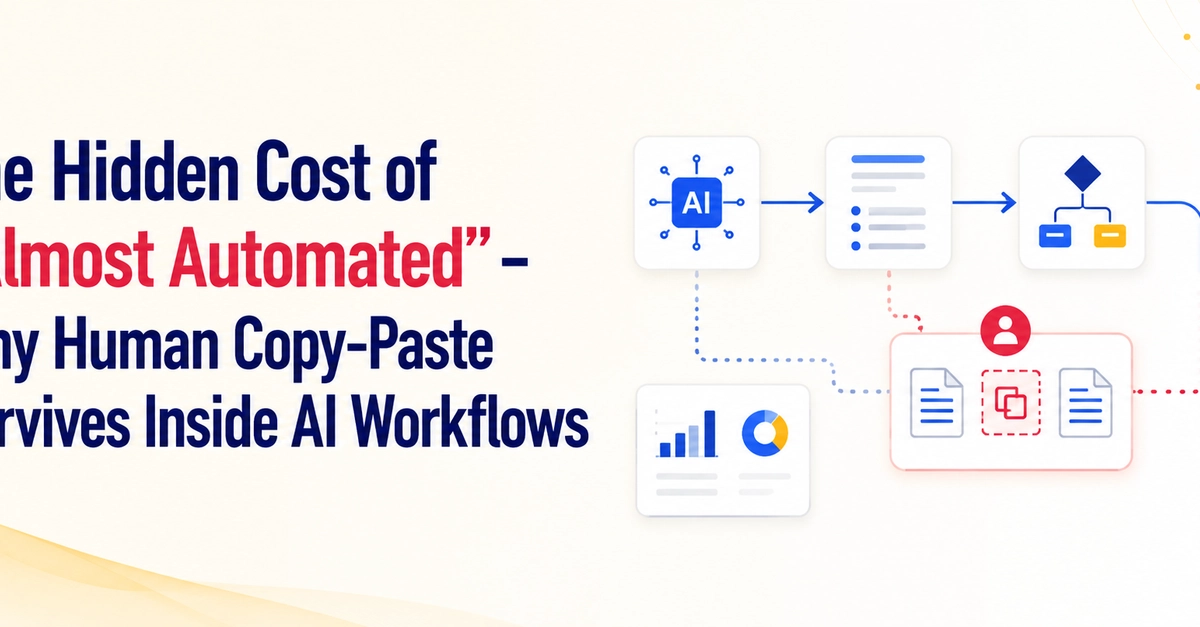
Enterprise AI faces a significant credibility problem. While the promise of fully automated workflows is compelling, the reality for many businesses is that these systems are only "almost automated." This means that when AI encounters an edge case, a system boundary, or simply a confusing input, the process doesn't halt gracefully. Instead, it often requires a human employee to step in, copy-pasting data, reformatting outputs, correcting errors, and generally rescuing the workflow. This hidden labor, while invisible in basic demos, quietly devours the anticipated return on investment (ROI) of AI initiatives.
Consider the example from June 2026, where Meta launched a sophisticated business agent intended to handle tasks like booking appointments, qualifying leads, and closing sales. Simultaneously, a separate system failure reportedly allowed unauthorized access to high-profile Instagram accounts. This juxtaposition highlights a critical, uncomfortable truth: "autonomous" AI often translates to automated until something breaks, confuses a field, or hits a predefined limit. At that point, human intervention becomes the de facto recovery mechanism.
The core issue is that most teams measure the success of AI by whether the model can produce an answer. They fail to track what happens *after* the answer is generated. This includes crucial post-processing steps: Did someone copy the AI's output into a CRM like Salesforce? Were unsupported or inaccurate claims removed before communication with customers? Was an account name correctly matched to the relevant entry in a database? These are not trivial tasks; they are essential quality control and integration steps that AI, in its current "almost automated" state, frequently fails to perform reliably.

Beyond the Demo: The True Cost of Incomplete Automation
The gap between a polished AI demo and a real-world enterprise workflow is where operational inefficiencies fester. When AI outputs require manual manipulation, the perceived gains in efficiency evaporate. This hidden labor isn't just about time; it's about the opportunity cost of what those employees *could* be doing if they weren't acting as AI's safety net. It also introduces the risk of human error during the copy-paste or reformatting stages, potentially negating the accuracy benefits the AI was supposed to provide.
This phenomenon is not unique to one industry or type of AI. Whether it's a customer service bot that can't handle nuanced queries, a content generation tool that produces factually inaccurate text, or a data analysis model that requires extensive manual data cleaning before it can be used, the pattern persists. The AI performs a part of the task, and then a human completes it. This creates a brittle system that appears automated on the surface but relies on a fragile human-dependent backup for actual operational viability. This is less like a fully autonomous system and more like a highly sophisticated assistant that requires constant supervision and manual correction.
The core problem lies in the definition and measurement of AI success. If success is defined solely by the AI model's output quality in isolation, then many AI projects might appear successful. However, if success is measured by the end-to-end operational efficiency and the actual business value generated, then the hidden costs of human intervention quickly become apparent. This requires a shift in how AI projects are evaluated, moving beyond model accuracy to encompass the entire workflow, including integration, error handling, and post-processing steps.
The Unanswered Question: What Is the True Tipping Point?
What remains largely unaddressed is the precise point at which the cost of this human intervention outweighs the benefits of the partially automated AI. At what volume of manual correction does an "almost automated" system become more expensive and less reliable than a fully manual process or a more traditional, deterministic software solution? Companies are investing heavily in AI based on the promise of autonomy, but without a clear understanding of this tipping point, they risk building complex, opaque systems that are more burdensome than beneficial. This lack of clear metrics and understanding means many organizations are flying blind, hoping the efficiency gains will materialize without fully accounting for the operational drag.
Rethinking AI Integration for Real-World Value
To truly unlock the value of AI in enterprise workflows, organizations must move beyond measuring just the AI model's performance. They need to implement robust tracking and measurement for the entire end-to-end process. This involves identifying every step where human intervention is required, quantifying the time and resources spent on these interventions, and assessing the impact on overall productivity and accuracy. Only then can businesses make informed decisions about where AI can provide genuine, sustainable value and where it might be creating more problems than it solves.
The goal should be to design AI systems that either handle the complete task autonomously or provide clear, actionable insights that genuinely augment human capabilities without requiring extensive manual rework. This might involve developing AI that can self-correct, integrate seamlessly with existing systems, or clearly flag its own limitations. Until then, the human copy-paste function will remain an indispensable, albeit costly, component of many enterprise AI workflows, undermining the very automation they are meant to deliver.