
The Siren Song of the Post-Documentation Era
A potent narrative is gaining traction in engineering circles: documentation is dead. The argument is seductive in its simplicity. We're told that AI agents, capable of parsing raw source code or instantly digesting OpenAPI specifications, render human-written documentation an obsolete, time-consuming chore. Why bother, the logic goes, when code churns too rapidly for prose to keep pace? Docs are outdated the moment they're committed, a relic of a bygone era.
This perspective, while appealing in its black-and-white clarity, is fundamentally wrong. It hinges on a misunderstanding of what documentation truly is and what code can, and cannot, convey. Chasing absolute determinism in a single source of truth—be it code or specification—is a pipe dream. Systems tell us how something works. They are, by their very nature, incapable of explaining why a particular design choice was made, why a specific trade-off was accepted, or why a feature was implemented in a certain way.
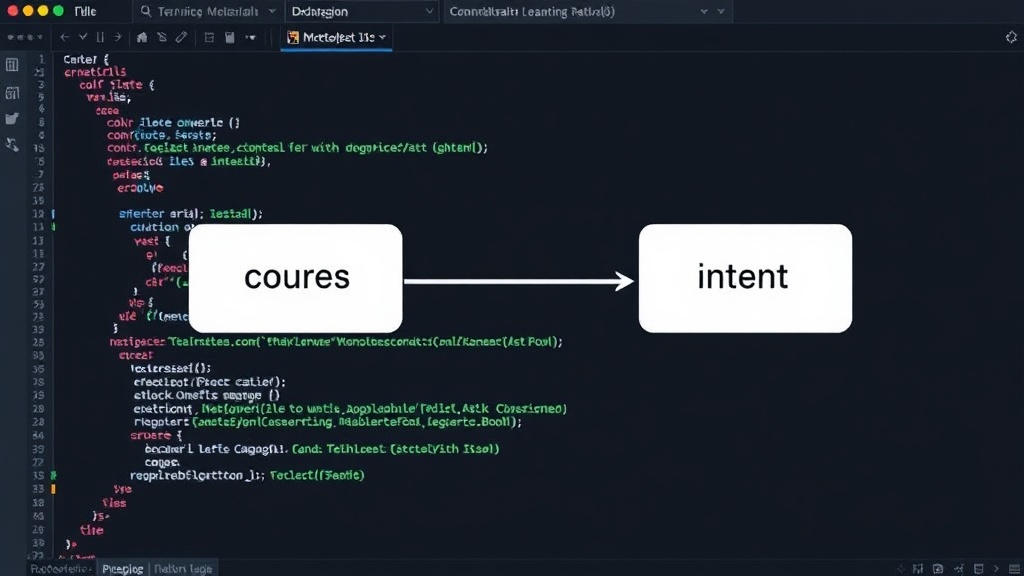
The Unbridgeable Intent Gap
Even for those building exclusively for downstream AI consumers, a massive, structural gap exists between a raw API specification and the actual human intent behind it. An API specification, for instance, can meticulously detail endpoints, request parameters, response schemas, and data types. It can define the contractual obligations of a service. However, it cannot articulate the business context that necessitated this API, the user problems it was designed to solve, or the evolving strategic decisions that shaped its current form. This is the 'intent gap' – the space between the mechanistic 'how' of the code and the contextual 'why' of its existence.
Consider a simple API endpoint for processing payments. The OpenAPI spec will define the fields required: `amount`, `currency`, `payment_method_token`. It will specify the expected response codes: `200 OK` for success, `402 Payment Required` for insufficient funds, `500 Internal Server Error` for backend issues. This is critical for machine consumption. But it won't explain why a 0.5% transaction fee was chosen over 0.4% or 0.6%. It won't detail the regulatory compliance hurdles that influenced the tokenization strategy. It won't explain the product decision to prioritize ease-of-use for small businesses over advanced features for enterprise clients. These are the pieces of information that human-written documentation, when done well, provides.
Why AI Agents Still Need Human Guidance
The argument that AI agents render documentation obsolete fundamentally misunderstands the role of documentation. It assumes that the primary, or sole, audience for documentation is the AI agent itself. This is a narrow and ultimately flawed premise. While AI can certainly benefit from structured data like OpenAPI specs or well-commented code, its utility is amplified, not replaced, by human-written context.
Think of it less like a database and more like a very organised friend who happens to remember everything you told them in 2019. The friend can recall facts (like code behavior), but without context, their recall is just data. The 'why' behind decisions, the historical context, the trade-offs made – these are the crucial elements that allow for truly intelligent interpretation and application of information. AI agents can parse the syntax of code, but they cannot inherently grasp the semantics of human decision-making that led to that code.
For instance, an AI agent might identify a deprecated function call. It can flag this as an error or a point of caution. But without documentation explaining why the function was deprecated—perhaps it had a security vulnerability, or a more efficient alternative became available—the AI's recommendation to replace it is purely mechanical. Human documentation can explain that the old function was deprecated due to a critical security flaw discovered in Q3 2023, and that the new function offers a 20% performance improvement and handles edge cases more robustly. This richer context enables more informed decision-making by both developers and the AI agents they employ.
The Evolving Role of Documentation
This doesn't mean documentation practices can remain static. The rise of AI necessitates an evolution, not an elimination, of documentation. The focus must shift from merely describing what the code does to illuminating why it does it, and how it fits into the larger ecosystem. This includes:
- Architectural Decisions Records (ADRs): Documenting significant architectural decisions, their context, and their consequences.
- Rationale for API Design: Explaining the choices made in API design, including trade-offs and considerations for different user types.
- Migration Guides and Best Practices: Providing clear guidance on how to use new features, migrate from deprecated ones, and avoid common pitfalls, including explanations of the underlying reasons for these recommendations.
- Conceptual Overviews: High-level explanations of system components, their interactions, and the business problems they solve, serving as a crucial on-ramp for new team members and AI models alike.
The speed of code churn is a valid concern. However, the solution isn't to abandon documentation, but to integrate it more tightly with the development lifecycle. Automated tools can help synchronize documentation with code changes, flagging outdated sections or suggesting updates based on code modifications. The goal is not static, perfect prose, but living, breathing context that evolves alongside the software.
The Future is Contextual, Not Code-Only
The engineers who champion the 'post-documentation era' are inadvertently creating a future where systems are opaque. They risk building complex software ecosystems where the 'how' is readily available in the code, but the 'why' is lost to time, buried in forgotten Slack channels or the memories of individuals who have long since moved on. This makes onboarding slower, debugging harder, and innovation more constrained.
If you're a developer or a founder, this means recognizing that your codebase is only part of the story. The human decisions, the strategic imperatives, and the contextual understanding are as vital as the lines of code. Investing in clear, contextual documentation isn't an administrative burden; it's a strategic imperative for building sustainable, understandable, and adaptable software. The myth of the post-documentation era is just that: a myth. The need for human context, for the 'why,' is more critical than ever.
What nobody has addressed yet is what happens to the thousands of developers who built on the old API if the 'why' behind its deprecation is lost. Will they be able to confidently migrate, or will they be left guessing, potentially introducing new bugs or security risks as they attempt to reverse-engineer the original intent?