The Illusion of Completion in AI Video
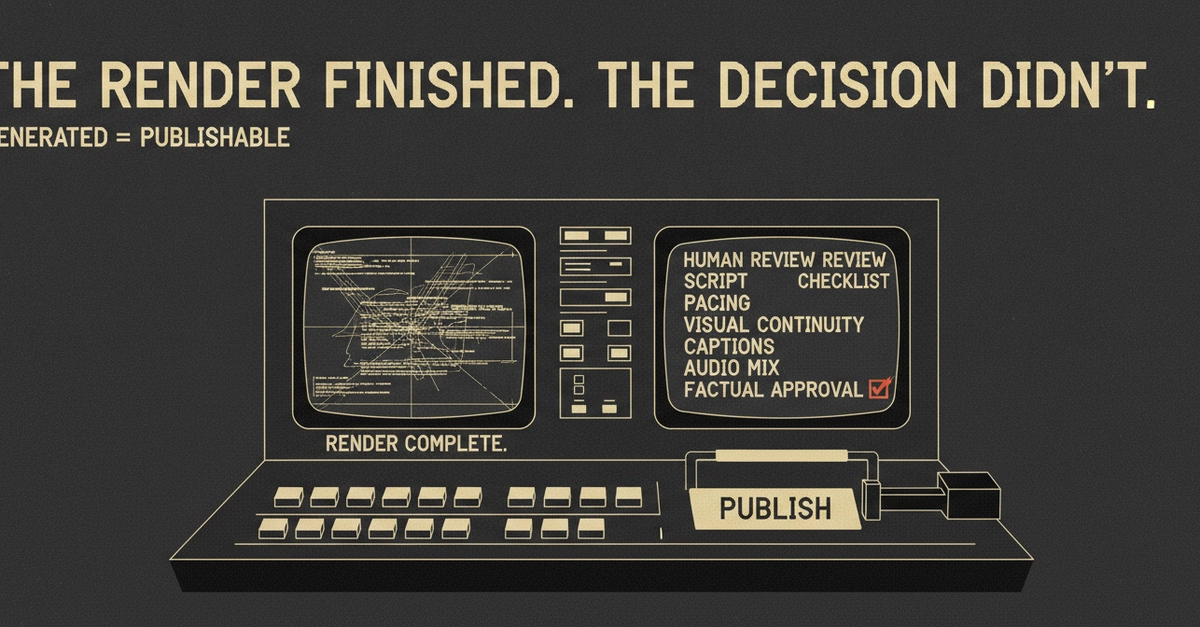
AI video generation pipelines often present a deceptive success state. A job can complete without error, meaning the script was processed, images were sourced, scenes were assembled, and an MP4 file was rendered. Yet, the output can still be a complete failure from a creator's perspective. This happened recently during testing of a faceless Shorts pipeline. The AI generated a video, but the visual direction shifted jarringly between scenes. The result felt disjointed, more like a random assembly than a directed piece of content. This isn't a crash; it's a qualitative failure that workers see as a completed job, but creators recognize as unusable for their channel.
The problem lies in the gap between automated completion and human-approved quality. Traditional pipelines might focus on technical execution – did it render? Did it crash? But for creative outputs like video, the definition of success is far more nuanced. A video that is technically perfect but visually incoherent is still a failure. This type of subtle failure is hard to represent in a system that only checks for technical completion. It requires a human understanding of aesthetic direction and narrative flow. The impulse might be to add more retries or tweak generation parameters, but that’s like asking a machine to guess better without understanding the problem. The real need is not for more automated attempts, but for intelligent points where human judgment can intervene before the cost of rendering becomes prohibitive.
Introducing Review Gates: Stopping Bad Renders Early
The solution is not another retry button. It requires implementing review gates at critical junctures within the pipeline. These gates act as checkpoints, allowing for human or AI-assisted qualitative assessment before proceeding to more computationally expensive stages like final rendering. Think of it less like a factory assembly line that only checks for parts, and more like a quality control process that inspects the product at multiple points, allowing for adjustments before significant investment is made.
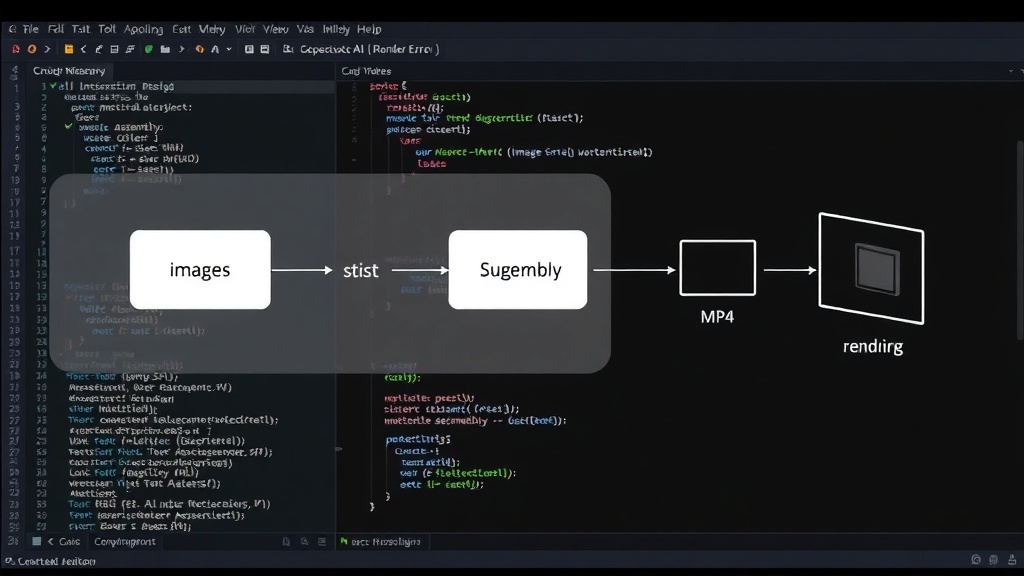
Consider a typical AI video pipeline. It might involve several stages:
- Script Generation: AI creates the narrative.
- Image/Asset Sourcing: AI finds or generates visuals.
- Scene Assembly: AI sequences visuals according to the script.
- Narration/Voiceover: AI adds audio.
- Final Rendering: The MP4 is compiled.
The failure in the Shorts pipeline occurred between scene assembly and final rendering. The visuals were technically sourced and sequenced, but the *direction* was wrong. A review gate placed after scene assembly, but before final rendering, could have flagged this issue. At this stage, the cost of changing the visual direction is relatively low. It might involve re-selecting assets or adjusting scene parameters. If the gate is only placed after the final MP4 is rendered, the cost of re-rendering can be substantial, especially for longer videos or complex effects. This is where computational resources and time are heavily consumed.
The Cost of Iteration: Where Pipelines Get Expensive
The expense in AI video pipelines isn't just in compute time for rendering. It's also in the opportunity cost of a creator's time and the potential loss of audience engagement if a poor-quality video is published. Rendering is often the most resource-intensive step. A single minute of high-resolution video can take minutes to hours to render, depending on complexity and hardware. When a pipeline reaches the final rendering stage, it has already consumed resources in script generation, asset retrieval or creation, and initial assembly. If the output is then deemed unusable, all those prior resources, plus the rendering cost, are wasted.
This is why review gates are crucial. They must be strategically placed to catch errors while the cost of correction is still manageable. For visual direction, a gate after asset selection and initial sequencing makes sense. For narrative flow or pacing, a gate after script and scene assembly, perhaps with a quick AI-generated storyboard or a human review of scene descriptions, would be effective. For audio quality, a gate after narration generation but before final audio mixing is appropriate.
The surprising detail here is not that AI video generation can produce flawed output, but that the systems are often designed to present these flaws as successful completions. This creates a false sense of progress and can lead to significant wasted effort and cost. The focus needs to shift from simply *completing* a job to *successfully creating usable content*. This requires a paradigm shift in pipeline design, incorporating human oversight or intelligent automated checks at points where intervention is most cost-effective.
Designing for Human Oversight
Implementing review gates means acknowledging that AI, while powerful, still requires human guidance for creative tasks. This doesn't necessarily mean a human has to watch every single frame of every intermediate step. Instead, it means designing the pipeline to present key decision points in a digestible format. For instance, after scene assembly, the system could present a series of thumbnail storyboards or brief text descriptions of each scene's visual content and transitions. A creator could then quickly review these and flag issues, such as inconsistent visual styles or abrupt changes in subject matter, before the expensive rendering begins.
This approach is analogous to how professional animation or VFX pipelines work. There are numerous review stages, from storyboarding and animatics to pre-visualization and dailies. Each stage allows for feedback and correction without redoing the entire final render. Applying this principle to AI video generation means building these checkpoints into the automated workflow. Developers need to think about not just the sequence of AI models but also the interfaces and triggers that allow for qualitative assessment at the right time.
What nobody has addressed yet is how to scale these review gates effectively. If a pipeline generates hundreds of videos daily, manual review of every gate becomes a bottleneck. This points to the need for AI-assisted review tools that can flag potential issues for human attention, rather than requiring full manual oversight. Such tools could analyze scene consistency, pacing, and visual coherence, providing a confidence score or highlighting specific frames for human evaluation. This hybrid approach—AI for initial screening and human for final judgment—could offer the best of both worlds: efficiency and quality control.
The Path Forward: Quality, Not Just Completion
Ultimately, the goal for AI video pipelines should be to produce high-quality, publishable content efficiently. This requires moving beyond a simple success/failure binary based on render completion. Developers building these systems must integrate qualitative checkpoints. These review gates prevent the expensive final render of an unusable product, saving both computational resources and creator time. By focusing on quality assurance at intermediate stages, we can ensure that the final output is not just a video file, but a video that serves its intended purpose and aligns with the creator's vision.