The Shifting Landscape of Software Engineering Education
For years, the path to becoming a proficient software engineer has involved a structured progression: learn foundational concepts, practice coding, debug errors, and seek guidance from experienced professionals. This model, deeply ingrained in technical education and corporate training, is now facing an unprecedented disruption. The recent acceleration in the capabilities of Large Language Models (LLMs) and AI-powered coding assistants has fundamentally altered how skills are acquired, leading to a critical re-evaluation of traditional teaching and mentoring methodologies.
The core of this shift lies in the AI's ability to automate many of the rote, repetitive, and even some complex problem-solving tasks that previously served as crucial learning experiences. Students and junior developers can now generate code, identify bugs, and even refactor entire sections of an application with a few prompts. While this offers immense potential for productivity gains, it simultaneously bypasses many of the 'friction points' that historically fostered deep understanding and critical thinking. This doesn't mean the end of learning, but rather a necessary evolution in pedagogical approaches.
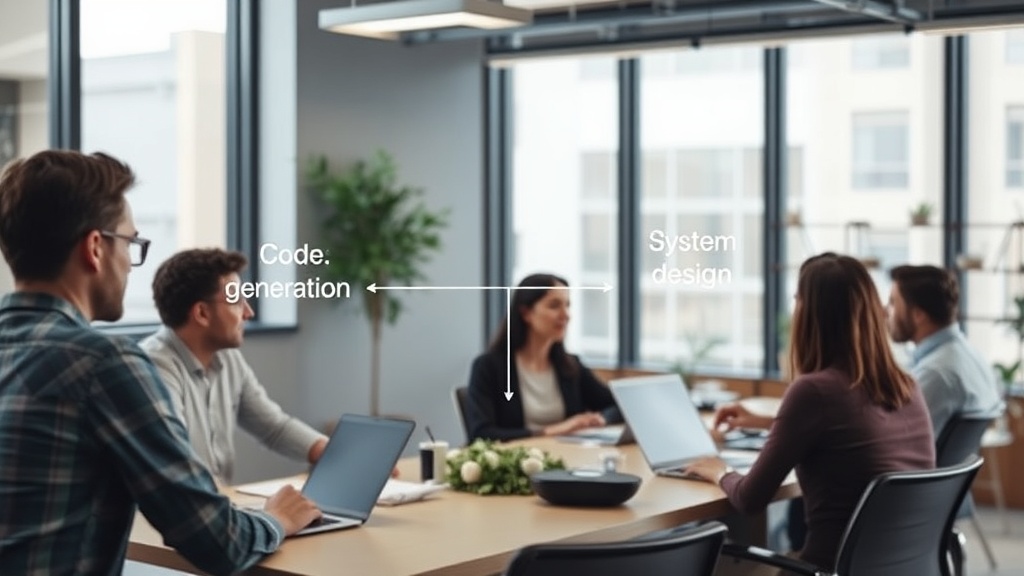
The challenge isn't that AI tools are making developers obsolete; rather, they are changing the nature of the skills that are most valuable. The ability to write syntactically correct code is becoming less of a differentiator when AI can do it almost instantaneously. Instead, the emphasis is moving towards higher-order skills: understanding complex systems, designing robust architectures, debugging nuanced logical errors, and, critically, knowing how to effectively leverage and direct AI tools. This is where the mentor's role becomes not just important, but indispensable.
Mentorship as the New Core Curriculum
In an era where AI can provide immediate answers and generate functional code, the value of human mentorship transforms. Mentors are no longer primarily conduits for technical knowledge or bug-fixing assistance. Their role now expands to guiding learners through the complexities that AI cannot yet replicate: strategic thinking, ethical considerations, understanding business context, and developing a deep, intuitive grasp of system design. This is the 'friction' that AI tools, by their nature, tend to smooth over, but it is precisely this friction that builds true engineering expertise.
Consider the process of debugging. Historically, a junior engineer might spend hours tracing a subtle bug, learning invaluable lessons about program flow, memory management, or concurrency. With AI, the bug might be identified and fixed in minutes. The junior engineer might learn *what* the fix is, but not necessarily *why* it occurred or how to prevent similar issues. A mentor can bridge this gap by asking probing questions: “Why do you think that error happened?” “What assumptions did we make about the system?” “How could we design this component to avoid this class of errors in the future?” These questions encourage critical reflection and deeper problem-solving, skills that AI currently assists with rather than replaces.
Furthermore, mentors are essential for cultivating the 'art' of software engineering. This includes understanding trade-offs, making pragmatic decisions under uncertainty, and developing a sense of craftsmanship. AI can present optimal solutions based on defined parameters, but it lacks the nuanced judgment that comes from years of experience and exposure to diverse, often messy, real-world systems. Mentors can share war stories, illustrate the consequences of technical debt, and impart the tacit knowledge that is difficult to codify and thus hard for AI to teach. They help mentees develop an intuition for what 'good' looks like, beyond mere correctness.
Rethinking Learning Frameworks
The traditional educational framework, often focused on delivering information and assessing recall, is insufficient in the age of AI. Future learning environments must prioritize active, inquiry-based approaches. This means designing curricula and mentoring programs that leverage AI as a tool for exploration, not as a crutch. Instead of asking students to write a sorting algorithm from scratch, a mentor might ask them to prompt an AI to write one, and then task the student with analyzing its time complexity, identifying potential edge cases the AI missed, and perhaps even explaining how to optimize it for a specific hardware architecture.
This approach treats the AI's output as a starting point for deeper learning. The friction is reintroduced not in the generation of code, but in its analysis, critique, and refinement. This mirrors the real-world experience of senior engineers who spend significant time reviewing, testing, and integrating code generated by themselves or their colleagues, including AI assistants. The goal is to cultivate engineers who are not just proficient coders, but masterful architects, critical thinkers, and adept collaborators in a hybrid human-AI development environment.
The implications extend beyond formal education. Bootcamps, online courses, and internal corporate training programs all need to adapt. Relying solely on AI-generated tutorials or code examples will create a generation of engineers who are adept at following instructions but lack the resilience and problem-solving depth required for complex, novel challenges. The human element – the guidance, the critical questioning, the shared experience of problem-solving – remains the most potent force in developing truly exceptional engineering talent.
The Future of Engineering Talent
The rise of AI tools is not a signal to abandon traditional learning methods entirely, but a call to evolve them. The skills that will define the next generation of top engineers are those that AI cannot easily replicate: creativity, critical thinking, complex problem-solving, and the ability to collaborate effectively. Mentorship, with its inherent emphasis on guidance, questioning, and nuanced feedback, is the ideal vehicle for cultivating these skills.
If you are an aspiring engineer, view AI tools as powerful co-pilots, not autopilot. Learn to prompt them effectively, but then spend your energy understanding their output, questioning their assumptions, and integrating their suggestions into a larger, well-understood system. If you are a mentor or educator, embrace the shift. Focus on fostering critical thinking, system design, and the 'why' behind the code, using AI as a catalyst for deeper exploration rather than a shortcut to an answer.
The true friction in software engineering is not in writing code, but in understanding complex systems, making difficult trade-offs, and building solutions that are robust, scalable, and maintainable. This is where the human touch, guided by experienced mentors, will continue to be the most valuable asset in the development lifecycle.