The Limits of Scaling Laws
For years, the AI development playbook was straightforward: bigger models, more data, and more compute. This approach, guided by scaling laws, made progress feel predictable, akin to earning compound interest. The formula was simple: increase parameters and dataset size, and watch the loss curve bend downwards, signaling improved performance. This predictable path made AI progress seem almost mundane, a matter of incremental, quantifiable gains.
However, this era of straightforward scaling is giving way to a new set of challenges. The industry is now grappling with a more nuanced question: given an existing model, how should it optimally allocate its computational resources on a per-query basis? This is not about training runs, but about the inference phase – how much time and processing power should a model spend to answer a single question effectively? The answer is no longer a simple extrapolation of training data or parameter count. It is emerging as a complex systems problem, moving beyond mere prompting tricks or simple parameter adjustments.
Shifting Focus to Inference Compute Allocation
The core of this new challenge is understanding that different problems require different amounts of computational effort. A simple query, like recalling a fact, might need minimal compute. A complex task, such as writing a novel chapter or debugging a large codebase, requires significantly more processing. The realization is that models already possess the latent capability to 'think longer' – to engage in more iterative reasoning, explore multiple paths, or perform deeper analysis – but this capability needs to be unlocked and managed efficiently during inference.
This shift signifies a move away from a brute-force approach to AI enhancement. Instead of simply building larger and larger models, the focus is now on optimizing the utilization of existing model architectures. This involves developing sophisticated inference engines and orchestration layers that can dynamically adjust the compute budget allocated to each query. Think of it less like building a bigger engine and more like designing a smarter transmission that knows exactly when to downshift for more power or when to cruise efficiently.
The implications are profound. For developers and researchers, it means exploring new techniques for controlling and directing model computation. This could involve methods like iterative refinement, where a model generates an initial response and then uses additional compute to critique and improve it, or branched reasoning, where the model explores multiple lines of thought in parallel before converging on a final answer. The goal is to achieve better quality responses without necessarily resorting to larger, more expensive models.

The Systems Engineering Challenge
Addressing this challenge requires a systems-level perspective. It's not just about tweaking hyperparameters or crafting clever prompts. It involves designing entire inference pipelines that can intelligently manage computational resources. This includes:
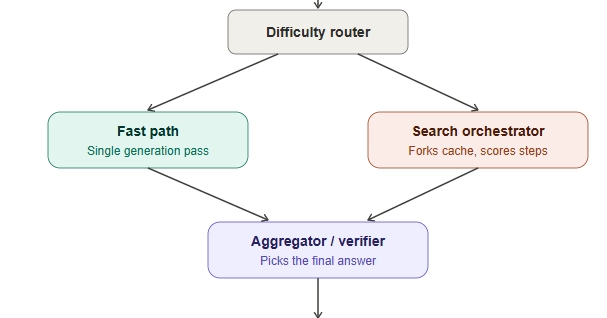
- Dynamic Resource Allocation: Systems that can assess the complexity of a query and allocate an appropriate amount of compute. This might involve using a fast, low-compute model for simple tasks and a more powerful, higher-compute path for complex ones, or allowing a single model to dynamically scale its internal computation.
- Orchestration Frameworks: Tools and frameworks that enable developers to build complex inference workflows. These frameworks would allow for the chaining of model calls, the implementation of self-correction loops, and the management of intermediate states.
- Efficient Model Architectures: While the focus is on inference, there's also a parallel research track into model architectures that are inherently more efficient at multi-step reasoning or that can be more easily controlled in terms of their computational depth.
- Evaluation Metrics: Developing new metrics that go beyond simple accuracy or perplexity to measure the quality of reasoning, the efficiency of computation, and the robustness of the generated output over multiple steps.
This is where the 'systems problem' aspect becomes critical. The ability of an AI to 'think longer' is not solely a function of its trained weights, but also of the infrastructure and logic that surrounds its execution. For example, a system might employ a 'router' model that first analyzes a query and decides whether it needs a quick answer or a deep dive. If a deep dive is needed, it might invoke a more computationally intensive process, potentially involving multiple passes of the core model or specialized sub-modules. This is analogous to how a human expert might break down a complex problem into smaller, manageable steps, consulting different resources or performing deeper analysis as needed.
Beyond Prompt Engineering
While prompt engineering remains a valuable skill, it is insufficient on its own to unlock the full potential of modern AI models for complex tasks. The idea that simply rephrasing a prompt can unlock deeper reasoning capabilities is a limited view. The real gains will come from building systems that can orchestrate and manage the model's computational process over time. This means moving from a single-shot inference paradigm to a multi-step, iterative one, where the model is given the opportunity and the resources to refine its own outputs.
Consider the task of writing a detailed technical report. A simple prompt might yield a decent overview. However, a system designed for 'thinking longer' would likely involve the model generating an outline, then drafting sections, then reviewing and expanding upon those sections, perhaps even performing simulated user testing or cross-referencing its own generated facts. Each of these steps consumes compute, and the system needs to manage this consumption intelligently.
The surprising detail here is not that models can do this, but that the industry's primary focus has been on scaling parameters rather than on optimizing the inference process itself. The potential for improvement by intelligently managing compute during inference, even with existing models, appears to be substantial. It suggests that the next wave of AI advancement might be less about building larger foundational models and more about building smarter inference systems.
The Future: Smarter Inference, Not Just Bigger Models
The path forward for AI development is branching. While continued scaling of models will undoubtedly yield further improvements, the immediate frontier for enhancing AI capabilities with existing models lies in inference optimization. This requires a deep understanding of AI systems engineering, moving beyond the art of prompt crafting to the science of computational resource management and intelligent orchestration.
For developers, this means exploring new frameworks and techniques for building these inference systems. For researchers, it means designing architectures and algorithms that are more amenable to dynamic computation and iterative refinement. For founders, it signifies a potential shift in the competitive landscape, where companies that can build more efficient and effective inference systems may gain a significant advantage, even with smaller or more widely available base models. The era of predictable scaling is evolving into an era of intelligent computation.