The Invisible Ink of AI Text
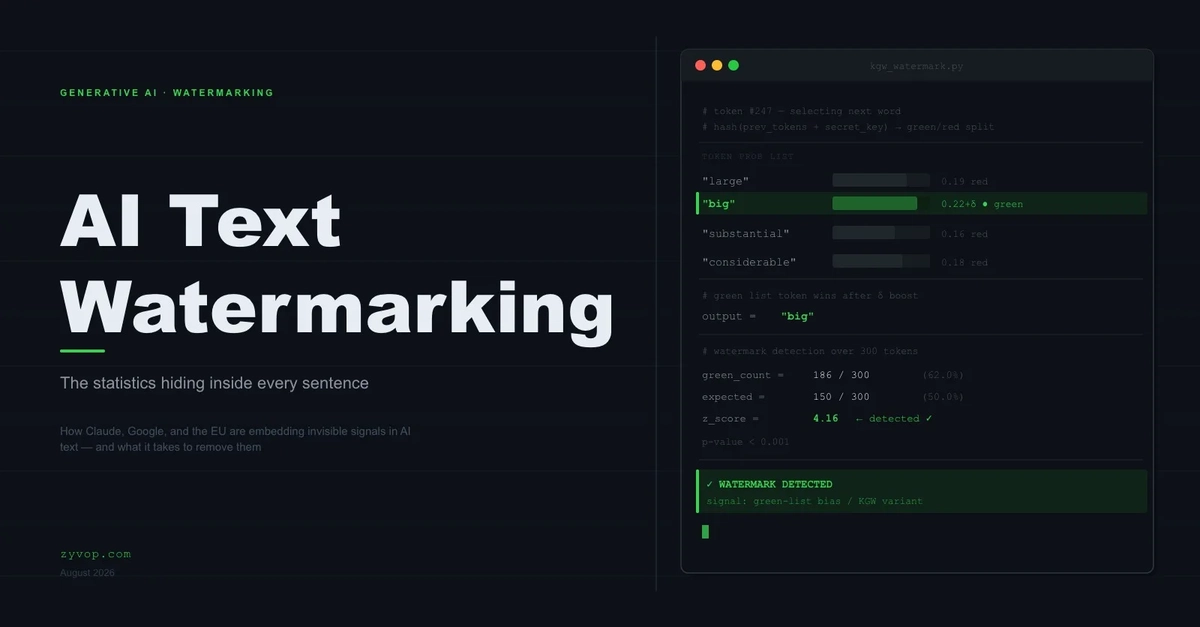
On August 2, 2026, something fundamental changed in how we interact with digital text. Every new Claude model, and indeed Google's models since 2024, began embedding an invisible mark into the content they generate. This isn't a hidden character, a secret Unicode symbol, or metadata appended to a file. The watermark is the text itself, manifesting as a subtle, statistical bias in the selection of words. OpenAI, while researching the technique for years, has yet to widely deploy it. This shift signals that AI text watermarking is no longer a niche academic pursuit but a pervasive feature impacting everyday digital communication.
Understanding this process requires looking beyond conventional notions of hidden information. The watermark isn't an overlay; it's woven into the fabric of the generated language. This approach leverages the core mechanics of how Large Language Models (LLMs) operate, fundamentally altering the output of these powerful tools.
Beyond Hidden Characters: The Statistical Core
To grasp AI text watermarking, it's crucial to understand what it is not. It does not involve embedding hidden characters that are invisible to the naked eye. It does not rely on obscure Unicode characters that might go unnoticed. Nor is it a piece of metadata attached to the end of a document or file. The watermark is intrinsically part of the text generated by the AI. It's a statistical characteristic—a deliberate skew in the probability distribution that guides the model's word choices.
This statistical bias is the linchpin of the technology. Instead of adding an external marker, the watermarking process influences the internal decision-making of the LLM during text generation. Think of it less like adding a watermark to a photograph and more like subtly influencing a painter's brushstrokes to leave a unique, statistical signature on every canvas.
How Language Models Select Words
At its heart, a language model doesn't 'know' the next word in a sequence. Instead, it performs a complex calculation. For any given point in generating text, the model assigns a probability score to every word in its vast vocabulary. This distribution of probabilities represents the model's assessment of which words are most likely to follow the preceding text, based on the massive datasets it was trained on.
For instance, after the phrase "The quick brown fox jumps over the...", the model might assign a high probability to "lazy," a moderate probability to "sleeping," and a very low probability to "dancing." The actual word chosen is typically sampled from this probability distribution. Watermarking introduces a controlled perturbation to this distribution.
Introducing the Statistical Bias
Watermarking works by subtly altering these probabilities. Before the model samples the next word, the watermarking algorithm intervenes. It might slightly increase the probability of certain 'green-listed' words and decrease the probability of others, termed 'red-listed' words. This manipulation is not drastic enough to be perceptible to a human reader or to significantly degrade the quality or coherence of the text. The changes are statistically significant only when analyzing a large volume of generated text.
The key is that this bias is consistent and predictable for a given watermarking scheme. When a piece of text is generated, the watermark is embedded by nudging the word selection process. For example, if the model is deciding between two words with nearly equal probabilities, the watermarking algorithm might consistently favor one over the other, or it might favor words that appear more or less frequently than expected in natural human writing. The extent of this bias is carefully calibrated. If the bias is too strong, it becomes noticeable and degrades the text's naturalness. If it's too weak, it becomes difficult to detect reliably.
The Detection Process
Detecting an AI-generated text watermark involves reversing this process. A detector analyzes a given text and calculates the statistical likelihood of its word choices conforming to the expected distribution of a watermarked model versus an unwatermarked one. It essentially looks for deviations from natural language patterns that are characteristic of the specific watermarking algorithm used.
This detection can be computationally intensive and often requires analyzing a substantial portion of the text to achieve high confidence. Short snippets of text might be too ambiguous for reliable detection. The accuracy of the detector depends heavily on the strength of the watermark, the sophistication of the detection algorithm, and the amount of text available for analysis. It's akin to a cryptographer trying to break a code; the longer the message, the more patterns can be identified and exploited.
Implications and Challenges
The widespread adoption of AI text watermarking has profound implications. For content creators and publishers, it offers a mechanism to distinguish between human-authored and AI-generated content, potentially combating misinformation and ensuring authenticity. For educators, it provides tools to address academic integrity concerns related to AI-generated essays. For cybersecurity professionals, it can help identify AI-driven phishing attacks or the spread of AI-generated propaganda.
However, challenges remain. Sophisticated actors may develop methods to strip or obscure these watermarks, leading to an ongoing arms race between generation and detection technologies. The statistical nature of the watermark means that any editing, paraphrasing, or even minor modifications to the text could potentially degrade or destroy the watermark, making detection unreliable. Furthermore, the computational cost of detection could be a barrier for real-time applications. The debate also continues about the ethical implications of embedding such invisible markers and the potential for misuse.
The Future of AI Text Authenticity
As LLMs become more integrated into our daily lives, the need for reliable methods to identify AI-generated content will only grow. Watermarking, despite its current limitations, represents a significant step in this direction. It's a testament to the ingenuity of researchers who have found a way to embed a digital signature not through external means, but by subtly shaping the very statistical choices that define language generation. The invisible ink is here, and it's changing the landscape of digital text forever.