Building a Retrieval-Augmented Generation (RAG) System: A Deep Dive
As the field of Artificial Intelligence rapidly advances, understanding the foundational components of complex systems like Retrieval-Augmented Generation (RAG) is crucial. Many developers interact with these systems through high-level APIs, but a true grasp of their mechanics requires building them from the ground up. This article chronicles the initial stages of such a project undertaken by an undergraduate AI Engineering student, detailing the process of constructing a functional RAG pipeline from raw health text.
Part 1: The Fundamental Concepts of RAG
Before diving into code, the project began with a thorough understanding of RAG's core principles. This involved several key areas:
Interacting with Large Language Models (LLMs) via APIs
The most immediate component of any LLM-powered application is the ability to send prompts and receive responses. For this project, the Gemini API was selected as the primary interface for interacting with a large language model. This phase involved writing simple scripts, such as llm_test.py, to ensure programmatic communication with the LLM was established and functioning correctly. This step is akin to learning how to talk to a very knowledgeable, but sometimes literal, assistant.
Understanding Embeddings and Vector Spaces
Central to RAG is the concept of embeddings: converting text into numerical vectors. The magic here is that semantically similar pieces of text are mapped to vectors that are close to each other in a high-dimensional space. This allows for efficient similarity searches. The student experimented with the sentence-transformers library to generate embeddings for a small set of sentences. By computing the cosine similarity between these vectors, they could empirically verify that sentences with similar meanings indeed produced closer vector representations. This is like assigning each word or sentence a unique coordinate on a map, where related concepts are neighbors.

The Role of Vector Databases
To efficiently store and query these embeddings, a vector database is essential. Unlike traditional databases that store structured data in tables, vector databases are optimized for storing and searching high-dimensional vectors. The project explored options for a suitable vector database, understanding that its performance would directly impact the retrieval speed and accuracy of the RAG system. The goal is to quickly find the most relevant pieces of information from a large corpus based on the query's embedding.
Part 2: Data Preparation and Ingestion
With the fundamental concepts in place, the next phase focused on preparing the raw health text data and ingesting it into the system.
Data Cleaning and Preprocessing
Raw text data, especially from sources like health forums or medical journals, is often messy. It can contain irrelevant information, formatting inconsistencies, special characters, and noise. This stage involved developing scripts to clean the text, remove unwanted elements, and standardize the format. For health-related text, this might include handling medical jargon, abbreviations, and ensuring consistency in terminology. The quality of the output from the RAG system is highly dependent on the quality of the input data; garbage in, garbage out.
Chunking Strategies
LLMs have context window limitations, meaning they can only process a certain amount of text at once. Therefore, large documents must be broken down into smaller, manageable chunks. The project investigated different chunking strategies. Simple fixed-size chunking can sometimes split sentences or paragraphs awkwardly, potentially losing semantic coherence. More advanced methods, such as sentence-based chunking or semantic chunking (grouping related sentences), were considered to maintain the integrity of the information within each chunk. The optimal chunk size and strategy are critical for effective retrieval.
Embedding Generation for the Corpus
Once the text was cleaned and chunked, each chunk needed to be converted into a vector embedding. This involves iterating through all the chunks and using the chosen embedding model (from Part 1) to generate a numerical vector for each. These embeddings represent the semantic meaning of each text chunk. This process can be computationally intensive, especially for large datasets, and often requires efficient batch processing.
Part 3: Implementing the Retrieval Pipeline
The final part of this initial journey involved assembling the components into a working retrieval pipeline.
Storing Embeddings in a Vector Database
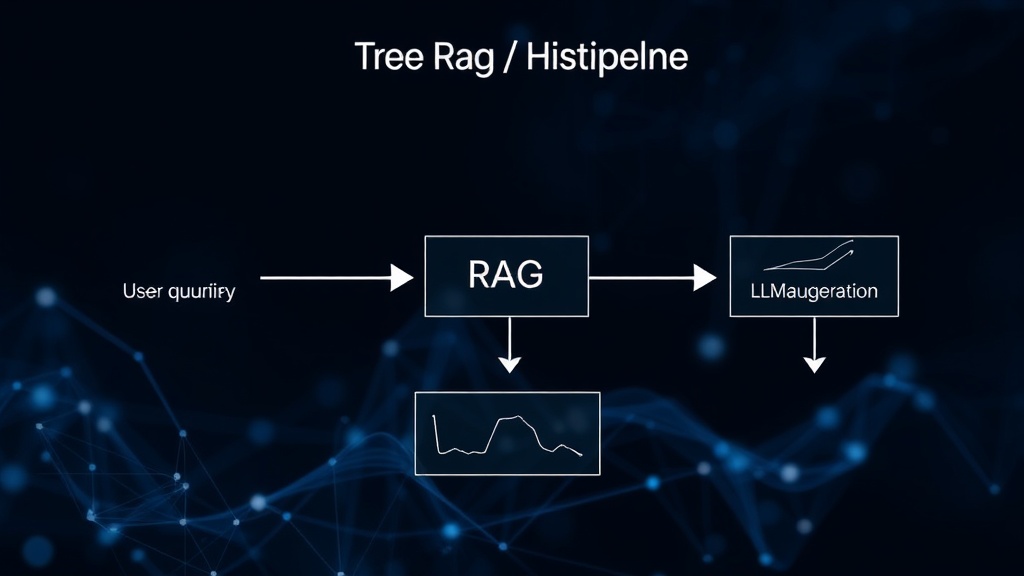
The generated embeddings, along with their corresponding text chunks, were then stored in the selected vector database. This setup allows for rapid similarity searches. When a user query comes in, it is also converted into an embedding, and the vector database is queried to find the embeddings (and thus text chunks) that are most similar to the query embedding.
Query Processing and Retrieval
The retrieval process begins with a user's natural language query. This query is first transformed into a vector embedding using the same model used for the corpus. This query embedding is then used to search the vector database. The database returns the top-k most similar text chunks. This is the 'retrieval' part of RAG, providing the LLM with relevant context.
Augmenting the LLM Prompt
The retrieved text chunks are then incorporated into the prompt sent to the LLM. Instead of asking the LLM a question in isolation, the prompt is augmented with the retrieved context. For example, the prompt might look something like: "Based on the following information: [retrieved text chunk 1] [retrieved text chunk 2] ..., answer the question: [user's original question]." This ensures the LLM's response is grounded in the specific data provided, reducing hallucinations and improving accuracy, especially for domain-specific knowledge like health information.
Generating the Final Response
Finally, the augmented prompt is sent to the LLM API. The LLM processes the prompt, leveraging the provided context to generate a coherent and informative answer. The student's project successfully demonstrated the end-to-end flow: from a raw user query to a contextually relevant response generated by an LLM, powered by a custom retrieval pipeline.
This foundational work sets the stage for more advanced RAG implementations, including fine-tuning embedding models, optimizing retrieval strategies, and handling more complex data sources.