
The Costly Conundrum of AI SQL Assistants
Integrating AI SQL assistants into development stacks promises efficiency and accessibility. Developers can translate natural language into SQL, and business users can query data without deep technical knowledge. However, as usage scales, the API bills for the underlying large language models (LLMs) can skyrocket. The initial allure of a powerful, frontier model quickly fades when faced with the reality of its per-token cost multiplied by thousands, or millions, of queries.
The common, albeit often suboptimal, solution is to downgrade the model to a cheaper, less capable alternative across the board. This approach, however, typically swaps one problem for another: high costs are replaced by a significant dip in query quality, accuracy, and the ability to handle complex requests. This trade-off undermines the very value proposition of the AI assistant.
The core issue isn't that models are inherently too expensive for all tasks, but rather that the workload is not being appropriately distributed. SQL queries are not a monolithic task. They range from trivially simple, single-table lookups to intricate, multi-join, analytical queries spanning entire schemas. Sending a basic `SELECT * FROM users WHERE id = 4471` to a state-of-the-art LLM designed for complex reasoning is akin to using a supercomputer to add two numbers.
Architectural Tiering: The Smarter Solution
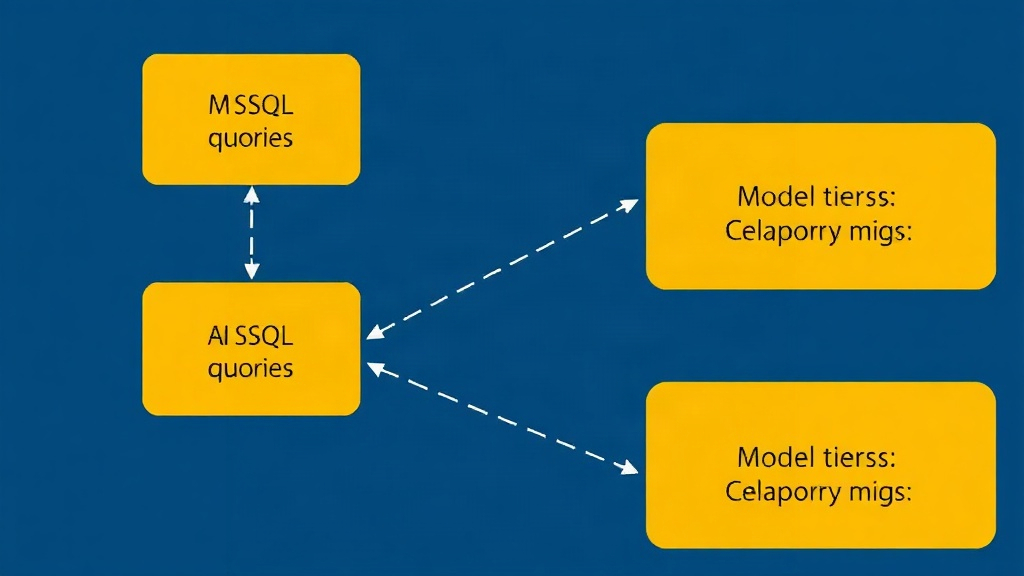
A more sophisticated and cost-effective approach lies in architectural design: implementing a query router that directs each SQL query to the model tier best suited for its complexity and resource requirements. This isn't about using a single, expensive model for everything, nor is it about exclusively using cheap models that fail on complex tasks. It's about intelligent distribution.
Imagine a system with several tiers of AI models, each optimized for different levels of complexity and cost:
| Tier | Description | Examples | Model Type |
|---|---|---|---|
| Tier 1 (Simple) | Handles basic, low-complexity queries. Requires minimal reasoning and context. | SELECT name FROM products WHERE id = 123;SHOW TABLES; |
Small, fast, and inexpensive models (e.g., GPT-3.5 Turbo, Llama 3 8B Instruct) |
| Tier 2 (Moderate) | Manages moderately complex queries involving joins, basic aggregations, or common filtering patterns. | SELECT COUNT(*) FROM orders WHERE order_date BETWEEN '2023-01-01' AND '2023-12-31';SELECT u.name, COUNT(o.id) FROM users u JOIN orders o ON u.id = o.user_id GROUP BY u.name; |
Mid-tier models offering a balance of capability and cost (e.g., GPT-4 Turbo, Claude 3 Sonnet) |
| Tier 3 (Complex) | Processes highly complex, multi-step queries, analytical tasks, and those requiring deep schema understanding or advanced SQL features. | Cross-schema analytical queries, window function usage, complex subqueries, performance optimization requests. | State-of-the-art, frontier models with advanced reasoning capabilities (e.g., GPT-4o, Claude 3 Opus) |
A sophisticated router would analyze incoming natural language requests or partially formed SQL, assess the likely complexity of the resulting SQL query, and then dispatch it to the appropriate model tier. This analysis could involve heuristics based on keywords, schema knowledge, or even a preliminary, very low-cost model call to estimate difficulty.
Implementing the Router: Key Considerations
Building such a router involves several critical components and decisions. First, a robust query complexity assessment mechanism is needed. This could be rule-based, leveraging knowledge of SQL syntax and common query patterns, or it could involve a small, dedicated model trained to classify query difficulty. The router must also maintain awareness of the available model tiers, their capabilities, and their associated costs.
Schema awareness is paramount. The router needs access to database schema information (table names, column names, data types, relationships) to accurately estimate the complexity of queries against that specific schema. This might involve caching schema metadata or performing real-time introspection.
Furthermore, the system needs to handle feedback loops. If a query routed to a simpler model fails or returns a poor result, the router should have the capability to escalate it to a more powerful model. This ensures that while cost optimization is a goal, user experience and accuracy are not compromised. This is a crucial point: the default fix of simply using cheaper models everywhere trades quality for cost. A tiered system with intelligent routing aims to have both cost-efficiency and high quality.
The development effort for this architecture is non-trivial. It requires expertise in natural language processing, SQL parsing, LLM orchestration, and system design. However, the long-term benefits in cost savings and improved performance can far outweigh the initial investment, especially for applications with high query volumes.
Beyond Cost: Quality and Scalability
This architectural shift moves beyond a simple cost-saving measure. It directly addresses the quality problem inherent in relying solely on cheaper models. By matching query complexity to model capability, the system ensures that simple queries are handled quickly and cheaply, while complex queries receive the advanced reasoning they require. This leads to more accurate SQL generation, better query performance, and a more robust user experience.
For founders and product managers, this approach represents a more sustainable path to scaling AI-powered data tools. It allows for rapid iteration and feature development without the looming threat of runaway LLM costs. It also provides a competitive advantage by offering a more performant and reliable product compared to competitors who might be sacrificing quality for simplicity.
What nobody has addressed yet is the long-term maintenance of such a tiered routing system. As LLM capabilities evolve and new models emerge, how frequently will the routing logic and tier definitions need to be updated to remain optimal? Will this become a continuous engineering effort, or can sophisticated self-optimizing mechanisms be built in?
Ultimately, the decision to build a query router rather than simply swapping models is a strategic one. It acknowledges the nuanced nature of AI workloads and prioritizes an intelligent, scalable, and cost-effective architecture. For any application where AI is translating natural language to SQL at scale, this architectural pattern is not just a good idea—it's becoming a necessity.