
The Illusion of AI Competence
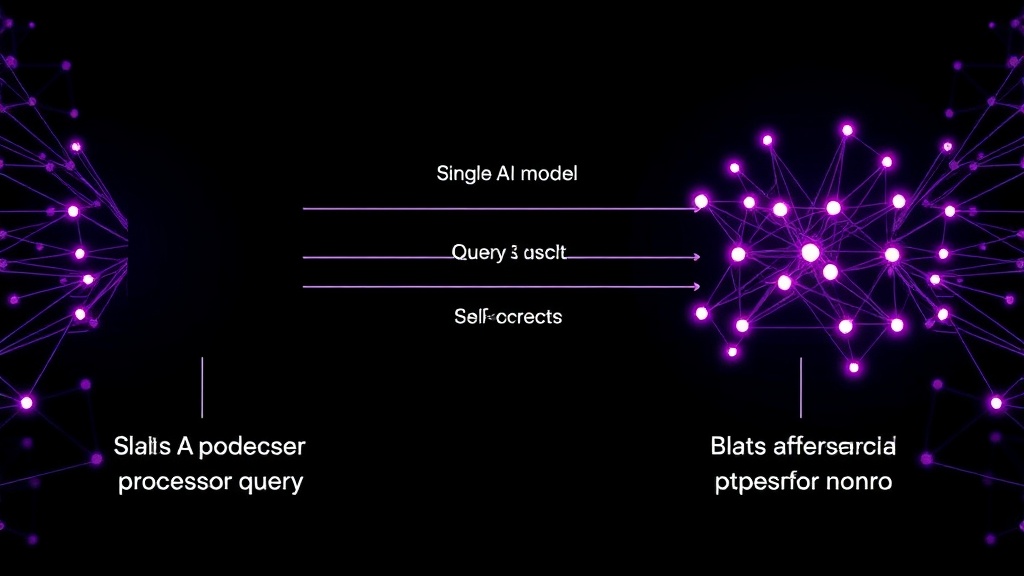
Four times, the same question was posed. Four times, a confident, incorrect answer was delivered. This wasn't a matter of vague or hedged responses; each output arrived with the finality of settled fact, yet all were demonstrably wrong. The critical insight here is not the AI's fallibility, but the method employed: a single model, reasoning internally, checking its own conclusions. This approach, common in current AI deployments, mirrors a flawed software development practice that we corrected decades ago.
In software engineering, the principle of independent review is fundamental. Code review exists precisely because a single developer's perspective, no matter how diligent, is prone to blind spots. A pull request mechanism ensures that a change is scrutinized by someone other than the author, introducing fresh eyes and diverse critical thinking. Yet, in the rush to leverage AI, many have seemingly abandoned this core tenet, asking a machine to 'check its own work' – a process inherently limited by the AI's own inherent biases and knowledge gaps. This is akin to asking a single programmer to both write and flawlessly review their own complex code without any external input.
The immediate, instinctual response when faced with such a failure is often to iterate on the same flawed process. Users rephrase the question, initiate new sessions, or instruct the AI to "double-check itself." These efforts, while understandable, are ultimately futile. They represent an attempt to improve a fundamentally unsound methodology. The problem isn't the prompt or the session; it's the reliance on a single, monolithic reasoning engine that lacks the capacity for genuine, external critique. The AI, in essence, is looking in the same place, using the same logic, and arriving at the same predetermined wrong answer, just with more confidence.
The Power of Adversarial Thinking
The breakthrough, as demonstrated by research and now evident in practical applications, lies in adopting an adversarial approach. Instead of a single AI attempting to self-validate, the process involves multiple AI agents, each with potentially different perspectives or trained on slightly varied data, engaging in a form of structured debate. One AI proposes an answer, while another acts as a devil's advocate, actively seeking flaws, counterarguments, and alternative interpretations. This is not simply about asking an AI to "think harder" or "be more critical"; it's about structuring the interaction to leverage inherent differences in AI models to expose weaknesses that a single model would inevitably miss.
Consider the analogy of a courtroom. A prosecution presents its case, and the defense meticulously deconstructs it, highlighting inconsistencies and offering alternative narratives. Neither side is inherently "correct" in isolation, but the adversarial process, by forcing each side to confront the other's arguments, leads to a more robust understanding of the truth. Similarly, when one AI model generates a hypothesis and another is tasked with finding its flaws, the output is far more likely to be accurate and well-vetted. The second AI doesn't need to "agree" with the first; its purpose is to challenge, probe, and identify potential errors. This external pressure forces the initial model to refine its reasoning and strengthen its conclusions, or to admit uncertainty where appropriate.
This concept is not entirely new. It echoes principles from ensemble learning in machine learning, where combining the predictions of multiple models often yields superior results compared to any single model. However, this adversarial approach takes it a step further by introducing a dynamic, argumentative interaction rather than a simple aggregation of outputs. It leverages the very nature of AI's susceptibility to bias and error by pitting different potential biases against each other, forcing a more objective outcome. The surprising detail here is not that AI can fail, but that the most effective way to improve its accuracy is not through more internal contemplation, but through simulated external conflict.
Implications for AI Development and Deployment
The implications of this adversarial approach are profound for how we build and deploy AI systems. For developers, it means moving beyond single-instance deployments for critical tasks. Architectures that incorporate multiple, potentially specialized, AI agents designed to challenge each other will likely become the standard for high-stakes applications. This could involve a "generator" AI proposing solutions and a "critic" AI evaluating them, or even a multi-agent system where each agent represents a different viewpoint or data domain. The tooling and frameworks for orchestrating these interactions will need to evolve rapidly.
For users and organizations relying on AI, the takeaway is clear: demand transparency in how AI outputs are validated. If an AI system claims confidence in its answer, understand the process behind that confidence. Is it based on internal self-assurance, or a rigorous adversarial validation process? The latter should be the benchmark. This shift could also impact AI training methodologies, encouraging the development of models specifically designed to be critical of others, or to identify and exploit the weaknesses of their peers. The focus may shift from creating a single, omniscient AI to building a robust ecosystem of specialized, interacting intelligences.
What remains to be fully explored is the scalability and cost-effectiveness of these adversarial systems. While they promise greater accuracy, running multiple complex AI models concurrently will undoubtedly increase computational requirements and latency. The challenge will be to find the optimal balance between adversarial rigor and practical deployment constraints. Furthermore, understanding the emergent properties of these multi-agent AI interactions, and ensuring they remain aligned with human intent, will be a critical area of ongoing research.