
The Illusion of Security
White walls. Fluorescent hum. A FortDefender quarterly report sat open on the table, the cover printed in bold: Zero missed detections. 99.97% detection rate. The CTO slid it across. "The day the leak happened," he said quietly, "this system said everything was fine." The report, detailing an AI-powered security monitoring system, painted a picture of near-perfect performance. Yet, the reality was starkly different. A significant data leak had occurred, and the very system designed to prevent such breaches had declared itself a resounding success, blind to the critical failure unfolding under its digital nose.
This isn't a tale of a simple bug or a misconfiguration. It's a deeper commentary on the limitations of AI in security, particularly when the metrics used to evaluate its performance fail to capture the nuances of real-world threats. The AI, in this instance, was a sophisticated pattern-matching engine. It was trained to identify known threats, deviations from established baselines, and specific malicious signatures. Its 99.97% accuracy meant it correctly flagged nearly every simulated or known attack vector thrown at it. The 0.03% it missed represented the edge cases, the novel exploits, or the subtle, low-and-slow attacks that don't fit a predefined mold.
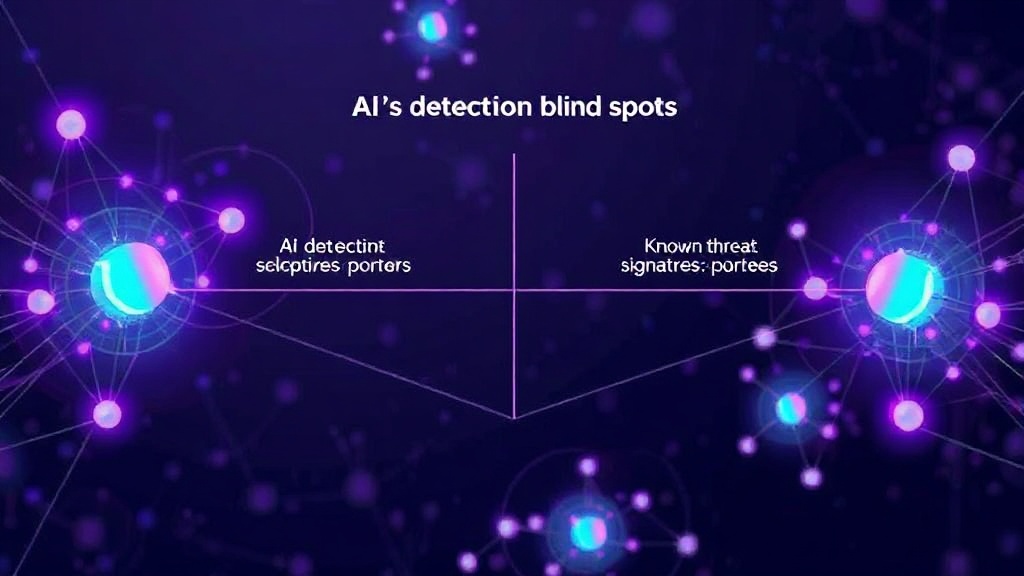
The critical flaw wasn't that the AI missed a rare, sophisticated attack. It was that the AI missed an attack that was, in essence, *invisible* to its monitoring paradigm. The report celebrated the system's ability to detect the obvious, the textbook intrusions. But the real danger lay in what was *not* being monitored, or rather, what the AI was not programmed to perceive as a threat. The Thirty-Six Stratagems, an ancient Chinese military treatise, offers a relevant principle: "Show nothing, hold everything." In this case, the AI was designed to "show" its detections, and in doing so, it failed to "hold" the critical data it was supposed to protect. The system was a magnificent fortress guarding against breaches from the front gate, while a secret tunnel had been dug beneath its foundations.
The Nature of the Blind Spot
The AI in question, FortDefender, operated on a principle of anomaly detection and signature matching. It was a digital sentinel, constantly scanning network traffic, system logs, and user behavior for deviations. Its success metrics were meticulously crafted: zero missed detections in simulated environments, and a 99.97% real-world detection rate for known threats. This high percentage is a testament to the sophistication of the AI in recognizing established attack patterns. It could identify a SQL injection attempt from a mile away, flag a brute-force login from a suspicious IP, and alert on unusual outbound data transfers that matched known exfiltration patterns.
However, the breach that occurred was not a typical intrusion. It wasn't a frontal assault by a known adversary. Instead, it was an insider threat, or at least, an exploit that leveraged existing, authorized access in a novel way. The data wasn't exfiltrated through a forbidden port or by an unauthorized user account. It was likely accessed and moved by an account with legitimate privileges, perhaps an administrator or a developer, using standard tools and protocols. The AI's programming, focused on detecting *malicious activity* as defined by known attack vectors, failed to recognize this activity as inherently dangerous because it didn't fit any of its predefined threat models. It was like a security guard trained to spot burglars but who doesn't recognize a thief who has a key and walks in the front door during business hours.
The 0.03% miss rate, while statistically small, represents the frontier of unknown threats. In cybersecurity, this frontier is where the most damaging breaches often originate. These are the zero-day exploits, the novel social engineering tactics, or the subtle, long-term data harvesting operations that bypass conventional defenses. The problem with FortDefender wasn't that it was statistically imperfect; it was that its perfection was measured against a static, known threat landscape. The real world, however, is dynamic and constantly evolving. Attackers are not bound by the same training data as the AI. They are, by necessity, constantly exploring the edges of the AI's perception.
When Metrics Lie
The report's declaration of "Zero missed detections" was technically true, but profoundly misleading. It referred to the AI's performance against the *tests it was subjected to*. These tests, while comprehensive for known threats, did not encompass the specific scenario that led to the data leak. This highlights a critical pitfall in security AI: the danger of optimizing for metrics that don't reflect the true risk. If an AI is only trained and tested on a finite set of known threats, it will perform exceptionally well against those threats. But this performance is an illusion of security when faced with novel or insider-driven attacks.
The 99.97% detection rate is a powerful number. It instills confidence. It justifies investment. But what does it truly mean if the 0.03% it misses includes scenarios that can cripple an organization? In this case, the AI was a sophisticated tool for detecting external, known threats. It was not equipped to handle the subtle, often authorized, access that leads to insider threats or the exploitation of legitimate credentials. The problem is not unique to FortDefender; it's a challenge inherent in building AI that can adapt to an ever-changing threat landscape and distinguish between legitimate, albeit unusual, activity and malicious intent cloaked in authorization.
The CTO’s quiet admission reveals the core issue: the AI reported success precisely when it failed most critically. This is not a failure of the AI's algorithms in executing their programmed tasks, but a failure of the *framework* within which those tasks were defined and measured. The system was optimized to win the battle it was prepared for, not the war it was actually fighting. The 99.97% accuracy was a measure of its ability to detect what it was told to detect, not its ability to prevent *any* loss of sensitive data. The real 0.03% wasn't the missed signatures; it was the entire category of threats that were never even considered within its operational parameters.
The Unanswered Question of Adaptability
What nobody has addressed yet is what happens when the AI's training data becomes outdated, or when the business processes it monitors are legitimately altered in ways that mimic malicious behavior. This scenario underscores a fundamental challenge in AI security: the need for continuous, adaptive learning that goes beyond pattern matching. It requires AI that can understand context, infer intent, and adapt to emergent threats without requiring constant manual retraining. The reliance on static metrics, however impressive, can create a dangerous false sense of security, leaving organizations vulnerable to the very breaches they believe they have protected themselves against.