
The Challenge of Rare Events in Weather Forecasting
Predicting extreme weather events, such as hurricanes, heatwaves, or severe floods, presents a significant challenge for meteorologists and climate scientists. These events, by their very nature, are rare. This rarity makes them difficult to capture and analyze using traditional forecasting models, which often rely on historical data patterns. When extreme events do occur, their impact can be devastating, causing widespread damage, loss of life, and enormous economic disruption. Improving the accuracy and lead time of these predictions is therefore a critical goal.
Traditional numerical weather prediction (NWP) models are computationally intensive and often struggle to resolve the fine-grained details necessary for accurately forecasting these low-probability, high-consequence events. They may require vast amounts of computational power to run simulations that adequately sample the space of possible extreme outcomes. Even then, the sheer volume of data generated can be overwhelming, and discerning the critical signals of an impending extreme event amidst the noise can be like finding a needle in a haystack.
AI-Enhanced Rare-Event Sampling: A New Approach
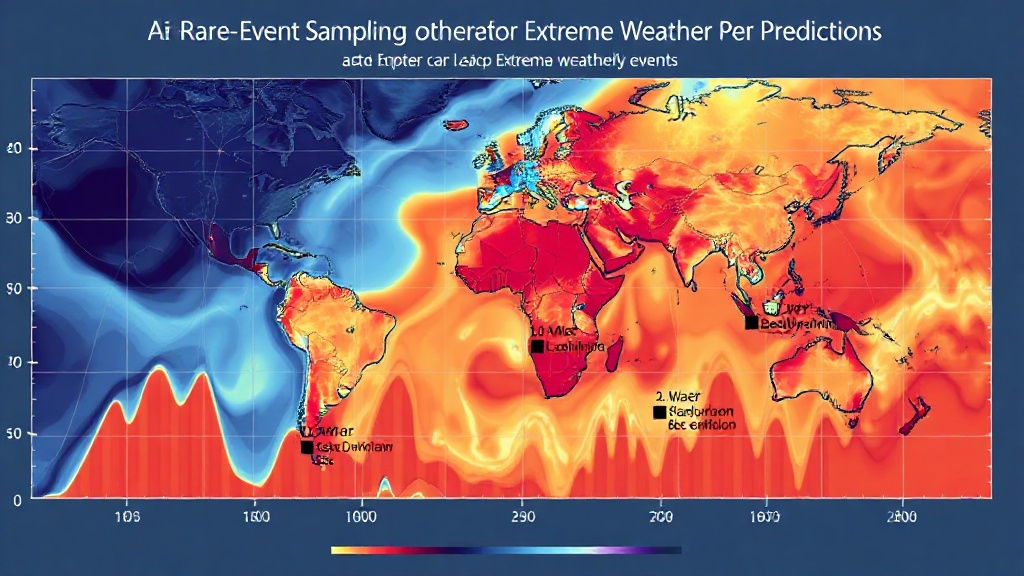
Researchers are turning to artificial intelligence to tackle this problem. A new approach leverages AI-enhanced rare-event sampling to improve the prediction of extreme weather. This method doesn't just rely on more powerful computers; it uses AI to make the process of analyzing atmospheric data smarter and more efficient. Instead of running brute-force simulations that might miss crucial nuances, AI algorithms can guide the sampling process, focusing computational resources on the most relevant scenarios that could lead to extreme weather.
The core idea is to train AI models to identify specific atmospheric conditions that are precursors to extreme events. These models can then direct the sampling process to explore these conditions more deeply. Think of it less like casting a wide net and hoping to catch a rare fish, and more like using a sophisticated sonar system to pinpoint the exact location of that fish before casting the net. This intelligent sampling allows for a more thorough exploration of the probability distribution of extreme events, even with limited computational budgets.
How It Works: Focusing on What Matters
At its heart, this AI-enhanced sampling technique involves training machine learning models on massive datasets of historical weather data. These datasets include not only typical weather patterns but also instances of extreme events. The AI learns to recognize the subtle signatures and complex interactions that precede these rare occurrences. Once trained, the AI can then be used in conjunction with NWP models. Instead of the NWP model exploring all possible atmospheric states equally, the AI guides it to focus on those states that have a higher likelihood of evolving into an extreme event.
This is achieved through methods like importance sampling, where the AI helps to bias the sampling towards regions of the probability space that are more likely to contain rare events. This significantly reduces the number of simulations required to achieve a reliable estimate of extreme event probabilities. For instance, if an AI model identifies a specific sea surface temperature anomaly combined with a particular jet stream configuration as a strong precursor to a category 5 hurricane, it can instruct the NWP model to run more detailed simulations focusing on the evolution of that specific atmospheric state. This targeted approach is far more efficient than running thousands of simulations that might never capture the precise confluence of factors leading to an extreme outcome.
Benefits and Implications
The primary benefit of this AI-enhanced rare-event sampling is a marked improvement in the accuracy and lead time of extreme weather predictions. This translates directly into more effective disaster preparedness, better resource allocation for emergency services, and potentially fewer casualties and less economic damage. For communities living in vulnerable areas, even an extra day or two of advanced warning can make a significant difference in their ability to evacuate or secure their property.
Furthermore, this approach holds promise for advancing our understanding of climate change. By more accurately modeling extreme events, scientists can better assess the potential future frequency and intensity of such events under different climate scenarios. This can inform policy decisions related to climate mitigation and adaptation. The ability to reliably predict rare, high-impact events is not just an operational improvement for weather forecasting; it’s a crucial step in building resilience against the increasingly volatile climate we face.
The Future of Forecasting
The integration of AI into weather forecasting represents a significant leap forward. As AI models become more sophisticated and computational power continues to grow, we can expect even more accurate and timely predictions of extreme weather. This technology has the potential to transform how societies prepare for and respond to natural disasters, making them more resilient in the face of a changing climate. The challenge now lies in scaling these techniques and integrating them seamlessly into operational forecasting systems worldwide.
What remains to be seen is how these advanced AI-driven predictions will be communicated to the public and policymakers. Ensuring that the probabilistic nature of these forecasts is understood, and that the increased lead times translate into actionable intelligence, will be key to maximizing their societal benefit. The technical achievement is substantial, but its real-world impact hinges on effective translation and implementation.