The Cumulative Problem of Character Drift
Generating a single, plausible illustration of a child from a reference photo is now a relatively straightforward task for modern AI image generation models. The real challenge emerges when attempting to produce a sequence of illustrations—say, twenty-four pages for a picture book—where the same character must appear consistently across different scenes and poses, without any noticeable degradation or change. This is where the subtle, yet pervasive, issue of ‘drift’ becomes critically apparent.
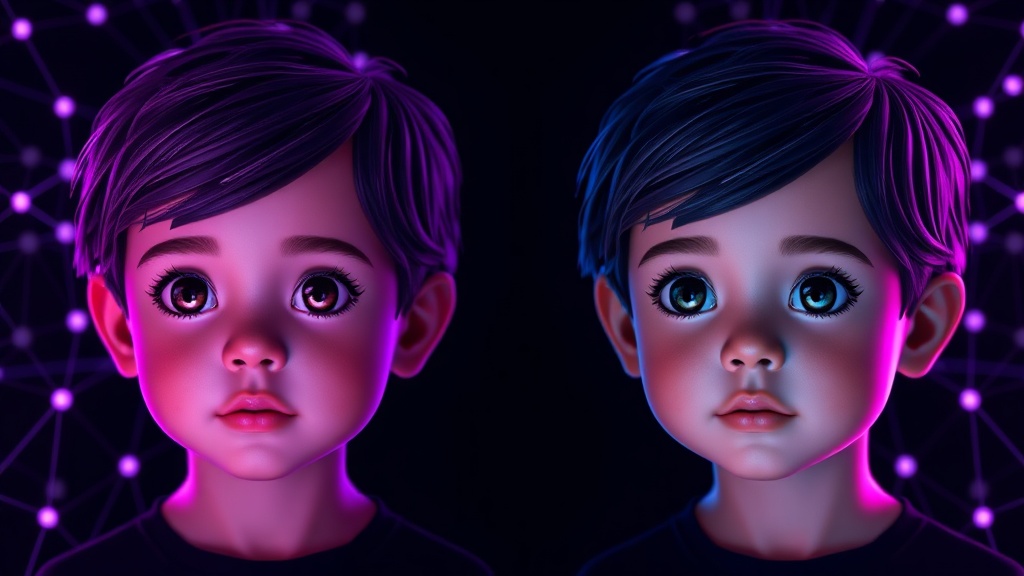
When each page is generated in isolation, the results might individually appear acceptable. However, when these pages are placed in sequence, the cumulative effect of drift becomes undeniable. A child might appear to age three years between page 4 and page 11, their hair length might change inexplicably, or the shape of their nose could subtly wander. While no single page might betray these inconsistencies, the book as a whole, consumed as a narrative sequence, highlights these compounding errors in a way that simple single-image quality metrics fail to capture. The reader’s immersion is broken, and the believability of the story falters.
This phenomenon is not unique to children’s characters; it applies to any character or object intended to remain consistent throughout a longer visual narrative. The sequential nature of storytelling amplifies even minor deviations, making consistency a paramount concern for AI-generated visual content intended for narrative use.
Distinguishing Identity from Style Consistency
To effectively combat drift, it is crucial to separate the concepts of identity consistency and style consistency. These are distinct problems with different underlying causes and, consequently, require different solutions.
Identity consistency refers to whether the character is recognizably the same individual across all generated images. This is primarily driven by the strength and application of the reference embedding used in the generation process. A stronger weighting of the reference embedding, applied judiciously, helps anchor the character’s core features. However, over-weighting can lead to a loss of flexibility, making it difficult to generate diverse poses or expressions. Conversely, too weak a weighting allows the character’s features to diverge too easily.
Style consistency, on the other hand, pertains to the overall aesthetic and artistic rendering of the images. This includes elements like color palette, brushstroke texture, lighting, and composition. While important for a cohesive visual experience, style drift does not necessarily mean the character itself is unrecognizable. A character might retain its identity but appear in a scene rendered with slightly different lighting or a different artistic filter, leading to a jarring, yet not identity-breaking, inconsistency.
The interplay between these two forms of consistency is complex. A technique that improves identity consistency might inadvertently affect style consistency, and vice versa. For instance, aggressively enforcing identity might lead to a rigid, less artistic style, while prioritizing a highly dynamic style could allow identity to waver.
Strategies for Enhancing Identity Consistency
Addressing identity drift requires a multi-pronged approach, focusing on how the AI model interprets and applies reference information.
One primary method involves fine-tuning the weighting of the reference embedding. This embedding, derived from a source image, acts as the AI's blueprint for the character. Experimentation is key to finding the optimal balance: strong enough to maintain recognizability, but not so strong as to prevent natural variations in expression and pose. Techniques like adjusting the ‘denoising strength’ or ‘guidance scale’ during generation can also influence how closely the output adheres to the reference.
Another effective strategy is the use of LoRAs (Low-Rank Adaptation) or textual inversion. These methods allow for more precise control over character representation by training smaller, specialized models or embeddings that capture the character's essence more robustly than a generic prompt alone. By training a LoRA on a set of images of the desired character, the AI can then generate new images that consistently adhere to that specific character's features, even in novel situations.
Prompt engineering also plays a vital role. Crafting detailed prompts that consistently describe the character’s key features (hair color and style, eye color, specific facial marks, build) can reinforce identity. However, relying solely on text prompts is often insufficient for high-fidelity consistency across many images.
Achieving Style Consistency
Style consistency is often more manageable but equally important for a polished final product. This involves ensuring that the artistic rendering remains uniform.
Using a consistent seed value across generations can help maintain a similar underlying noise pattern, which can lead to more consistent stylistic elements, especially when combined with other control mechanisms. However, this alone does not guarantee style consistency.
A more potent method is employing style-referencing techniques. This can involve using a style-transfer model or providing a style reference image alongside the character reference. Some advanced AI image generation platforms allow for the explicit definition of a style, which the model then attempts to replicate across all outputs. This might involve specifying artistic mediums (e.g., watercolor, oil painting), artists’ styles (e.g., in the style of Beatrix Potter), or even specific color palettes.
Consistency in lighting and composition can also be controlled through detailed prompting or using control networks like ControlNet, which can enforce similar poses, camera angles, and lighting conditions across generated images. For a picture book, specifying a consistent light source direction and time of day can significantly enhance stylistic cohesion.
The Unanswered Question: Scalability and Workflow
While these techniques offer promising avenues for improving character consistency in AI-generated narratives, a significant question remains: how scalable are these methods for professional, high-volume content creation? The current workflows often involve considerable manual iteration, prompt tweaking, and post-generation editing. For a small project, this might be feasible. But for a studio aiming to produce an entire series of books or a feature-length animated film, the time and computational resources required for such meticulous control could become prohibitive. What are the optimal workflows and tools that will allow creators to leverage AI for consistent character generation at an industrial scale, without sacrificing artistic integrity or incurring prohibitive costs?
Conclusion: The Future of AI-Driven Visual Storytelling
The ability to generate consistent characters across extended visual narratives is a frontier in AI image generation. It moves beyond the novelty of single impressive images to the demanding requirements of sequential storytelling. By understanding and addressing the distinct challenges of identity and style consistency, creators can begin to harness AI for more complex narrative projects. While the current methods require careful management and often manual intervention, ongoing research into specialized embeddings, fine-tuning techniques, and control mechanisms promises to make AI a more robust tool for visual storytellers. The journey from generating one plausible image to crafting an entire, coherent visual story is arduous, but the progress made suggests a future where AI plays an increasingly integral role in bringing narratives to life.