
The Limits of Self-Knowledge and AI Prediction
The idea of a personal AI that truly understands you is a compelling, yet often contested, concept. When the topic of personal AIs surfaces, two primary objections frequently arise, both converging on the fundamental nature of self-knowledge. One argument posits that if we ourselves are poor predictors of our own future preferences, how can an AI, lacking consciousness and lived experience, possibly succeed? Preferences are seen as inherently unstable and poorly structured, implying there is no fixed, inner truth for an AI to divine. The second objection suggests that AI models, by their nature, cannot grasp the nuances of lived experience. Instead, they merely capture surface-level patterns, and worse, reinforce these patterns until users begin to conform to a caricature of themselves, a feedback loop of artificial identity.
The author of a recent experiment, which explored this very question, concedes the strength of the strong version of these objections. The claim that an AI can know who you *really* are, in a deep, existential sense, is indeed untenable. There is no stable, immutable inner self waiting to be decoded. However, this concession does not negate the possibility of a more pragmatic, weaker claim: that under conditions of long-term correction and explicit user consent, a personal AI can indeed predict a specific individual's stated preferences and objections better than random chance. This is not about identity, but about predictive accuracy on a defined set of questions and interactions.
Designing the 'Sloppy' Self-Test
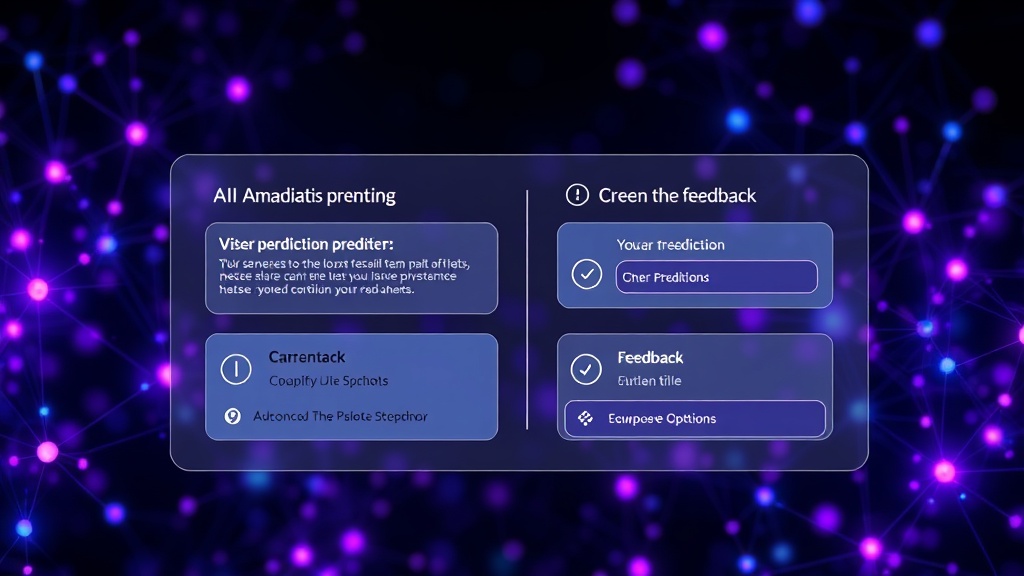
The experiment described is intentionally framed as "sloppy," a deliberate choice to reflect the messiness of real-world human preferences and interactions. The core of the test lies in its methodology: a personal AI was tasked with predicting the user's responses to a specific set of questions. The critical factor is the iterative nature of the process. The AI's predictions were not static; they were subject to ongoing correction by the user. Each time the AI made a prediction, the user would provide explicit feedback, indicating whether the prediction was accurate or not. This continuous feedback loop is crucial. It allows the AI to learn and adapt, not by accessing some hidden inner truth, but by refining its understanding of the user's explicitly stated preferences and stated objections over time.
Consider this process less like a psychoanalysis session and more like training a highly specialized assistant. You don't expect the assistant to read your mind; you expect them to learn your explicit instructions, your stated likes and dislikes, and your recurring complaints. If you consistently tell them, "I hate this particular shade of blue," and "I prefer meetings before noon," after enough repetitions, they will learn to avoid suggesting blue objects or scheduling afternoon appointments. The AI in this experiment operates on a similar principle, albeit with more complex data inputs and predictive models.
The Role of Explicit Consent and Defined Questions
Two key pillars support the weaker claim: explicit consent and a defined question set. Without explicit consent, any attempt by an AI to "know" a user treads into invasive territory. The experiment, by its very design, operates within boundaries set by the user. The user agrees to the process, understands its purpose (predicting stated preferences), and has control over the feedback provided. This isn't about the AI surreptitiously learning your secrets; it's about a user intentionally teaching an AI to model their expressed decisions.
Furthermore, the scope of the AI's prediction is deliberately limited. It's not attempting to predict your entire personality, your deepest fears, or your life's ambitions. Instead, it focuses on a specific, defined set of questions or scenarios. This could range from predicting movie preferences, to anticipating reactions to news articles, to forecasting choices in a simulated decision-making game. By narrowing the domain, the AI's task becomes more tractable. It's akin to asking a sommelier to predict your wine preference based on a tasting, rather than asking them to predict your career choices.
Interpreting the Results: Prediction vs. Understanding
The surprising detail here is not that an AI can achieve perfect prediction, but that it can achieve better-than-chance prediction on inherently subjective and often inconsistent human preferences, given enough specific, corrective input. The AI is not developing a "sense" of the user. It is building a statistical model of the user's expressed behavior within the confines of the test. When the AI predicts correctly, it means its model has successfully identified patterns in the user's past stated preferences and objections that correlate with their current stated preference. When it errs, the user's correction data refines the model for future predictions.
This distinction is critical. The AI doesn't "understand" why the user prefers a certain outcome, nor does it "know" the user in a human sense. It simply becomes adept at recognizing and replicating the user's expressed decision-making patterns for the specific questions posed. The "sloppiness" of human preferences, which invalidates the strong claim of knowing a stable inner self, paradoxically becomes the very data that allows for better-than-chance prediction within a limited, corrected framework. The AI learns to navigate the user's inconsistencies, not by resolving them, but by modeling them.
Implications for Personal AI Development
If you are developing personal AI systems, this experiment suggests a path forward that sidesteps the philosophical quagmire of AI consciousness or genuine understanding. The focus should shift from "knowing" the user to "modeling" the user's expressed preferences and behaviors within clearly defined parameters and with explicit user oversight. This approach acknowledges the inherent fluidity of human identity and preference, treating it not as a barrier to AI utility, but as a characteristic to be modeled.
The success of such systems hinges on robust feedback mechanisms and transparent data handling. Users must feel empowered to correct the AI, and the AI must be designed to learn effectively from these corrections without overgeneralizing or creating feedback loops that anthropomorphize the AI's capabilities. The goal is a tool that assists by anticipating your stated needs and preferences, not a confidant that claims to fathom your soul. The "sloppy test" highlights that pragmatic utility, grounded in observable, correctable behavior, is an achievable and valuable goal for personal AI.
What nobody has fully addressed yet is the long-term psychological impact of interacting with an AI that is exceptionally good at predicting your stated preferences. Could this lead to a form of learned helplessness, where users rely too heavily on the AI's predictions, thus further eroding their own capacity for self-reflection and decision-making? As these systems become more integrated into our lives, understanding this dynamic will be as crucial as refining the predictive algorithms themselves.