
The Limits of the Single AI Assistant
The current landscape of AI tools is dominated by the concept of a singular assistant. Whether it's a chatbot for general queries, a coding copilot, or a writing aid, most users interact with one AI at a time, performing a specific set of tasks. This mirrors an early stage of human organizational development where a single individual might wear multiple hats. However, as businesses mature and scale, they inevitably develop specialized roles and teams. This fundamental difference between how humans organize and how we currently deploy AI is the fertile ground for a new paradigm: the AI organization.
The idea is simple yet profound: instead of a monolithic AI assistant trying to cover all bases, imagine a structured network of specialized AI agents, each with a defined role and responsibility, much like a human company. This approach acknowledges that complex tasks and organizational structures require more than a one-size-fits-all solution. A startup, for instance, has distinct departments like engineering, product, design, marketing, and sales, each with its own set of challenges and requiremen
Introducing the AI Organization Framework
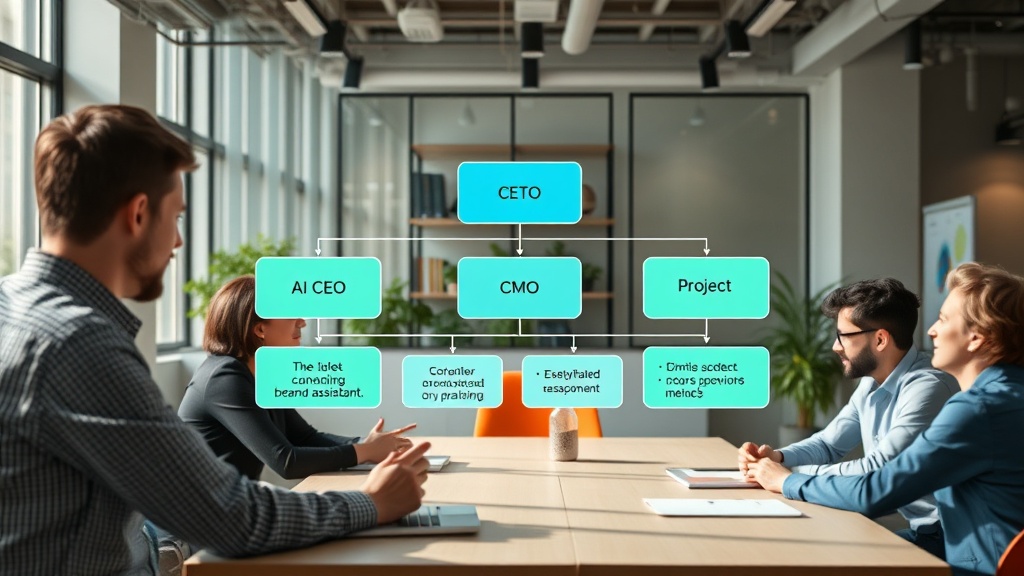
Consider a company structure. At the top, you might have an AI CEO, an AI CTO, an AI CMO, and an AI CFO. These high-level agents would be responsible for strategic decision-making, resource allocation, and overall company direction. Below this executive layer, projects would be managed by dedicated AI teams. For example, 'Project A' could have an AI Product Manager, an AI Engineer, an AI Designer, and an AI Marketing specialist. Each of these roles would be trained and optimized for their specific domain, allowing for deeper expertise and more efficient task execution.
This tiered structure allows for a division of labor that mirrors human organizations. The AI Product Manager for Project A would focus solely on defining the product roadmap, user stories, and feature prioritization for that specific project. The AI Engineer would concentrate on the technical implementation, code generation, and debugging. The AI Designer would handle UI/UX concepts, while the AI Marketing specialist would craft go-to-market strategies and promotional content. This specialization prevents the cognitive overload that a single, general-purpose AI might experience when tasked with such diverse responsibilities.
The Benefits of Specialization
The primary advantage of an AI organization lies in its potential for enhanced efficiency and effectiveness. By assigning specific roles to AI agents, each agent can be fine-tuned with domain-specific data and objectives. This deep specialization means that an AI Engineer agent, for instance, would possess a more profound understanding of coding best practices, debugging techniques, and relevant programming languages than a general-purpose AI. Similarly, an AI Marketing agent could be optimized for content creation, SEO optimization, and campaign analysis, leading to superior marketing outcomes.
This modular approach also facilitates better collaboration and delegation. An AI CEO could delegate a strategic initiative to the AI CTO, who could then assign specific tasks to AI Engineers and AI Researchers. The AI Product Manager could then provide feedback on the technical feasibility and market fit. This creates a dynamic workflow where AI agents interact and collaborate, much like human teams, but with the potential for much faster iteration cycles. It’s less like a single, overwhelmed personal assistant and more like a well-oiled machine with specialized parts, each performing its function optimally.

Addressing Complexity and Scalability
The current single-assistant model struggles with complexity. As projects grow and stakes get higher, asking a single AI to manage everything from strategic vision to granular execution becomes increasingly untenable. An AI organization, conversely, is inherently scalable. New projects can be spun up with their own dedicated AI teams, and existing teams can be expanded or reconfigured as needed. This mirrors the agility of human organizations, allowing for rapid adaptation to market changes and business needs.
Furthermore, this structure allows for better accountability and performance tracking. Each AI agent, with its defined role, can have its performance measured against specific Key Performance Indicators (KPIs). If an AI Marketing agent is underperforming in campaign engagement, its metrics can be analyzed, and its training or parameters can be adjusted without affecting other parts of the organization. This granular control is difficult to achieve with a single, all-encompassing assistant.
The Unanswered Question: Inter-Agent Communication and Orchestration
While the concept of an AI organization is compelling, a significant challenge remains: effective inter-agent communication and orchestration. How do these specialized AI agents communicate seamlessly? What protocols govern their interactions? Developing robust frameworks for AI agents to understand each other's outputs, negotiate tasks, and resolve conflicts will be critical. This is more than just API calls; it requires a sophisticated layer of AI-to-AI understanding and coordination. The success of this paradigm hinges on solving this complex orchestration problem, turning a collection of specialized AIs into a cohesive, functional organizational unit.
Building the Future of AI Collaboration
The transition from single AI assistants to AI organizations represents a significant evolution in how we leverage artificial intelligence. It moves beyond treating AI as a simple tool and positions it as a partner in complex, structured endeavors. For developers, this opens up new avenues for building sophisticated AI platforms and agent frameworks. For businesses, it promises a future of unprecedented operational efficiency and scalability. The journey from individual AI tools to a fully realized AI organization is underway, and its implications for productivity and innovation are vast.