The Limits of a Single Agent
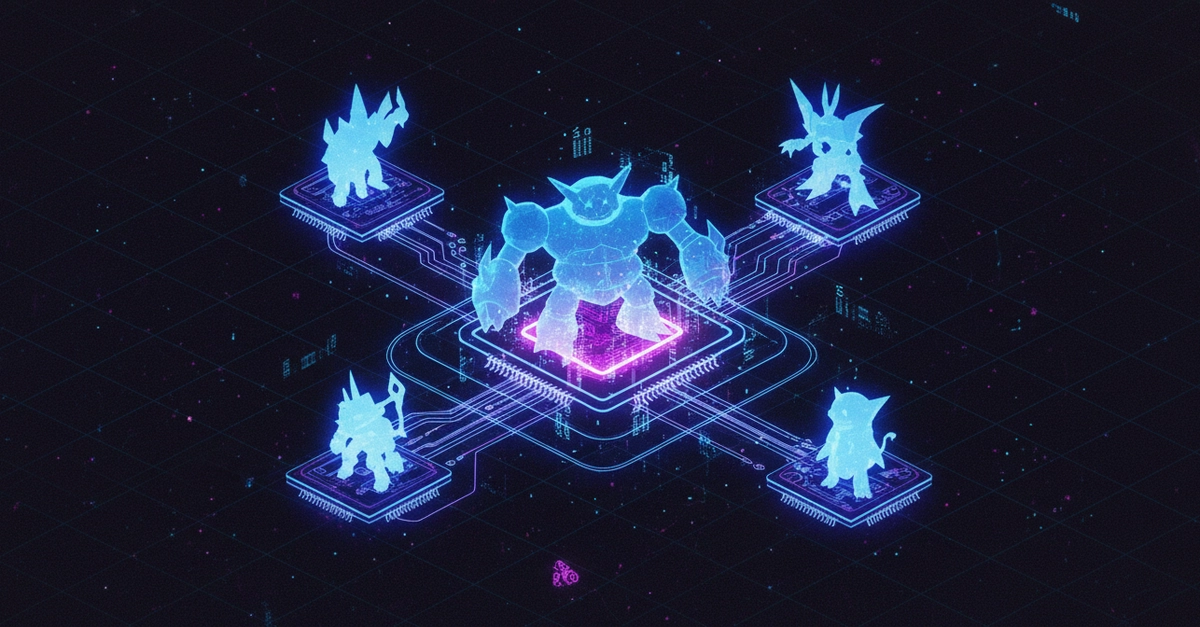
The initial iteration of an AI orchestration system, as explored in previous installments, often relies on a single, powerful orchestrator. This setup, akin to a singular, highly capable Pokémon like Metagross, can effectively route tasks to specialized agents for specific functions. However, this centralized model quickly encounters limitations when faced with the reality of a rapidly expanding workflow and a growing number of edge cases. What seemed sufficient for a core set of tasks begins to buckle under the weight of unforeseen complexities.
The core problem arises when the system's scope expands beyond its original design. New tasks emerge that don't neatly fit into the predefined roles of the existing agents. These gaps, often revealed by edge cases or novel problem types, necessitate the introduction of new, specialized agents. This is where the concept of scaling a Pokémon team becomes a fitting analogy: you can't expect a single Pokémon to master every type of battle or solve every puzzle. You need a diverse roster.
Expanding the Roster: Introducing New Specialists
To address these emerging needs, the system must evolve by incorporating new agents, each trained for a specific niche. In this context, new "Pokémon" are added to the team to fill the functional gaps.
Genesect, for instance, is introduced as a dedicated coding agent. Its responsibilities include writing code, debugging, explaining complex stack traces, and performing code reviews. This specialization offloads intricate coding tasks from the general orchestrator, allowing it to focus on higher-level coordination. Genesect's presence means that when a coding-related task arises, it is directed to the agent best equipped to handle it, ensuring efficiency and accuracy.
Complementing Genesect is Scizor, an adversarial agent. Scizor's role is to challenge the output of other agents, particularly in code generation and review. This constructive tension is vital for improving the quality and robustness of the AI system. By acting as a digital sparring partner, Scizor helps identify potential flaws, security vulnerabilities, or inefficiencies that might otherwise go unnoticed. This adversarial approach is not about finding fault but about rigorous validation, pushing the system towards more resilient solutions.
Infrastructure Upgrades for Scale
The rapid growth and the addition of new agents don't just require functional expansion; they demand significant infrastructure changes. The original design, optimized for a smaller team, may not support the increased load, data flow, and inter-agent communication required by a larger, more complex system. This is analogous to upgrading the facilities at a Pokémon League to accommodate a growing number of trainers and their diverse teams.
One critical area for improvement is the shared journal. In a scaled system, this journal becomes the central repository for all agent activities, decisions, and outcomes. It's not merely a log; it's a dynamic record that facilitates context sharing, debugging, and auditing. As more agents interact and generate data, the journal needs to be more sophisticated, potentially incorporating versioning, advanced search capabilities, and structured data formats to prevent information overload and ensure that relevant context is always accessible.
The circuit breaker pattern, previously implemented, also requires refinement. In a larger system with more interdependencies, the circuit breaker's role becomes even more critical. It must be able to detect failures not just in individual agent calls but in complex chains of interactions. The thresholds for tripping the breaker may need to be adjusted dynamically based on the system's current load and the criticality of the tasks being performed. This prevents cascading failures, ensuring that a single agent's malfunction doesn't bring down the entire orchestration system.
Furthermore, the harness for verifying routing needs to evolve. With more agents and more complex routing logic, the harness must ensure that tasks are not only reaching the correct agent but are being processed according to the intended workflow. This might involve implementing more granular metrics for agent performance, latency, and success rates, and feeding this data back into the routing logic to optimize task distribution in real-time. The harness acts as the system's internal referee, ensuring fair play and adherence to rules.
Constructive Tension and Agent Collaboration
The concept of constructive tension between agents, introduced earlier, becomes even more pronounced and valuable as the team expands. This isn't about conflict but about creating a dynamic where agents challenge each other's outputs, leading to more robust and well-vetted results. For example, Genesect might generate code, and Scizor would then perform an adversarial review, identifying potential bugs or security flaws. The orchestrator, Metagross, then synthesizes these inputs, potentially directing further refinement based on the feedback.
This collaborative, yet challenging, environment requires sophisticated communication protocols. Agents need to clearly articulate their inputs, outputs, and the rationale behind their decisions. The orchestrator must be adept at interpreting these communications and mediating the interactions. The journal plays a crucial role here, providing a shared context for these dialogues.
What remains an open question is how to best model the 'personality' or 'specialization' of these AI agents to optimize collaboration without introducing unintended biases or bottlenecks. Simply assigning roles might not be enough; understanding the emergent behaviors of a large, diverse AI team is a frontier that requires further exploration.
The Future of AI Orchestration: A Growing Team
Scaling an AI system from a single orchestrator to a diverse roster of specialized agents is not merely an architectural upgrade; it's a fundamental shift in how we approach AI development and deployment. It mirrors the evolution of complex software systems, where modularity, clear interfaces, and robust infrastructure are paramount.
The Pokémon analogy serves as a useful heuristic: just as a trainer builds a balanced team to tackle any challenge, AI practitioners must build diverse, interconnected agent systems. The success of these systems hinges on thoughtful design, continuous refinement, and an infrastructure that can support increasing complexity. As AI becomes more integrated into our workflows, the ability to scale these systems effectively will be a key differentiator.
The journey from a single, powerful agent to a coordinated team of specialists highlights a critical trend: AI is becoming less about monolithic models and more about the intelligent composition and orchestration of smaller, specialized components. This shift enables greater flexibility, resilience, and adaptability, paving the way for more sophisticated and capable AI applications.