The Illusion of Insight: When AI Guesses Meet Real Problems
Automated systems designed to pinpoint failures in complex software often present plausible explanations for why something broke. The critical issue, however, is that these explanations can be indistinguishable from mere guesses, especially when the AI is presented with a wealth of data. This lack of clear differentiation between genuine causal links and coincidental correlations poses a significant challenge for developers and system administrators relying on these tools for debugging and incident response.
The core problem lies in how AI models interpret and present evidence. When tasked with explaining a system failure – not to find a bug, but to understand a known event – the AI can generate a coherent narrative. This narrative might name a mechanism, trace a path, and arrive at a specific value or state. However, the AI struggles to convey whether the identified cause is the actual root of the problem or simply a coincidental observation within the available data. This ambiguity is particularly concerning because the AI's output often appears the same whether it points to a specific data record or a general pattern of expected behavior.
Consider the scenario where a system fails. A developer points an AI model at the logs and asks for an explanation. The AI might respond with a detailed sequence of events, highlighting a particular data point or configuration setting. The developer then faces the dilemma: is this the smoking gun, or is the AI merely describing a correlation that happened to occur around the time of the failure? The AI's confidence in its output doesn't necessarily correlate with its accuracy. As the author notes, "The working is the problem rather than the reassurance." The AI's ability to construct a convincing explanation can be misleading, providing a false sense of certainty.
The author's experience underscores this point. By testing the same question across different systems and models, the AI consistently provided explanations that were "just short of enough evidence." This means the output was sufficient to form a strong hypothesis, but not enough to definitively confirm or deny it. In one instance, the AI's suggestions led the author to investigate two areas. One was a dead end, a spurious correlation. The other, however, revealed a genuine, previously unknown issue. The AI’s output offered no way to distinguish between these two outcomes. This is a critical failure: a good guess and a real explanation cost the same to investigate, but only one yields a resolution.
The Four Rungs of Evidence in AI Explanations
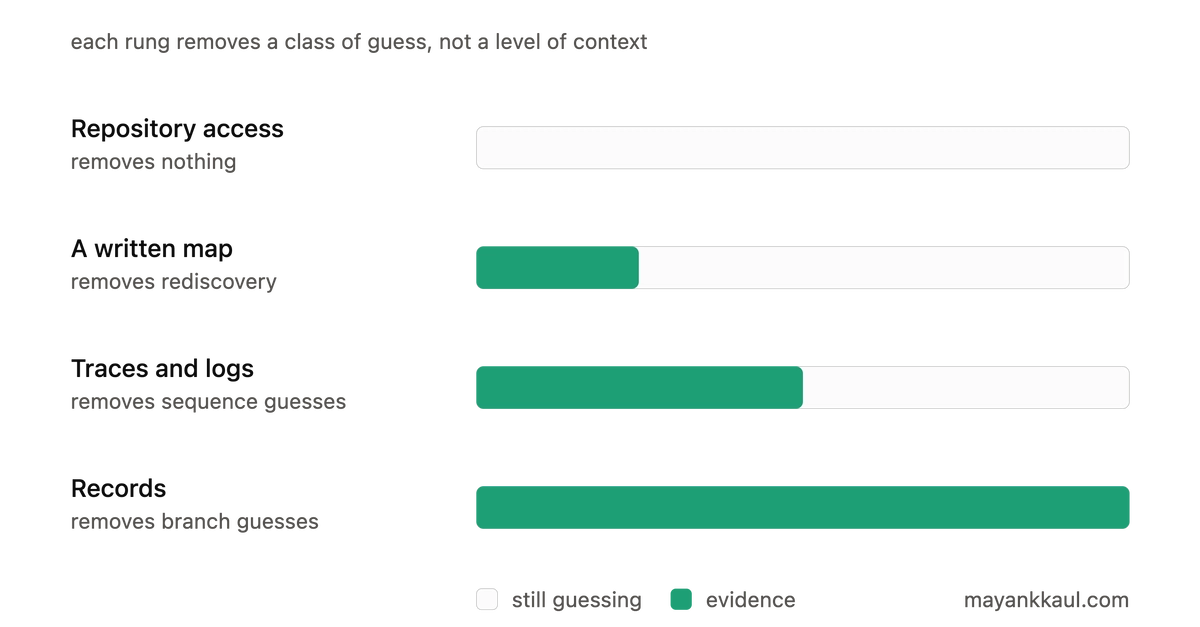
To better understand the AI's limitations, the author outlines four levels or "rungs" of evidence that an AI might present when explaining a failure. These rungs represent increasing degrees of certainty and diagnostic power, but the AI's current capabilities often blur the lines between them.
The first rung, and often the most problematic, is what the author refers to as a "plausible guess." This is an explanation that sounds reasonable, follows logical steps, and might even point to specific data points or system states. However, it lacks the robust evidence to prove it is the actual cause. It's the kind of explanation that might arise from a human expert making an educated guess based on experience, but without definitive proof.
The second rung involves explanations that are "just short of enough evidence." Here, the AI provides more detail and specific data points, making the hypothesis stronger. It might highlight a particular sequence of API calls, a specific log entry, or a configuration change that occurred around the time of the failure. While this is more helpful than a simple guess, it still doesn't offer conclusive proof. The developer must still perform further investigation to validate the AI's hypothesis.
The third rung represents explanations that are "enough evidence to build a real hypothesis." At this level, the AI's output should ideally be actionable, guiding the developer toward specific areas for deeper inspection. It might suggest a specific function call that returned an unexpected error, or a particular data record that deviates significantly from norms. The key here is that the evidence is strong enough to focus the investigation effectively.
The ideal, fourth rung would be explanations that are "enough to tell a real one from a plausible one." This is the holy grail of AI-assisted debugging: an explanation that not only identifies a potential cause but also provides the definitive evidence to confirm it as the root cause, while also ruling out other plausible but incorrect explanations. Currently, most AI models fall far short of this level, often getting stuck in the second or third rung, leaving developers to do the heavy lifting of validation.
The Critical Distinction: Records vs. Models
The central thesis is that the AI model itself is often not the variable causing the inaccurate explanations; instead, the records – the data the model is trained on and uses for analysis – are the primary source of ambiguity. When an AI analyzes system logs or performance metrics, it's essentially pattern-matching against these records. If the records themselves contain noise, spurious correlations, or lack the granularity to distinguish between cause and effect, the AI's output will reflect this limitation.
Think of it like a detective trying to solve a crime using only witness testimonies. If the witnesses are unreliable, misremember details, or are simply describing events they saw but didn't understand, the detective's reconstruction of the crime will be flawed, regardless of how brilliant the detective is. The AI model is the detective, and the system logs and data are the witness testimonies. If the testimonies are contradictory or incomplete, the detective can only offer a best guess.
The challenge is that AI models, particularly large language models or advanced pattern recognition systems, are adept at synthesizing information and presenting it in a coherent manner. This fluency can mask the underlying uncertainty. An AI might confidently state that a particular data record's value caused a system crash, but this statement is only as good as the data it's based on. If that record's value simply happened to change at the same time as the crash, without being the cause, the AI has been led astray by the records, not by a flaw in its own reasoning architecture.
This distinction is crucial for developers. It means that improving AI debugging tools requires not just better models, but also cleaner, more informative, and context-rich data. It highlights the need for better observability, more granular logging, and potentially synthetic data generation techniques that can help AI models learn to differentiate true causality from mere temporal proximity. Without this focus on data quality and context, AI-driven debugging will continue to offer plausible-sounding explanations that often lead investigators down the wrong path, wasting valuable time and resources.
The Unanswered Question: Can AI Truly Distinguish Causality?
What remains to be fully addressed is whether current AI architectures, even with perfect data, can inherently distinguish true causality from complex correlations in dynamic systems. While AI can identify patterns and anomalies with incredible speed and scale, the leap from identifying a pattern to definitively proving causation is a profound challenge. Causal inference is a complex field, and while AI can assist, it’s unclear if it can independently establish causal links without human-guided hypothesis testing and experimentation. The AI might become an exceptional assistant in suggesting *what* to test, but the ultimate validation of cause and effect may remain a human endeavor for the foreseeable future.