The Challenge: Recreating the Mona Lisa with Text Prompts
Imagine asking a digital artist to paint the Mona Lisa. Now imagine that artist can only understand your instructions through text. This is the core challenge faced by large language models (LLMs) when tasked with generating images. A recent experiment, detailed on Hacker News, pitted several leading AI models against this iconic artwork: GPT-4.5 (a hypothetical future version, though the source uses GPT-4.5 as a placeholder for a strong GPT model), Claude, Gemini, and Grok. The goal was to see how these models, primarily text-based, would interpret and visually represent Leonardo da Vinci's masterpiece using only textual descriptions or commands.
The experiment wasn't about artistic perfection in the traditional sense. Instead, it focused on the LLMs' ability to translate complex visual information, nuances of expression, and historical context into a coherent visual output. The Mona Lisa, with its enigmatic smile, subtle chiaroscuro, and detailed background, presents a formidable challenge. It requires not just the recognition of key features—a woman, a landscape—but also the understanding of artistic techniques and the cultural significance of the piece.
Performance Breakdown: Who Excelled and Who Stumbled
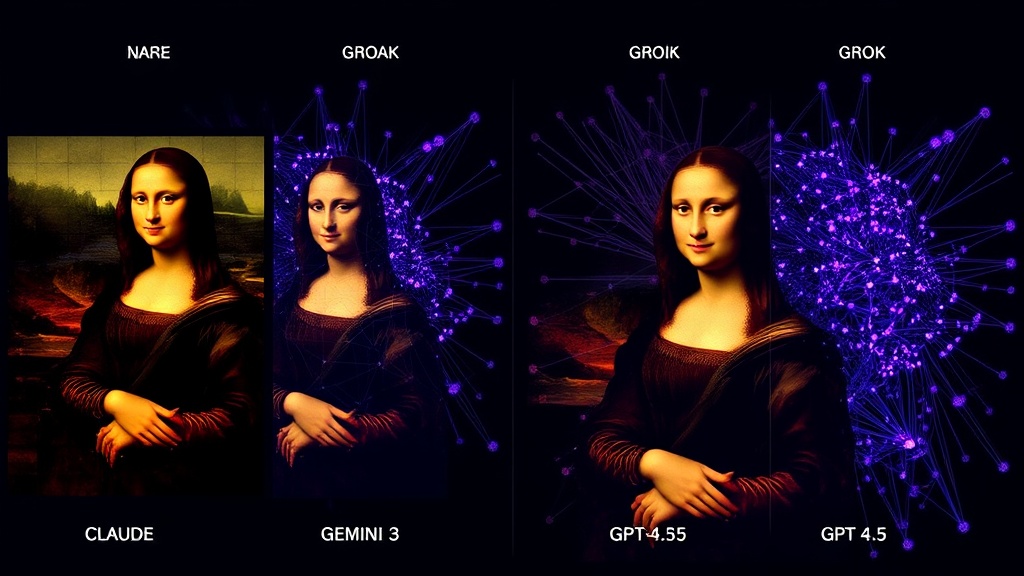
The results were varied, highlighting distinct strengths and weaknesses among the models. Claude, particularly in its later iterations, demonstrated a remarkable ability to capture the essence of the Mona Lisa. Its interpretations often included a more nuanced rendering of the smile and a better grasp of the atmospheric perspective in the background. This suggests Claude's training data and architectural design are more adept at processing and translating subtle visual cues embedded in text prompts.
Gemini, Google's multimodal AI, also showed strong performance. Its outputs frequently exhibited good color fidelity and a solid understanding of the composition. Gemini's multimodal capabilities, allowing it to process and generate information across different formats, likely contribute to its ability to handle complex visual descriptions more effectively. The model seemed to grasp the overall mood and iconic elements of the painting.
Grok, Elon Musk's AI, offered a more idiosyncratic approach. While it could produce an image that vaguely resembled the Mona Lisa, the results were often less faithful to the original's detail and artistic style. Grok's outputs tended to be more stylized, sometimes leaning towards a more abstract or even cartoonish interpretation. This might reflect its development philosophy, which often prioritizes directness and a touch of irreverence over strict adherence to established artistic norms.
GPT-4.5 (or the strong GPT model used in the comparison), while generally capable, appeared to lag behind Claude and Gemini in this specific task. Its interpretations, though recognizable, often lacked the subtle details and atmospheric depth that characterized the better outputs from other models. This suggests that even highly advanced models can have specific areas where they are less proficient, especially when dealing with highly nuanced artistic interpretation based solely on text.
The Role of Prompting and Model Architecture
The experiment underscores the critical role of prompt engineering. The quality of the output is directly tied to how effectively the user can translate the visual characteristics of the Mona Lisa into a textual prompt that the AI can understand. A prompt might include details about the subject's pose, facial expression, clothing, the background landscape, lighting, and artistic style (e.g., sfumato). The LLM's ability to parse these details, prioritize them, and synthesize them into a coherent image is a testament to its underlying architecture and training.
Claude's success, for instance, could be attributed to its advanced reasoning and its ability to handle long context windows, allowing it to process more detailed prompts. Gemini's strength might stem from its inherent multimodal design, making it more intuitive for visual tasks. Grok's distinct style could be a result of its specific training objectives, which may not have emphasized photorealism or strict artistic replication as much as other models.
What remains unaddressed is the precise weighting each model assigns to different elements within a prompt. Does it prioritize the smile over the landscape? Does it understand